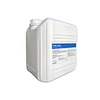
TUW-4400 Ionic Liquid Antistat
TUW-4400
An ionic liquid antistat with ≥99% assay, 1.28 g/mL density and 23 mPa·s viscosity, liquid at room temperature, dosed at 1–10% of resin weight. Functional alternative to 3M FC-4400.
minimum order:
1 kilogram
Country of Origin:
CHINA
Quantity:
[Overview]
TUW-4400 Ionic Liquid Antistat is an ionic-liquid antistatic additive, chemically triethylammonium bis(fluorosulfonyl)imide. It is a clear, colourless to pale yellow liquid with no odour and an assay of at least 99%. It dissipates static through its own ionic conductivity rather than by absorbing atmospheric moisture, so it does not stop working in dry winter air and does not turn tacky or bloom in humid weather the way quaternary ammonium salts do.
Against 3M Ionic Liquid Antistat FC-4400, the most practical difference is physical form: FC-4400 melts at about 27.5 °C and is a solid at room temperature, so it must be melted before dosing, while TUW-4400 Ionic Liquid Antistat freezes below 0 °C and can be metered straight from the drum. The anions differ (FSI versus TFSI), which makes this a functional alternative rather than an identical swap — re-calibrate loading and processing window against your own resin before conversion.
[Key Properties]
- Chemical name: Triethylammonium bis(fluorosulfonyl)imide
- Formula: (CH₃CH₂)₃HN⁺N⁻(SO₂F)₂
- Appearance: Clear, colourless to pale yellow liquid
- Assay: ≥ 99%
- Density (25 °C): 1.28 ± 0.02 g/mL
- Viscosity (25 °C): 23 mPa·s
- Freezing point: < 0 °C
- pH: 4–6
- Water solubility: Miscible up to about 70%
- Recommended dosage: 1–10% of final resin weight
[Typical Applications]
1. Thermoplastic resins — PE, PP, PET, PC, ABS and TPU, compounded on the extruder into antistatic masterbatch or direct compounds.
2. Thermoset systems — Epoxy, polyurethane and UV-cure formulations, dissolved in the monomer or oligomer before cure for flooring, electronic potting and cured films.
3. Electronics and displays — Carrier tape, trays, foams and totes for ESD protection, with low metal-ion and low-halide content for cleanroom use.
4. Optical parts — High-clarity compounds where transmission and haze must be preserved, including optical sheet, protective film and display packaging.
[Handling & Compatibility]
Dose at 1–10% of the final resin weight and work back from the target surface resistivity: run a four-point ladder at 1%, 3%, 5% and 10%, measure surface resistivity and haze, then fix the grade. Too little leaves the part conductive nowhere; too much costs mechanical properties and clarity, and can bloom to the surface.
The product is compatible with most engineering plastics, but strongly polar substrates such as PA and POM deserve a compatibility trial first. Keep processing below 280 °C and avoid long residence times at temperature to prevent discolouration. Store below 40 °C, sealed and dry, and use the drum promptly after opening to limit moisture pickup.
[Packaging & Availability]
1 kg, 5 kg and 25 kg pails as standard, with samples on request. Stocked in South China and supplied with TDS, SDS and batch COA; we can support ladder trials at your line.
TUW-4400 Ionic Liquid Antistat is also available as a 20% antistatic masterbatch, dry-blended with resin so the line avoids on-site metering error.
Recommend Products