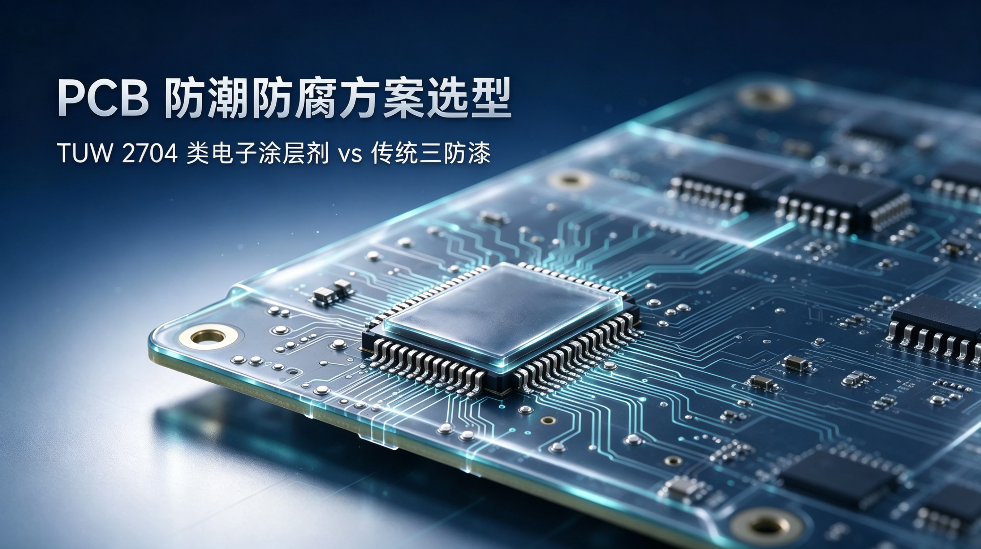
PCB Protection Solution Selection: TUW 2704 Nano Conformal Coating vs. Traditional Conformal Paint
PCBs operating long-term in humid, salt-spray, and condensation environments rely on moisture, salt-spray, and corrosion protection ("three-proofing") as the bottom line of electronic equipment reliability. In scenarios such as new energy, charging piles, energy storage, and outdoor communications, inadequate protection directly drives up failure rates and after-sales costs.
Traditional conformal paint is a mature protection solution. However, as electronic equipment evolves toward higher density and miniaturization, its limitations become increasingly apparent, making ultra-thin coatings a new choice. TUW 2704 fluoropolymer electronic coating agent is a representative product in this trend.
1. What Is TUW 2704: A Fluoropolymer Electronic Coating Agent
TUW 2704 is a fluoropolymer-based electronic coating agent (conformal coating) belonging to the family of electronic protective coatings. Fluoropolymers offer excellent hydrophobicity, oleophobicity, and chemical stability, making them an ideal material foundation for high-end PCB protection. TUW 2704 leverages these properties to form an ultra-thin protective film. The coating is nearly transparent after application and almost invisible to the naked eye, yet forms a stable protective barrier on the surface.
2. Core Characteristics of TUW 2704
- Ultra-thin film formation: Forms a micron-level ultra-thin protective film on the PCB surface with controllable, uniform coverage that barely adds thickness or weight to the board.
- Three-proof performance: Provides moisture, salt-spray, and corrosion protection, defending circuit boards against harsh environments and ensuring long-term stable insulation and electrical performance.
- No impact on electrical connections or heat dissipation: The coating barely alters component appearance or electrical connections and adds no significant thermal resistance, suiting high-density boards.
- Gap coverage: Reaches beneath components and into narrow gaps, reducing protection dead zones—something thick coatings struggle to achieve.
- Environmental friendliness: Compared with traditional solvent-based conformal paint, it offers lower VOC emissions, aligns with green coating trends, and reduces coating-workshop environmental treatment costs.
3. Nano Conformal Coating vs. Traditional Conformal Paint
| Comparison Dimension | TUW 2704 Nano Coating | Traditional Conformal Paint |
|---|---|---|
| Coating thickness | Micron-level ultra-thin | Thicker, tens of microns and above |
| Coverage uniformity | Uniform; reaches beneath components and into gaps | Prone to dead zones beneath components and in gaps |
| Reworkability | Easy to rework and remove | Difficult to rework after curing |
| VOC emissions | Low | Higher for solvent-based products |
| Heat dissipation impact | Minimal thermal resistance impact | Thick coating may increase thermal resistance |
| Suitable scenarios | High-density, high-reliability, lightweight | Thick-film protection, harsh mechanical environments |
4. Primary Use: PCB Moisture and Corrosion Protection
The core purpose of TUW 2704 is to provide moisture and corrosion protection for PCB circuit boards and electronic components, forming a "transparent armor." It maintains circuit insulation and electrical performance in humid, condensation, and salt-spray environments, extends product lifespan, and reduces failure rates and after-sales costs. For outdoor and automotive applications, a stable protective layer also reduces intermittent failures caused by condensation.
5. Application Scenarios
- New-energy vehicle electronic control units (VCU, BMS mainboards, etc.);
- Charging pile control boards and energy storage system control boards;
- 5G base station RF modules and outdoor communication equipment;
- Industrial servo drives, sensors, and LED displays;
- Other scenarios with high protection requirements and sensitivity to thickness and weight.
6. Selection Recommendations
- Traditional applications, thick-film protection, and harsh mechanical environments can continue using conformal paint;
- For high-density, high-reliability, lightweight scenarios, prioritize evaluating ultra-thin electronic coatings like TUW 2704;
- Regardless of the solution chosen, it is recommended to verify protection performance with reliability tests such as the double-85 (85°C/85% RH) test;
- Confirm material compatibility based on the coating process (spray, dip, or selective coating).
In summary, TUW 2704, with its ultra-thin film formation and excellent three-proof performance, is a reliable choice for upgrading high-density PCB protection. Combined with application-environment assessment and testing validation, it maximizes protection value.
Huayi Brothers' TUW series offers performance-comparable PFC and HFE replacement fluorinated fluids and supporting electronic protective coating solutions, covering PCB three-proof coating, precision cleaning, and reliability testing applications, helping production lines secure long-term supply chain stability. If you are selecting a PCB protection solution or looking for coating agents similar to TUW 2704, feel free to contact Huayi Brothers for technical documentation, TDS/MSDS, and testing support.
TUW-3283 Electronic Fluorinated Fluid: A Domestic Replacement Guide for Wafer Fabs After the FC-3283 Phase-out
Related Article