PCB Protection Solution Selection: TUW 2704 Nano Conformal Coating vs. Traditional Conformal Paint
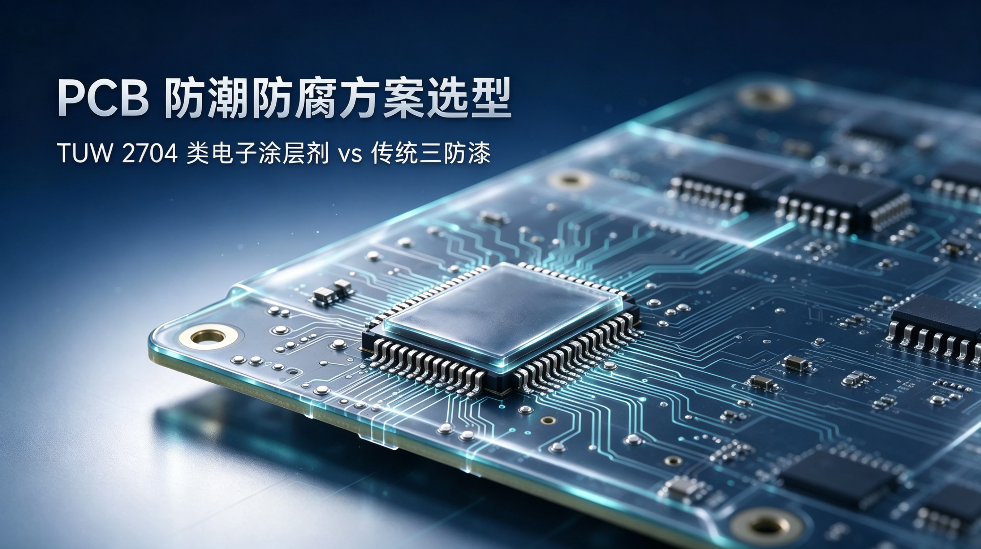
PCBs run for years in humid, salt-fog and condensing environments. Moisture, salt-fog and corrosion protection — the classic “three-proof” requirement — sets the baseline for electronic equipment reliability. In new energy, charging piles, energy storage and outdoor communications, inadequate protection drives failures and after-sales costs up directly.
Conventional conformal coating is a mature solution, but as equipment moves toward high density and miniaturization, its limits show up more often, and ultra-thin coatings are becoming the new choice. TUW 2704 fluoropolymer electronic coating agent represents that shift.
I. What TUW 2704 Is: A Fluoropolymer Electronic Coating Agent
1.1 Product Positioning: The Ultra-Thin Option in the Electronic Protection Coating Family
TUW 2704 is a fluoropolymer-based electronic coating agent (conformal coating compound) that belongs to the electronic protection coating family.
1.2 How the Material Delivers Protection
Fluoropolymers offer excellent hydrophobic and oleophobic performance plus chemical stability, which makes them an ideal material basis for high-end PCB protection; TUW 2704 uses exactly this property to build an ultra-thin protective film. Once applied, the coating looks almost transparent, practically invisible to the eye, yet it forms a stable protective barrier on the surface.
II. Core Characteristics of TUW 2704
2.1 Ultra-Thin Film with Controllable Thickness
Ultra-thin film: forms a micron-level protective film on the PCB surface, with controllable thickness and even coverage, adding almost no thickness or weight to the board.
2.2 Three-Proof Performance and Electrical Stability
Three-proof performance: delivers moisture, salt-fog and corrosion resistance, resists harsh-environment attack on the circuitry, and keeps insulation and electrical performance stable over time.
No impact on electrical connections or heat dissipation: the coating barely changes component appearance or electrical connections and adds no significant thermal resistance, which suits high-density boards.
2.3 Gap Coverage Without Dead Zones
Gap coverage: reaches component undersides and narrow gaps, reducing protection dead zones — something thick coatings struggle to achieve.
2.4 Environmental Profile and Process Fit
Environmentally friendly: lower VOC emissions than conventional solvent-borne conformal coatings, in line with green coating trends, and it cuts the cost of environmental treatment in the coating shop.
III. Nano Coating vs Conventional Conformal Coating
3.1 A Five-Dimension Comparison
|
Dimension |
TUW 2704 nano coating |
Conventional conformal coating |
|
Coating thickness |
Ultra-thin, micron level |
Thicker, several tens of microns or more |
|
Coverage uniformity |
Uniform; reaches component undersides and gaps |
Prone to dead zones under components and in gaps |
|
Reworkability |
Easy to rework and remove |
Difficult to rework after cure |
|
VOC emissions |
Low |
Higher for solvent-borne products |
|
Thermal impact |
Minimal thermal resistance |
Thick coating may add thermal resistance |
|
Typical applications |
High density, high reliability, lightweight |
Thick-film protection, harsh mechanical environments |
3.2 What the Differences Mean for Selection
Thickness and coverage uniformity decide whether a high-density board can be protected without dead zones; reworkability and VOC emissions drive yield and the cost of environmental compliance in the coating shop. The two options do not simply replace each other — evaluate them per product form.
IV. Main Use: PCB Moisture and Corrosion Protection
4.1 Moisture and Condensation Control: Keeping Insulation Intact
The core use of TUW 2704 is moisture and corrosion protection for PCBs and components — a “transparent armor” that keeps insulation and electrical performance intact in humid, condensing and salt-fog environments.
4.2 Corrosion Protection Over Service Life: Fewer Failures, Lower After-Sales Cost
A stable protective layer extends product life and cuts failure rates and after-sales cost. For outdoor and automotive-grade applications, a stable protective layer also reduces intermittent faults caused by condensed water.
V. Application Scenarios
5.1 New Energy and Energy Storage
New energy vehicle control units (VCU, BMS mainboards and similar); charging pile control boards and energy storage system control boards.
5.2 Communications and Industrial Electronics
5G base station RF modules and outdoor communications equipment; industrial servo drives, sensors and LED displays; other applications with high protection demands and sensitivity to thickness and weight.
VI. Selection Guidance
6.1 When to Stay with Conventional Conformal Coating
Traditional applications, thick-film protection and harsh mechanical environments can stay with conformal coating.
6.2 When to Evaluate Ultra-Thin Coating First
High-density, high-reliability and lightweight designs should evaluate TUW 2704-class ultra-thin protective coatings first.
6.3 Validation and Process Matching
Either way, validate protection with reliability testing such as the 85/85 damp heat test; confirm material compatibility with the application process (spray, dip, selective coating).
In short, TUW 2704 combines an ultra-thin film with solid three-proof performance, which makes it a reliable upgrade for high-density PCB protection. Match the choice to the operating environment and back it with test validation to get the most protection value.
Huayi Brothers’ TUW series supplies performance-matched PFC and HFE alternative fluorinated liquids along with electronic protection coating solutions, covering PCB conformal coating, precision cleaning and reliability testing to help production lines keep the supply chain stable over the long term. If you are selecting a PCB protection solution or looking for a TUW 2704-class electronic coating agent, contact Huayi Brothers for technical data, TDS/MSDS and test support.
TUW-3283 Electronic Fluorinated Fluid: A Domestic Replacement Guide for Wafer Fabs After the FC-3283 Phase-out
Related Article