
One Table to Rule Them All: How to Choose Between HFE and PFC — The Complete TUW Series Electronic Fluorinated Fluid Selection Guide
2026-10-30

Almost every engineer who buys electronic fluorinated liquids has faced the same question: what exactly is the difference between a hydrofluoroether (HFE) and a perfluorocarbon (PFC), and which one should I choose? Both look like colorless, transparent liquids, and both are insulating and non-flammable, yet their price, temperature range and environmental profile differ widely. The wrong choice wastes money and can also undermine process stability. This article settles the question once and for all with one master table plus an application-by-application breakdown.
1. Chemical Structure Determines Performance: Start with the Essential Difference
1.1 Molecular Difference: Perfluorinated Backbone vs. Ether Linkage
In PFC (perfluorocarbon), every hydrogen atom on the molecular skeleton is replaced by fluorine, so only C–F bonds remain. The result is extreme chemical inertness — it reacts with practically nothing — and a wide temperature range, but a high GWP. HFE (hydrofluoroether) keeps some hydrogen atoms and an ether linkage (C–O–C), has a shorter molecular chain, a lower GWP, a short atmospheric lifetime and a better environmental profile; the trade-off is that its inertness is not as extreme as that of PFC. This structural difference directly produces the performance split below:
1.2 The Performance Split Caused by Structure
Table 1 HFE vs. PFC performance comparison
|
Performance dimension
|
HFE (hydrofluoroether)
|
PFC (perfluorocarbon)
|
|
Chemical inertness
|
Good
|
Extremely high, virtually non-reactive
|
|
Application temperature range
|
Moderate
|
Wide, covers extreme temperatures
|
|
GWP
|
Low (1–320)
|
Higher (100 to several thousand)
|
|
Solvency
|
Moderate, suitable for cleaning
|
Very weak, cooling only
|
|
Typical boiling point
|
40–134 °C
|
60 °C up to 200 °C and above
|
|
Supply risk
|
Mature domestic supply
|
Some overseas models discontinued
|
2. Parameter Master Table of the 14 TUW Products
2.1 All 14 Models at a Glance
Table 2 Parameters of the 14 TUW series electronic fluorinated liquids
|
Model
|
Type
|
Boiling point
|
Density (25 °C, g/cm³)
|
GWP
|
Primary use
|
|
TUW-7500
|
HFE
|
134 °C
|
1.626
|
1
|
Data center immersion cooling
|
|
TUW-7200
|
HFE
|
76 °C
|
1.42
|
55
|
Precision cleaning / electronic cooling
|
|
TUW-7300
|
HFE
|
98 °C
|
1.6
|
297
|
Heat transfer / lubricant deposition
|
|
TUW-7100
|
HFE
|
61 °C
|
1.52
|
320
|
Precision cleaning / solvent
|
|
TUW-3283
|
PFC (electrochemical)
|
128 °C
|
1.83
|
118
|
Semiconductor equipment temperature control
|
|
TUW-40
|
PFC
|
155–160 °C
|
1.82
|
175
|
High-temperature heat transfer
|
|
TUW-770
|
PFC
|
95 °C
|
1.79
|
Higher
|
Supercomputing / military direct cooling
|
|
TUW-71IPA
|
HFE azeotrope
|
approx. 57 °C
|
1.22
|
Low
|
Precision cleaning, light contamination
|
|
TUW-71DA
|
HFE azeotrope
|
40 °C
|
1.33
|
Low
|
Medium and heavy oil removal
|
|
TUW-72DA
|
HFE azeotrope
|
44 °C
|
1.27
|
Low
|
PCBA flux cleaning
|
|
TUW-72DE
|
HFE azeotrope
|
43 °C
|
1.28
|
Low
|
Coating / lubricant deposition
|
|
TUW-73DE
|
HFE azeotrope
|
43 °C
|
1.3
|
Low
|
Heavy-duty vapor degreasing
|
|
TUW-2704
|
Fluorinated coating
|
— (coating solution)
|
1.52
|
—
|
PCB protective coating (4%)
|
|
TUW-1700
|
Fluorinated coating
|
— (coating solution)
|
1.52
|
—
|
Ultra-thin protection (2%)
|
2.2 Notes on the Data Conventions
Note: density in g/cm³ is numerically equivalent to g/mL, and g/cm³ is used throughout this table. GWP values marked “low” or “higher” are qualitative grades — for azeotropic cleaning fluids, 3M and mainstream alternative suppliers publish only a low-GWP statement rather than an exact figure. For the exact GWP, refer to the TDS/SDS of the specific product.
3. Choosing by Application: The Best Option for Each Duty
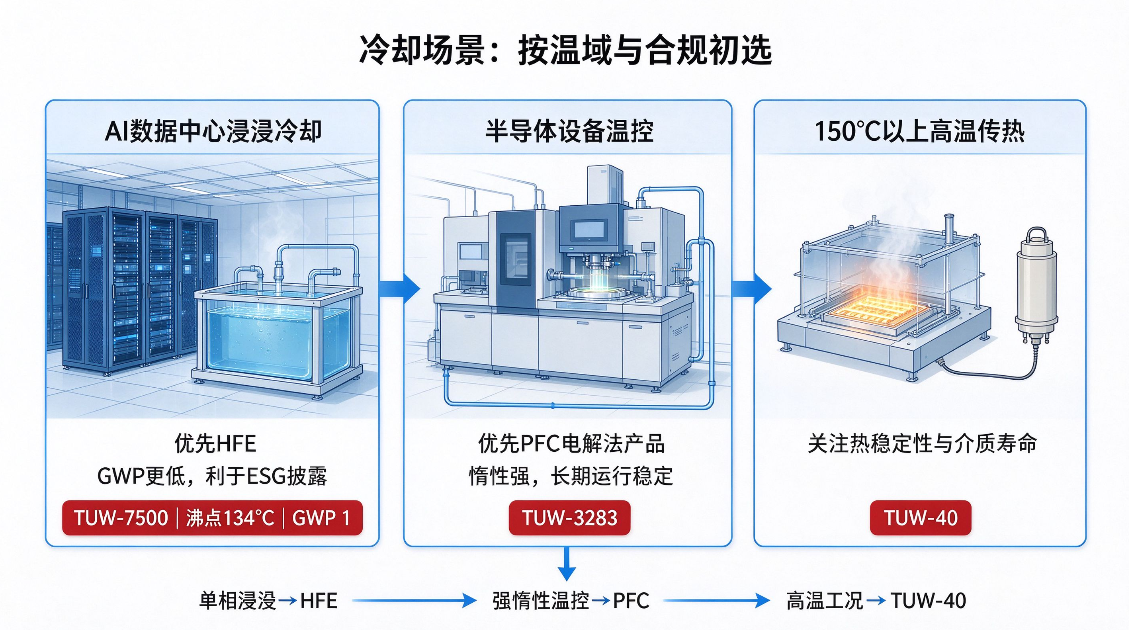
3.1 AI Data Center Immersion Cooling
Choose HFE first. Data centers must report under ESG frameworks, so the lower the GWP the better; TUW-7500 has a GWP of only 1 and a boiling point of 134 °C, which suits single-phase immersion. PFC grades perform well too, but their higher GWP creates long-term compliance exposure.
3.2 Temperature Control for Etch and Ion-Implantation Tools
Choose the electrochemical PFC grade TUW-3283: the tool requires a medium of extreme chemical inertness that will not decompose in long high-temperature service and offers batch-to-batch consistency. Where more than 150 °C is required, use TUW-40.
3.3 Precision Cleaning (PCBA, Optics, Semiconductor Parts)
Choose the HFE azeotropic series: TUW-71IPA for light contamination, TUW-71DA for medium to heavy oil, TUW-72DA for flux residue, and TUW-73DE for multi-process compatibility. PFC solvency is too weak for cleaning.
3.4 Direct Cooling for Supercomputing and Military Electronics
Choose the PFC grade TUW-770. These applications demand extreme temperature-range capability and maximum reliability, where the chemical inertness and thermal stability of PFC are clear advantages.
3.5 PCB Protective Coatings
Choose TUW-2704 or TUW-1700: 2704 (4% solids) for thicker protection, 1700 (2% solids) for ultra-thin conformal protection.
4. Pitfalls to Avoid and a Recommended Selection Workflow
4.1 Five Common Pitfalls
-
Looking only at GWP and ignoring the temperature range: an HFE with a low GWP may not boil high enough for high-temperature duties.
-
Looking only at boiling point and ignoring viscosity: a high-viscosity liquid cannot be moved by the pump and the loop responds slowly.
-
Ignoring supply stability: some overseas PFC models are being discontinued, so new projects should favor the domestic TUW series.
-
Skipping material compatibility testing: different seals (Viton vs. EPDM) tolerate fluorinated liquids differently.
-
Ignoring batch consistency: cheap products vary widely from batch to batch and force repeated adjustment of process parameters.
4.2 Five-Step Recommended Workflow
-
Define the application (cooling, cleaning, coating or testing).
-
Determine the critical duty parameters (temperature range, whether energized, type of contaminant).
-
Shortlist two or three candidate models from the TUW series.
-
Request samples and verify compatibility and performance.
-
Confirm with a small pilot batch before volume purchasing.
4.3 Sample Testing and Technical Support
Shenzhen Huayi Brothers specializes in electronic fluorinated liquids and fluorinated functional fluids, and provides customers with product documentation, sample testing and application consultation.
TUW-3283 Electronic Fluorinated Fluid: A Domestic Replacement Guide for Wafer Fabs After the FC-3283 Phase-out
AI Server Rack Power Breaches 30 kW: Why TUW-7500 Hydrofluoroether Becomes the Preferred Immersion Cooling Medium
Related Article
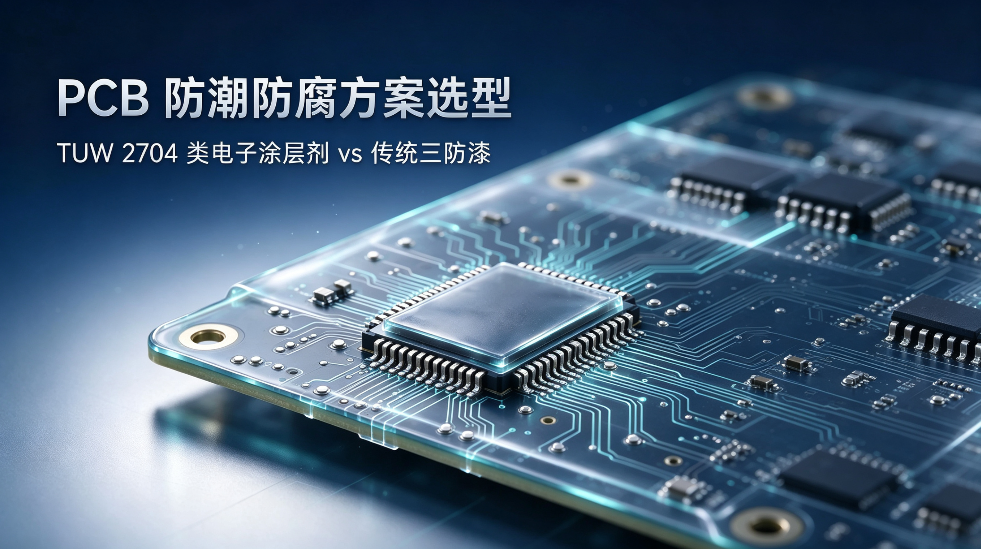
This article introduces the product positioning and core characteristics of TUW 2704 fluoropolymer electronic coating agent, compares its differences with traditional conformal paint, and explains its applications in PCB moisture and corrosion protection as well as the selection logic for scenarios such as new energy and high-density boards.
PCB Protection Solution Selection: TUW 2704 Nano Conformal Coating vs. Traditional Conformal Paint

3M has discontinued FC-3283 — how should wafer fabs choose a domestic replacement? This article details the TUW-3283 electrochemical fluorination product's parameter alignment with FC-3283, the selection logic, and a four-step switchover process to help you complete your domestic substitution smoothly.
TUW-3283 Electronic Fluorinated Fluid: A Domestic Replacement Guide for Wafer Fabs After the FC-3283 Phase-out
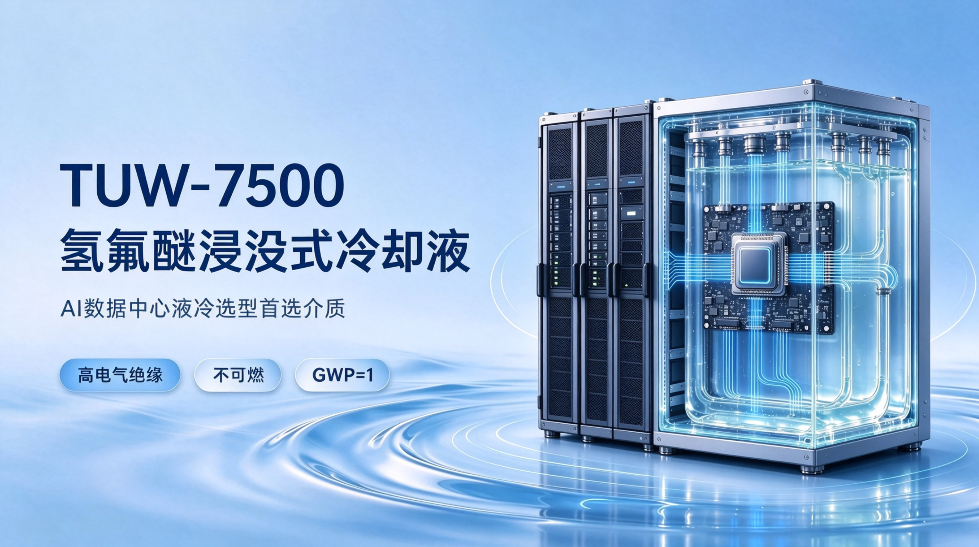
As AI server rack power density breaks 30 kW, TUW-7500 hydrofluoroether delivers a GWP of just 1, becoming the preferred medium for single-phase immersion cooling. This article details its insulating, non-flammable, and environmentally friendly properties along with deployment verification points.
AI Server Rack Power Breaches 30 kW: Why TUW-7500 Hydrofluoroether Becomes the Preferred Immersion Cooling Medium
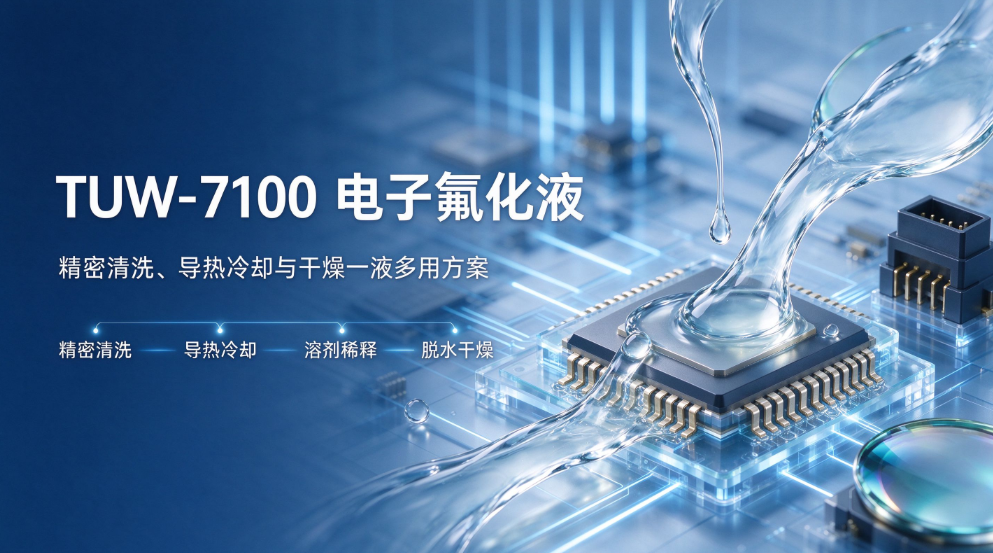
TUW-7100 covers precision cleaning, thermal cooling, solvent dilution, and dehydration drying in a single fluid. This article details its physical properties and the cost-saving value of "one fluid, multiple uses."
TUW-7100 Electronic Fluorinated Fluid: One Solution for Precision Cleaning, Thermal Cooling & Drying