Rack Power Above 100 kW: Why TUW-7500 Hydrofluoroether Works as an Immersion Cooling Medium
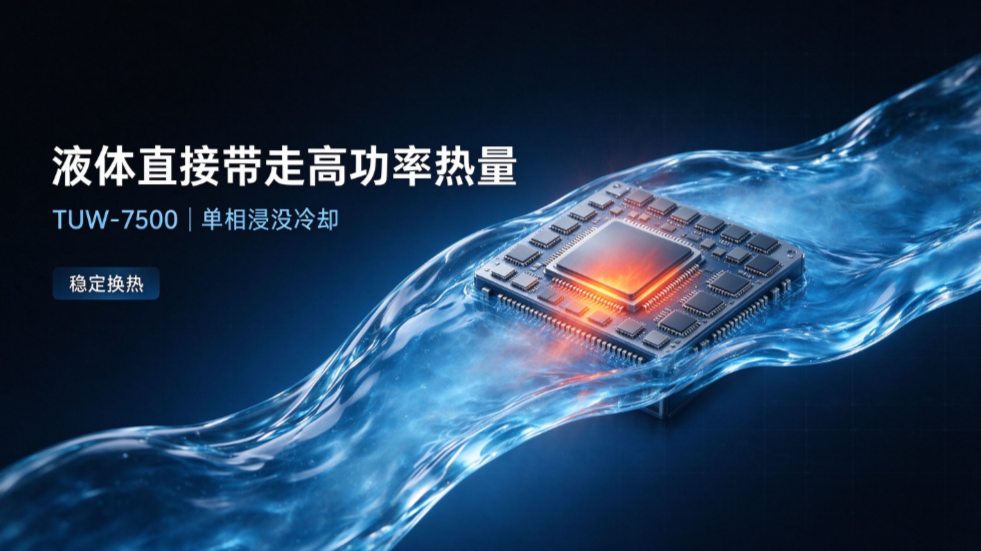
Rack power has climbed from 30 kW to more than 100 kW. Air cooling can no longer hold junction temperature, and even cold-plate liquid cooling is starting to struggle. That is when immersion liquid cooling becomes the real subject: submerge the whole server in a non-conductive fluorochemical liquid and let the liquid carry the heat away directly.
Not every non-conductive liquid qualifies as an immersion medium. This article focuses on TUW-7500 and answers four questions: how heat is removed, whether the physical properties are sufficient, how materials stay compatible, and how a data center deploys it.
1. In a 100 kW rack, how does the liquid take the heat away?
1.1 Cold plate, single-phase immersion and two-phase immersion
Cold-plate liquid cooling pumps fluid into a cold plate attached to the chip. Heat passes through the thermal interface material into the metal and then into the liquid. The heat path is long, which suits racks of moderate power density. Single-phase immersion submerges the entire server in liquid. The liquid absorbs heat and then circulates to an external heat exchanger through natural convection or pumping, giving a large heat-transfer area and few hot spots. Two-phase immersion absorbs heat through boiling. It delivers the strongest heat transfer, but it places the highest demands on fluid boiling point, sealing and vapor management.
A 100 kW rack usually lands somewhere between single-phase and two-phase immersion. Single-phase wins on system simplicity, maintenance friendliness and infrequent fluid make-up, which makes engineering deployment easier.
1.2 Why single-phase immersion is steadier at the 100 kW level
In a single-phase system, flow rate and the heat exchanger set the temperature, and local boiling cannot create a dry-out point. The liquid never changes phase, pressure management stays simple, and the tank sealing requirement is relatively relaxed. The price is a large fluid inventory and high circulation pump power, which you offset with a low-viscosity fluid.
This is why viscosity, specific heat and thermal conductivity become the first group of selection criteria, rather than the single question of whether the fluid insulates.
2. Are TUW-7500's physical properties good enough?
2.1 The four properties that decide whether a fluid can be used for immersion
TUW-7500 is nonafluoroisobutyl methyl ether (HFE). It has a boiling point of 134 °C, a density of 1.626 g/mL, a melting point of −93 °C, a molecular weight of 332.09, no flash point, an ODP of 0 and a GWP of 1. High density means each unit of volume holds more heat, a low melting point keeps the fluid from solidifying in cold environments, and the absence of a flash point removes the flammability concern that immersion sites worry about most.
Dielectric performance decides whether the fluid can touch live power modules and motherboards directly. In practice you also need to know whether dielectric strength drifts after prolonged immersion, which requires ageing at the operating temperature and then measuring.
2.2 Main technical parameters
The table below lists the full parameter set for TUW-7500. When selecting, focus on the four rows for boiling point, density, dielectric data and GWP, and treat the rest as inputs for loop design.
The hidden indicator behind the parameters is batch-to-batch consistency. An immersion system consumes a large fluid volume and changing the charge is expensive, so a supplier who can deliver stable supply over the long run, with every batch inside the property window, matters more than a single impressive data point.
Table 1. Main technical parameters of TUW-7500
|
Parameter
|
Value
|
|
Chemical name
|
Nonafluoroisobutyl methyl ether (HFE)
|
|
Appearance
|
Clear liquid
|
|
Odour
|
Ether odour
|
|
Boiling point
|
134 °C @760 mmHg
|
|
Melting point
|
−93 °C
|
|
Density
|
1.626 g/mL @25 °C
|
|
Molecular weight
|
332.09
|
|
Flash point
|
None (non-flammable below 150 °C)
|
|
ODP
|
0
|
|
GWP (100-year)
|
1
|
|
Solubility
|
Moderate solubility; compatible with most materials
|
|
Reclamation
|
Distillation recovery; reusable
|
Note: values are typical. Refer to the product TDS and the batch test report for actual data.
3. How do equipment and materials stay compatible?
3.1 Selection points for pumps, seals and heat exchangers
A pump in an immersion system must be reselected against fluid density and viscosity: at 1.626 g/mL, shaft power at the same flow rate runs noticeably higher than in a water system. Seal materials should be fluoroelastomer or perfluoro seals rated for fluorochemical fluids, because ordinary nitrile rubber tends to swell after prolonged soaking. Brazed-plate or shell-and-tube heat exchangers work well, provided internal cleanliness is high enough to prevent particle deposition.
Tanks usually use stainless steel or engineering plastics. Confirm the compatibility of welds and sealants as well, and pay particular attention to what the adhesive layer releases after long immersion.
3.2 Moisture and particles are the long-term enemy
Once a fluorochemical liquid absorbs moisture, its dielectric performance drops and, at high temperature, it generates acidic by-products that corrode metal. The system needs a desiccant breather or a closed loop, plus periodic sampling to measure water content. Particle control matters just as much: filter to at least 10 µm upstream of the pump so that coolant channels do not clog.
4. How does a data center put it into service?
4.1 Tank, heat rejection and operations: three essentials
Reserve enough expansion volume and a return channel in the tank, and lay out the inlet and outlet so that dead zones cannot form. Size the external heat exchanger at 1.2 times peak power or more to cover headroom in summer. On the operations side, keep a fluid log that records make-up volume, moisture, particles and colour change, and use it as the criterion for changing the charge.
A rack retrofit also has to consider how maintenance will happen. Immersion tanks are usually serviced by pulling the whole unit out, so lifting space and a drip recovery tray belong in the design stage.
4.2 Typical application scenarios and supporting configuration
The table below lists typical scenarios for TUW-7500 and the matching priorities. Requirements for flow rate, filtration and heat exchanger type differ widely by scenario, so define the system configuration first and then decide the fluid volume.
For a site migrating from air cooling, start with a single-rack pilot: immerse one rack and keep the rest on air cooling, then let measured PUE and junction temperature data set the rollout pace. That keeps risk lowest.
Table 2. Typical application scenarios of TUW-7500
|
Scenario
|
How it is used
|
Value delivered
|
|
Single-phase immersion tank for AI servers
|
Whole server or node submerged; pumped circulation to a CDU heat exchanger
|
Lower PUE; noise and dust problems solved at the same time
|
|
High power-density racks
|
Rack-level immersion module with a heat exchange unit
|
Supports rack power density above 100 kW
|
|
Energy storage packs and battery thermal management
|
Module immersion; suppresses thermal runaway propagation
|
Dielectric medium; no short circuit and no combustion
|
|
Power devices and IGBT testing
|
Direct immersion cooling with a temperature-controlled stage
|
Uniform temperature; repeatable tests
|
|
Local temperature control in semiconductor equipment
|
Cooling loop for chambers and optical components
|
Chemically inert; does not contaminate the clean environment
|
Note: an immersion system requires compatible pumps, seals, piping and heat exchanger materials. Validate material compatibility first.
Shenzhen Huayi Brothers (深圳华益兄弟) supplies electronic fluorochemical liquids and fluorine-based functional fluids. For sample testing or selection advice for a specific process, click the consult link on the right.
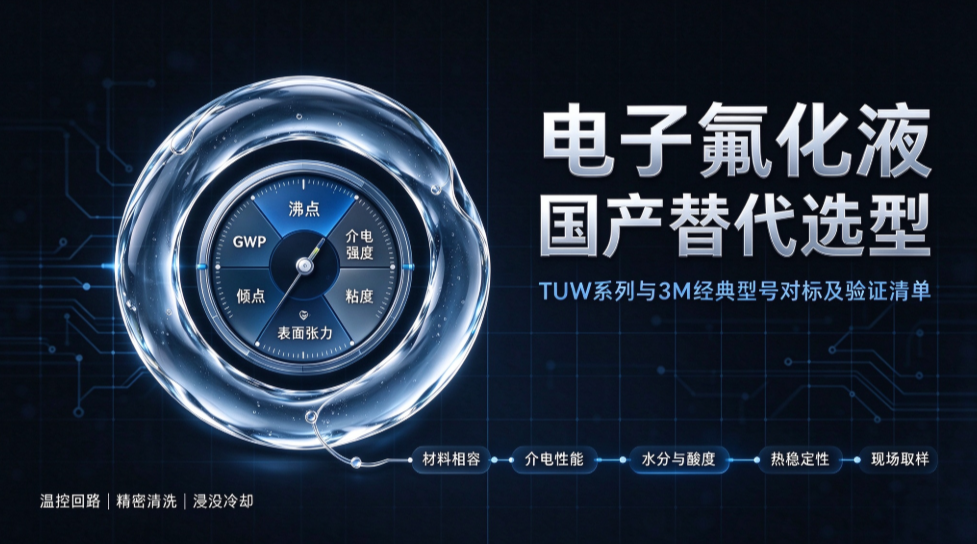
After 3M Exited PFAS: Selection Logic and Verification Checklist for Domestic Replacement of Electronic Fluorinated Fluids