Why Are Electronic Package Leak Testing and High/Low-Temperature Testing Inseparable from FC-40 Perfluorocarbon Fluid?
The reliability of electronic components depends to a large extent on package hermeticity. MEMS sensors, optoelectronic devices, RF modules, etc., operate in sealed cavities. Once the seal fails, moisture and oxygen ingress can cause electrode corrosion, performance drift, or even failure.
Therefore, after packaging is completed, airtightness testing must be carried out, and the choice of test medium directly affects detection accuracy and safety—it must sensitively detect tiny leaks without damaging the device under test. FC-40 perfluorocarbon fluid is a mature medium that has been validated over the long term for this step.
1. What Is FC-40: A Multi-Purpose Perfluorocarbon Fluid
FC-40 is a representative product of the perfluorocarbon fluid (PFC) family and belongs to the electronic fluorinated fluid family. PFC molecules are composed entirely of carbon-fluorine bonds, are extremely chemically inert, and have a wide temperature range. They are a common medium for reliability verification and special cooling scenarios.
In the product line, FC-40 is positioned for multiple uses: electronic cooling/heat transfer, package leak testing fluid, and support for high/low-temperature reliability testing and insulation testing. It is a versatile medium that balances verification and cooling—one medium can cover multiple steps in the laboratory and on the production line.
2. Core Properties of FC-40
-
Wide-temperature stable liquid: It remains a stable liquid over a wide temperature range, covering the temperature window of most reliability tests. It requires no frequent medium replacement and facilitates rapid switching between high- and low-temperature test chambers.
-
Extremely chemically inert: It does not corrode or react with packaging materials, metal leads, sealants, etc. The leak testing process does not damage the device under test, ensuring the authenticity of test results and device integrity.
-
Low surface tension: It easily penetrates tiny gaps and can efficiently detect micron-scale leak paths, improving leak-test sensitivity and minimizing the risk of missed leaks.
-
Good electrical insulation: It can be safely used for live structures and insulation testing, with no short-circuit risk when combined with high/low-temperature testing.
-
Volatilizes without residue: After testing, it volatilizes without leaving residue, does not affect subsequent processes or device performance, and keeps the test environment clean.
3. Main Use One: Package Leak Testing
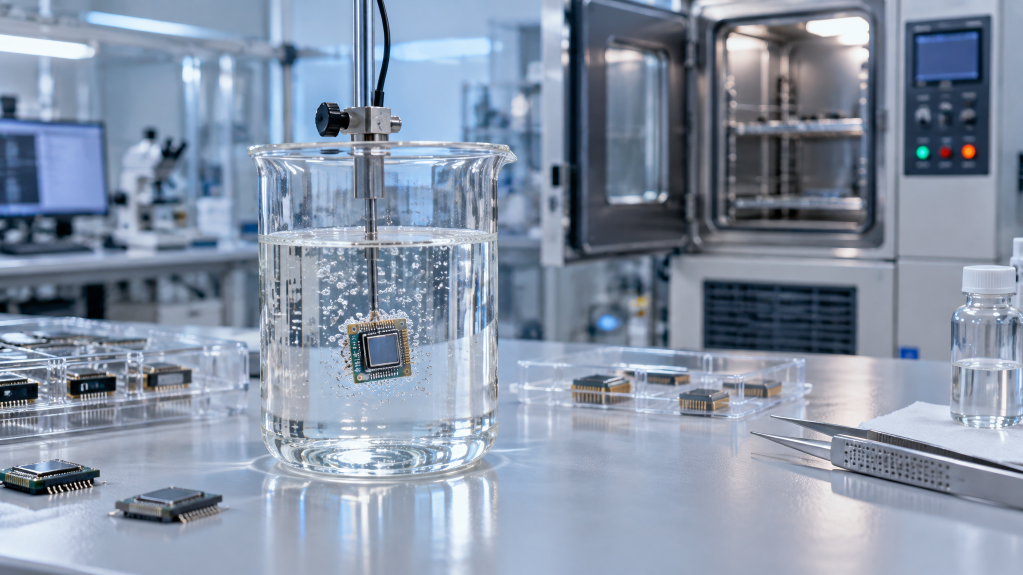
Package leak testing is a key step in hermeticity verification for MEMS, sensors, optoelectronic devices, RF modules, and other devices. FC-40 serves as a leak detection fluid. After immersing the device, users judge whether the seal is intact by observing bubbles or by pressure differential detection. Its low surface tension and chemical inertness ensure accurate test results and do not damage the device. For high-volume packaging lines, FC-40 also supports continuous operation of automated leak detection equipment, providing stable test output.
4. Main Use Two: Electronic Cooling and Heat Transfer
FC-40 also handles electronic cooling and heat transfer tasks and can be used for direct-contact cooling of heat-generating devices and equipment temperature control. Its insulation, inertness, and non-flammability make it a reliable choice in live cooling scenarios where safety is required—it efficiently removes heat without causing electrical or chemical risks.
5. Extended Applications: High/Low-Temperature Reliability Testing and Insulation Testing
In reliability verification, FC-40 can be used as a constant-temperature medium for thermal shock and temperature cycling tests, providing a stable temperature field for chips and modules; its dielectric properties also support insulation testing of high-voltage devices. The typical correspondence between applications and key performance requirements is as follows:
| Application | Role of FC-40 | Core Properties Relied Upon |
|---|---|---|
| Package leak testing | Leak detection fluid | Low surface tension, chemical inertness |
| Electronic cooling/heat transfer | Direct-contact cooling medium | Insulation, non-flammable, inertness |
| High/low-temperature reliability testing | Constant-temperature medium | Wide temperature range, thermal stability |
| Insulation testing | Insulating medium | Dielectric properties |
One fluid, multiple uses; it effectively reduces the variety of media in laboratories and production lines.
6. Usage and Management Points
-
Cost and supply chain: Some perfluorocarbon fluid grades have been discontinued or are subject to production limits. It is necessary to evaluate alternatives and dual supply sources and establish reasonable safety stock.
-
Recovery and sealing management: Properly recover the medium and manage sealing to reduce evaporation loss and control long-term use costs.
-
Cleanliness control: Avoid cross-contamination before and after testing that could affect test results, and regularly monitor medium purity.
With stable physical properties and a mature application system, FC-40 has become a standard medium in reliability verification. By placing supply sustainability and performance on an equal footing, it can be used stably over the long term.
Huayi Brothers TUW series can provide performance-equivalent PFC and HFE alternative fluorinated fluids, covering package leak testing, high/low-temperature reliability testing, precision cleaning, and electronic cooling, helping production lines ensure long-term supply chain stability. If you are selecting a medium for package leak testing or reliability testing, or looking for an FC-40 alternative, welcome to contact Huayi Brothers for technical data, TDS/MSDS, and testing support.
Related Article