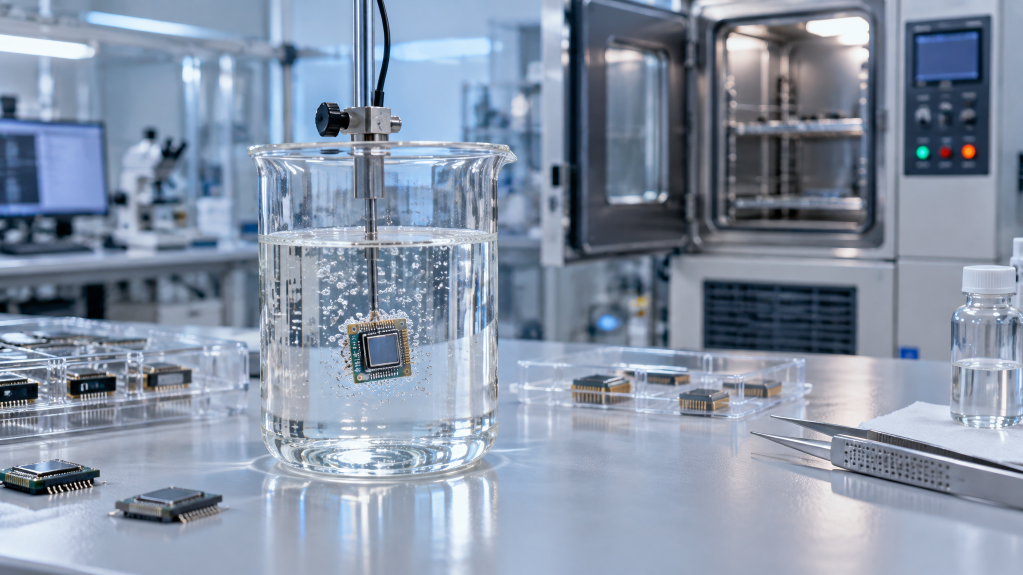
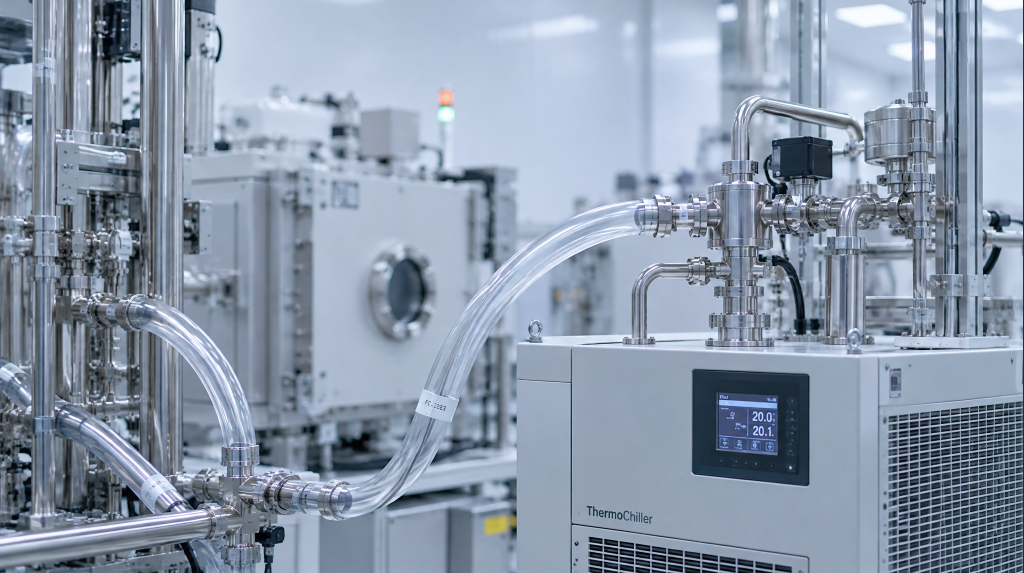
FC-3283 Perfluorocarbon Fluid Full Analysis: Characteristics and Applications of a Temperature Control Medium for Semiconductor Equipment
In semiconductor wafer fabs, there is a type of “invisible” liquid that does not participate in chemical reactions but directly affects the stability of every process—this is the electronic fluorinated fluid used for equipment temperature control. Etchers, ion implanters, and CVD equipment generate large amounts of heat during operation, while advanced processes are often sensitive to temperature within ±0.1°C. FC-3283 is one of the classic perfluorocarbon (PFC) temperature control media that takes on this important task.
This article will systematically interpret FC-3283, a classic semiconductor temperature control medium, from four dimensions: product attributes, physicochemical properties, product features, and application scope, providing procurement and process engineers with a complete selection reference.
I. Product Attributes
FC-3283 belongs to the perfluorocarbon (PFC) system and is a classic model in the electronic fluorinated fluid family. Its molecule is composed entirely of carbon-fluorine bonds and contains no hydrogen. This structural feature makes it one of the most chemically inert fluorinated fluid systems, reacting with almost no materials, and therefore it is widely used in the semiconductor field, which has extremely high requirements for cleanliness and chemical stability.
In terms of positioning, FC-3283 is a heat transfer medium for semiconductor manufacturing. Its core use is temperature control for equipment such as etchers and ion implanters, and it is a mature choice for high-end process temperature control. The main product attributes are summarized as follows:
Chemical category: perfluorocarbon (PFC); Molecular structure: all carbon-fluorine bonds, hydrogen-free; Form: colorless, transparent, insulating electronic fluorinated fluid; Product line positioning: heat transfer medium for semiconductor manufacturing.
II. Physicochemical Properties
The key physicochemical parameters of FC-3283 are as follows (subject to the product TDS):
| Parameter | Value |
|---|---|
| Chemical category | Perfluorocarbon (PFC) |
| Boiling point | approx. 128°C |
| Pour point | approx. -50°C |
| Liquid density (25°C) | approx. 1.82 g/cm³ |
| Kinematic viscosity | approx. 0.75 cSt |
| Surface tension | approx. 15 mN/m |
| Dielectric constant | approx. 1.9 |
| Dielectric strength (0.1-inch gap) | >40 kV |
| Thermal conductivity | approx. 0.066 W/m·K |
| Flammability | No flash point, nonflammable |
These parameters together determine the applicability of FC-3283 in semiconductor temperature control and testing: wide temperature range, high insulation, low viscosity, low surface tension, nonflammability, and chemical inertness, which can simultaneously meet the stringent requirements of advanced processes for temperature control media.
III. Product Features
Strong chemical inertness for greater material compatibility peace of mind: The perfluorinated structure, hydrogen-free, is not prone to reacting with common acids, bases, oxidants, and process by-products. For long-running temperature control loops, this means lower risk of medium degradation, fewer corrosion and deposition problems, and helps extend equipment maintenance intervals.
Wide temperature range, no compromise on thermal shock: Boiling point approx. 128°C, pour point approx. -50°C, wide liquid temperature range; it can be used in conventional temperature control loops as well as reliability testing scenarios such as thermal shock and high-low temperature cycling, covering more operating conditions with one medium.
Excellent electrical insulation performance: Dielectric constant approx. 1.9 and high dielectric strength; it is a typical high-insulation, low-dielectric-constant fluorinated fluid, reducing the risk of short circuits and breakdown even when in contact with live components.
Nonflammable, enhancing safety level: PFC-type fluorinated fluids generally have no flash point and are nonflammable, making them safer when used near high-temperature, high-energy equipment; this is especially critical for high-risk equipment such as etchers and ion implanters.
Low viscosity and low surface tension: Kinematic viscosity approx. 0.75 cSt and surface tension approx. 15 mN/m; excellent flowability and wettability allow it to quickly enter tiny gaps and complex flow channels, improving temperature control loop response speed and reducing pumping resistance.
Good thermal stability, suitable for long-term operation: Under reasonable use conditions, it has good thermal and chemical stability, suitable for long-term continuous operation of semiconductor equipment; its low surface tension also allows it to quickly penetrate tiny leaks in precision leak detection.
Classic model with high industry recognition: FC-3283 is a classic PFC liquid model frequently searched and selected in the semiconductor temperature control field; technical data are mature, application cases are abundant, and selection communication costs are lower.
IV. Product Application Scope
Main use—semiconductor equipment temperature control:
-
Etchers: remove heat from chambers and electrostatic chucks, maintain stable plasma process temperature, and improve etching uniformity.
-
Ion implanters: cool beamline components to prevent temperature rise from causing dose deviation.
-
CVD/thin-film equipment: serve as chiller loop medium to precisely control deposition temperature.
Its high chemical inertness is particularly important: equipment temperature control media are exposed to high temperatures and clean environments for long periods, and contaminants from medium decomposition can directly affect yield; the stability of FC-3283 can minimize this risk.
Extended applications—testing, cleaning, and leak detection:
-
Thermal shock reliability testing: as a constant-temperature medium, provides stable high and low temperature environments for chips and modules.
-
Precision cleaning: removes particles and organic contaminants from wafer and component surfaces.
-
Package and device leak detection: utilizes low surface tension and high wettability to detect tiny leaks.
One bottle of medium covers multiple processes, simplifying material management and reducing overall costs.
V. Special Note: 3283 Produced by Electrolysis, Different from Chemically Synthesized Versions on the Market
When purchasing 3283 fluorinated fluid, you often encounter the terms “electrolytic method” and “chemical synthesis method.” First, clarify what “electrolysis” means here: it refers to electrochemical fluorination (ECF, Simons electrolytic fluorination process)—this is the synthesis route for producing this fluorinated fluid, not that the liquid itself is charged or used as an electrolyte in an electrolytic cell.
A common misconception must be clarified here: the liquid itself is still an insulating electronic fluorinated fluid, not a conductive electrolyte; “electrolysis” only represents its manufacturing method, not its use.
So why is the electrolytic method so important? The original 3M FC-3283 is produced by electrolytic fluorination, so high-end domestic equivalents also label “electrolytic,” representing benchmarking against the original manufacturer’s process. Many imitation 3283 fluorinated fluids on the market are made by chemical synthesis; they cost less but have poor purity and stability, and cannot be used with confidence in demanding scenarios such as semiconductors and high-end liquid cooling. The two processes are compared in the table below:
| Comparison Dimension | Electrolytic Method (ECF / Simons Electrolytic Fluorination Process) | Chemical Synthesis Method |
|---|---|---|
| Process route | Electrochemical fluorination, benchmarked against original FC-3283 process | Chemical synthesis route |
| Purity and stability | High purity, good stability, meets semiconductor/high-end liquid cooling requirements | Relatively poorer purity and stability |
| Typical applicable scenarios | Demanding scenarios such as semiconductor etching/ion implanter temperature control and reliability testing | General scenarios |
| Key note | The liquid itself is insulating; “electrolysis” refers only to the manufacturing method | Lower cost, but caution is needed in demanding scenarios |
In one sentence: electrolytic 3283 is FC-3283 electronic fluorinated fluid produced by electrochemical fluorination, used to distinguish it from low-purity chemically synthesized imitations on the market; the properties of the liquid itself remain unchanged.
VI. Selection and Supply
Special attention should be paid to the fact that some models in the perfluorocarbon fluid series (such as FC-3283) have been announced discontinued or are in their last purchase period, and PFC liquids have high GWP and may be affected by PFAS regulations and environmental policies. When purchasing and selecting, be sure to assess supply chain sustainability:
-
Confirm inventory and lead times, and establish reasonable safety stock.
-
Evaluate the feasibility of alternative models in the same series, domestic perfluorocarbon fluids, and hydrofluoroether (HFE) options.
-
Alternative media need to undergo new material compatibility, thermal performance, electrical performance, and long-term stability testing.
At the same time, when purchasing domestic 3283 equivalents, be sure to confirm whether the production process is electrolytic—this is the key to distinguishing “high-purity media benchmarked against the original manufacturer’s process” from “low-cost chemically synthesized imitations,” and is directly related to reliability in semiconductor and high-end liquid cooling scenarios.
Overall, FC-3283 is a mature medium for temperature control in high-end semiconductor processes. When selecting, placing supply chain risk, production process, and performance on an equal footing is necessary to ensure long-term stable operation of production lines.
Huayi Brothers TUW series can provide performance-benchmarked PFC and HFE alternative fluorinated fluids, covering applications such as semiconductor temperature control, thermal shock testing, precision cleaning, and leak detection, helping production lines ensure long-term supply chain stability. If you are selecting a temperature control medium for semiconductor equipment or looking for an FC-3283 alternative, please contact Huayi Brothers for technical data, TDS/MSDS, and testing support.
Related Article