
HFE Eco-Friendly Solvents TUW-347 & TUW-458: The "Invisible Assistants" for Drying, Dust Removal, and Non-Condensable Gas Elimination
2026-10-14

Yield in precision electronics, optical components and semiconductor parts often fails at the least conspicuous steps: water left behind after cleaning, airborne dust, and non-condensable gas trapped in pipelines. Traditional water washing relies on long hot-air drying, which slows the takt time and easily leaves water marks, while legacy solvent systems such as trichloroethylene, n-propyl bromide (nPB) and HFCs face ODP, GWP and RoHS/REACH compliance pressure. Solving these problems takes more than equipment and process: it takes a suitable medium, and that is exactly where HFE solvents deliver value.
1. The Invisible Needs of Precision Manufacturing
In applications such as optical lenses, precision instruments, semiconductor packaging and medical electronics, a single water mark or dust particle on a part surface can cause appearance defects or performance anomalies. These problems stay invisible and intangible, yet they directly determine yield. TUW-347 and TUW-458 target these invisible problems directly: they carry out cleaning, drying, dust removal and non-condensable gas removal as supporting functions, and they serve a wide range of industries including medical, electronics, precision instruments, optical lenses, communications and aerospace.
2. What Is TUW-347 (HFE-347)
TUW-347 is a hydrofluoroether eco-friendly solvent that works as a cleaner, a drying agent and an aid for dust and non-condensable gas removal. It evaporates fast and leaves no residue, which suits applications that demand fast drying and mark-free results.
2.1 Chemical Composition and Key Properties
Chemical identity: 1,1,2,2-tetrafluoroethyl 2,2,2-trifluoroethyl ether, molecular formula C₄H₃F₇O, CAS No. 406-78-0.
Key properties:
|
Parameter
|
Value
|
|
Boiling range
|
approx. 56.2°C
|
|
Melting point / freezing point
|
-91°C
|
|
Density
|
1.487 g/cm³ (25°C)
|
|
GC purity
|
99.5% – 99.99%
|
|
Refractive index
|
1.27
|
|
Appearance / odor
|
Clear liquid, slight odor
|
|
Flammability
|
Non-flammable, no flash point
|
|
ODP
|
0
|
2.2 Fast Drying and Inline Station Compatibility
Why it dries fast: a boiling range of 56.2°C means the solvent evaporates quickly at room temperature, so parts dry within seconds after cleaning, with no need for long hot-air drying. That makes it a natural fit for fast-takt production lines and inline drying stations that cannot tolerate water marks.
3. What Is TUW-458 (HFE-458)
TUW-458 (1,1,2,2-tetrafluoroethyl 2,2,3,3-tetrafluoropropyl ether) is also an HFE eco-friendly solvent. Beyond cleaning, drying, dust removal and non-condensable gas removal, it can serve as a raw material for synthesizing other fluorinated products and as an electrolyte additive, which gives it a wider application envelope.
3.1 Chemical Composition and Key Properties
Chemical identity: molecular formula C₅H₄F₈O (HCF₂CF₂CH₂OC₂CF₂H), CAS No. 16627-68-2, molecular weight 232.
Key properties:
|
Parameter
|
Value
|
|
Boiling point
|
93.2°C (760 mmHg)
|
|
Melting point
|
-94°C
|
|
Density
|
1.533 g/cm³ (25°C)
|
|
GC purity
|
≥ 99.95%
|
|
Dielectric constant (1 kHz)
|
5.82
|
|
Dielectric strength
|
40 kV/mm
|
|
Dynamic viscosity
|
0.61 cP
|
|
Specific heat capacity
|
1.37 kJ/(kg·K)
|
|
Appearance
|
Colorless clear liquid
|
|
Flash point
|
None
|
|
ODP
|
0
|
3.2 How Purity and Dielectric Performance Extend Its Reach
Why it extends into electrolytes and synthesis: purity above 99.95% keeps ionic impurities and moisture at extremely low levels, and a dielectric strength of 40 kV/mm meets the strict purity and insulation requirements of battery and capacitor electrolytes. A boiling point of 93.2°C also makes temperature control easier in synthesis reactions and keeps evaporation losses low.
4. Application Scenarios in Detail
4.1 Precision Cleaning and Post-Cleaning Drying
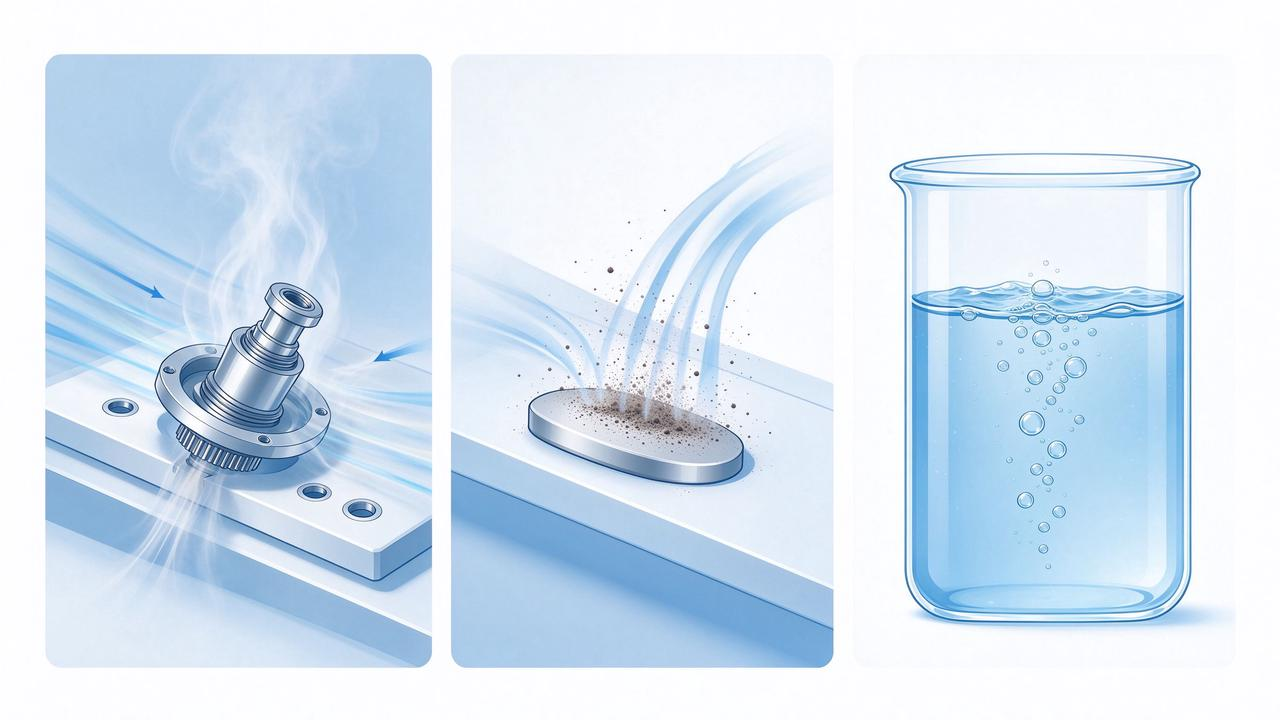
Precision cleaning. Low surface tension lets the solvent penetrate tiny gaps and micropores in parts. It removes light oil, fingerprints, flux residue and particles from precision part surfaces, and it evaporates without leaving stains, water marks or oil films. It suits precision metal parts, connectors, optical lenses and semiconductor packaging.
Drying agent. After cleaning, parts dip into or spray with the solvent, which quickly displaces and carries away surface moisture. No water marks or spots remain, hot-air drying time drops sharply, and process takt improves.
4.2 Surface Dust Removal and Non-Condensable Gas Purging
Dust and non-condensable gas removal. Low surface tension and fast evaporation help clear the dust that adheres to part surfaces. Before refrigeration, heat pump or vacuum systems start up, the solvent purges and flushes non-condensable gas out of pipelines, so residual gas does not degrade heat transfer efficiency or process stability.
4.3 Fluorinated Synthesis Raw Material and Electrolyte Additive
Raw material and additive (TUW-458 only). The product serves as a raw material for synthesizing other fluorinated products, or as an electrolyte additive that improves the electrochemical performance and stability of lithium batteries, supercapacitors and similar devices.
5. Environmental Compliance and Safety
Both products are HFE-based eco-friendly solvents: ODP is zero, so they do not deplete the ozone layer; GWP is low and atmospheric lifetime is short; and they contain no chlorine or bromine, so they meet RoHS and REACH environmental requirements. On the operational side, neither product has a flash point and neither one is flammable, which makes handling safer; distillation regenerates the waste liquid for reuse and lowers total cost further. As substitutes for ODS (ozone-depleting substances), they serve a wide range of industries including medical, electronics, precision instruments, optical lenses, communications and aerospace.
6. Choosing Between the Two
|
Item
|
TUW-347 (HFE-347)
|
TUW-458 (HFE-458)
|
|
Positioning
|
Eco-friendly solvent
|
Eco-friendly solvent + raw material
|
|
Cleaning / drying
|
Suitable
|
Suitable
|
|
Dust / non-condensable gas removal
|
Suitable
|
Suitable
|
|
Synthesis raw material
|
—
|
Suitable
|
|
Electrolyte additive
|
—
|
Suitable
|
|
Typical applications
|
General precision drying and dust removal, fast-dry stations
|
Drying and dust removal + fluorinated product synthesis / electrolyte
|
One-line selection: for routine drying, dust removal and cleaning, especially on fast-takt lines that need parts to dry right after cleaning, TUW-347 is enough; to support downstream fluorinated product synthesis as well, or to serve as an electrolyte additive for batteries and capacitors, choose TUW-458.
Shenzhen Huayi Brothers specializes in electronic fluorinated fluids and fluorinated functional liquids. For sample testing or process-specific selection support, contact us through the link on the right.
TUW-7200 Electronic Fluorinated Fluid: Precision Cleaning, Hermeticity Leak Testing, Thermostatic Bath — One Fluid for Three Uses, NO PFAS Domestic Alternative
In-depth Application of Electronic Fluorinated Fluids in Semiconductor Manufacturing: A Full Analysis of TUW Series from Equipment Temperature Control to Precision Cleaning
Related Article
This article introduces the product positioning and core characteristics of TUW 2704 fluoropolymer electronic coating agent, compares its differences with traditional conformal paint, and explains its applications in PCB moisture and corrosion protection as well as the selection logic for scenarios such as new energy and high-density boards.
PCB Protection Solution Selection: TUW 2704 Nano Conformal Coating vs. Traditional Conformal Paint

3M has discontinued FC-3283 — how should wafer fabs choose a domestic replacement? This article details the TUW-3283 electrochemical fluorination product's parameter alignment with FC-3283, the selection logic, and a four-step switchover process to help you complete your domestic substitution smoothly.
TUW-3283 Electronic Fluorinated Fluid: A Domestic Replacement Guide for Wafer Fabs After the FC-3283 Phase-out

What's the difference between HFE and PFC? Which one to pick for cooling, cleaning, and testing? This article compares 14 TUW-series products in a single master table and gives scenario-based selection recommendations.
One Table to Rule Them All: How to Choose Between HFE and PFC — The Complete TUW Series Electronic Fluorinated Fluid Selection Guide
As AI server rack power density breaks 30 kW, TUW-7500 hydrofluoroether delivers a GWP of just 1, becoming the preferred medium for single-phase immersion cooling. This article details its insulating, non-flammable, and environmentally friendly properties along with deployment verification points.
AI Server Rack Power Breaches 30 kW: Why TUW-7500 Hydrofluoroether Becomes the Preferred Immersion Cooling Medium