
TUW-7100 Electronic Fluorinated Fluid: One Solution for Precision Cleaning, Thermal Cooling & Drying
2026-10-26
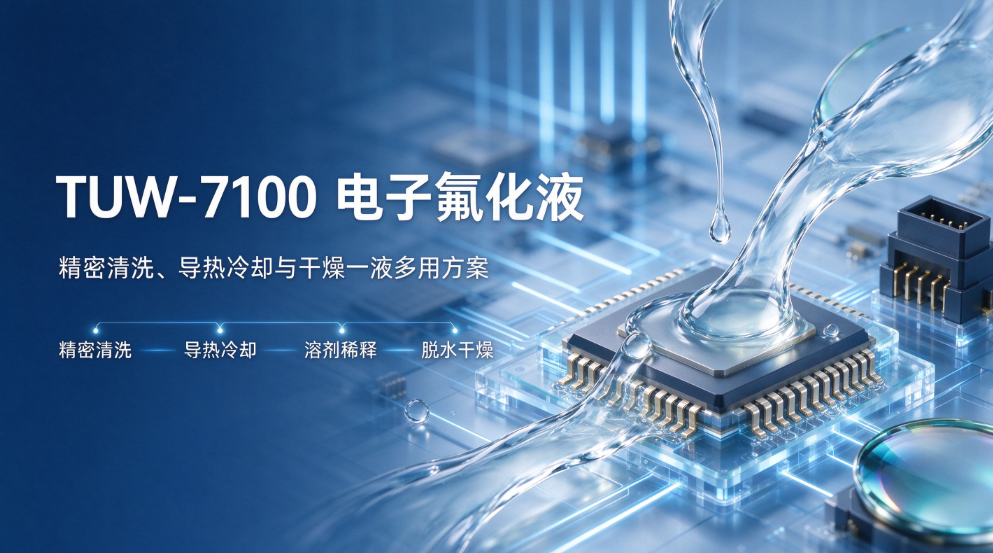
Throughout the entire process of electronics manufacturing and precision equipment maintenance, electronic fluorinated liquids are an indispensable auxiliary material. Unlike wet chemicals that act directly on the product, hydrofluoroether (HFE) electronic fluorinated liquids work mainly at the equipment and component level, handling precision cleaning, low-temperature heat transfer, solvent dilution and dehydration drying. TUW-7100 is representative of this class of product: rather than pushing every scenario to its limit, it relies on one fluid serving many uses, so that production lines with moderate requirements can complete the most process steps with the fewest material types.
1. Product Overview of TUW-7100
1.1 Chemical Identity and Substitution Positioning
TUW-7100 is nonafluorobutyl methyl ether (C4F9OCH3, molecular formula C5H3F9O), the domestic substitute for 3M™ Novec™ 7100 electronic fluorinated liquid (NO PFAS). Its CAS number is 163702-08-7, its GC purity is 99%, and it is a colorless transparent liquid.
1.2 Environmental Profile and Industry Coverage
The product offers zero ODP (ozone depletion potential) and low GWP (global warming potential), a short atmospheric lifetime, high chemical and thermal stability, low toxicity and low surface tension. It is an ideal substitute for ODS (ozone-depleting substances) and is widely used in medical, electronics, metal, precision instrument, optical lens, communications and aerospace applications.
1.3 Key Physical Properties at a Glance
The table below summarizes the core physical property data of TUW-7100. Boiling point, surface tension and solubility directly determine how it performs in cleaning and drying steps.
Table 1 Key Physical Properties of TUW-7100
|
Property
|
Value
|
|
Product model
|
TUW-7100
|
|
Chemical name
|
Nonafluorobutyl methyl ether (HFE-7100 type)
|
|
Molecular formula
|
C5H3F9O
|
|
CAS No.
|
163702-08-7
|
|
Molecular weight
|
250
|
|
Appearance
|
Colorless transparent liquid
|
|
Boiling point
|
61°C
|
|
Density (25°C)
|
1.52 g/mL
|
|
Freezing point
|
-135°C
|
|
Surface tension
|
13.6 dyn/cm
|
|
Vapor pressure (25°C)
|
202 mmHg
|
|
Latent heat of vaporization
|
112 kJ/kg
|
|
ODP
|
0
|
|
GWP
|
320
|
|
Flash point
|
None
|
|
Solubility of solvent in water
|
12 ppmw
|
|
Solubility of water in solvent
|
95 ppmw
|
|
GC purity
|
99%
|
|
Allowable exposure concentration (TWA)
|
750 ppm
|
2. Product Characteristics and Advantages
2.1 Mild Solvency and Low Surface Tension
Mild solvency is the first safeguard TUW-7100 provides in precision cleaning: it removes light oil, fingerprints and particles without damaging coatings or sensitive materials on precision parts. Working alongside it is a low surface tension of 13.6 dyn/cm, which penetrates strongly into micron-scale gaps and carries residues out of internal structures.
2.2 Wide Temperature Range from a Low Boiling Point and Low Freezing Point
A low boiling point of 61°C lets the fluid volatilize quickly, drying within tens of seconds and leaving no water marks. A low freezing point of -135°C keeps it liquid and flowing in low-temperature environments without solidifying. Together, these thermal characteristics allow one fluid to serve both fast-dry cleaning steps and low-temperature cooling loops.
2.3 Stability, Operational Safety and Environmental Compliance
The product has high chemical and thermal stability, so its performance remains stable and reliable over time. It is low in toxicity and has no flash point, which makes operation safe and allows it to replace conventional organic solvents. With zero ODP and a low GWP of 320, it is environmentally compliant and has a short atmospheric lifetime. These properties together form the basis for multi-purpose use: one fluid covering the four steps of cleaning, cooling, dilution and drying.
3. One Fluid, Four Applications
3.1 Precision Cleaning: From Etch Chambers to Display Panels
Precision cleaning is the primary use of TUW-7100. It covers semiconductor etch chamber cleaning (removing polymer deposits from chamber walls), FOUP (front opening unified pod) cleaning, precision electronic parts such as connectors, sensors and hard drive components, and LCD/OLED display cleaning. A boiling point of 61°C means fast volatilization: parts dry within tens of seconds after washing, with no drying step and no water marks.
3.2 Thermal Cooling: From Constant-Temperature Baths to Immersion Cooling
For thermal cooling, TUW-7100 suits laboratory constant-temperature baths, temperature control of small electronic devices, test fixture cooling, as well as data center immersion cooling, power device immersion cooling and temperature control in dry etching equipment. Its freezing point of -135°C means it will not solidify in low-temperature environments. For high heat-flux scenarios such as immersion cooling of high-power servers, TUW-7500 is recommended, with a boiling point of 134°C and a GWP of only 1.
3.3 Solvent Dilution and Dehydration Drying: Two Auxiliary Steps
As a solvent and diluent, TUW-7100 can serve as a diluent for electronic coatings, a medium for airtightness and voltage testing, a reaction solvent and analytical extraction solvent, and a diluent for lubricant deposition on precision mechanisms. In dehydration drying it acts as a displacement drying agent after water-based cleaning: the fluid displaces surface water and then volatilizes quickly, leaving the workpiece dry with no water marks.
4. Environment and Safety
4.1 Balancing Zero ODP with Moderate GWP
TUW-7100 has an ODP of 0 and does not deplete the ozone layer. Its GWP of 320 is a moderate level among hydrofluoroethers: far lower than perfluorocarbon (PFC) fluids, though not as low as TUW-7500, which has a GWP of 1. Its atmospheric lifetime is short, so the environmental burden is small.
4.2 Operational Safety Limits and Protection Requirements
The product has no flash point and low toxicity, with an allowable exposure concentration (TWA) of 750 ppm, giving high operational safety. It is still a chemical, however, so ventilation and basic protective measures are required during use; refer to the MSDS for detailed safety data.
4.3 Carbon Footprint Considerations for Export
If the product is exported to Europe and the customer is sensitive to carbon footprint, models with a lower GWP can be evaluated so as to match the environmental procurement requirements of the customer.
5. Selection Guidance and Economic Value
5.1 Comparison Across the TUW Series
TUW-7100 suits production lines with moderate requirements, where cleaning is not heavy and cooling is not extreme. The comparison with other products in the TUW series is as follows.
Table 2 Comparison of TUW Series Products
|
Product model
|
Boiling point
|
Key parameters
|
Core positioning
|
|
TUW-7100
|
61°C
|
GWP 320, freezing point -135°C, density 1.52 g/mL
|
Precision cleaning as the main use, with cooling, dilution and drying; one fluid, many uses
|
|
TUW-72DA
|
44°C
|
Azeotrope, density 1.27 g/mL, surface tension 18 mN/m
|
Medium to heavy degreasing and flux removal, for heavy oily residues such as PCBA flux
|
|
TUW-7500
|
134°C
|
GWP 1, melting point -93°C, density 1.626 g/mL
|
High-end thermal control such as immersion cooling of high-power servers
|
5.2 The Economics of Multi-Purpose Use
Consider the economics. If a production line previously used three media, namely cleaning agent A, drying agent B and coolant C, at 200 liters each per year, and switches to TUW-7100 as a single fluid, purchase orders fall from three to one and administrative cost drops; inventory falls from three items to one and storage space is saved; operators need to learn only one procedure; and the number of waste streams to handle is reduced.
5.3 Application Boundaries and Alternatives
TUW-7100 is not universal. If the cleaning task is especially demanding, for example RMA flux residues, a strongly solvating azeotropic product such as TUW-72DA is still required. If the cooling duty is extreme, TUW-7500 is needed. But on many production lines with moderate requirements, where cleaning is not heavy and cooling is not extreme, standardizing on TUW-7100 is a highly cost-effective choice.
6. Conclusion
Requirements for auxiliary materials in electronics manufacturing are shifting from single-function compliance toward multi-purpose performance, stable reliability and environmental compliance. Built on hydrofluoroether chemistry, TUW-7100 integrates precision cleaning, thermal cooling, solvent dilution and dehydration drying into one fluid, meeting process requirements while significantly reducing the total cost of purchasing, storage, training and waste handling.For electronics manufacturers that pursue efficient operations, this is a solution worth serious evaluation.
Shenzhen Huayi Brothers specializes in electronic fluorinated liquids and fluorine-based functional fluids, and provides product documentation, sample testing and discussion of application solutions. To request a sample test, please use the contact panel on the right.
AI Server Rack Power Breaches 30 kW: Why TUW-7500 Hydrofluoroether Becomes the Preferred Immersion Cooling Medium
TUW-7300 HFE Electronic Fluorinated Fluid: In-Depth Analysis of Dual Applications in Semiconductor Equipment Temperature Control and Precision Cleaning
Related Article
This article introduces the product positioning and core characteristics of TUW 2704 fluoropolymer electronic coating agent, compares its differences with traditional conformal paint, and explains its applications in PCB moisture and corrosion protection as well as the selection logic for scenarios such as new energy and high-density boards.
PCB Protection Solution Selection: TUW 2704 Nano Conformal Coating vs. Traditional Conformal Paint
3M has discontinued FC-3283 — how should wafer fabs choose a domestic replacement? This article details the TUW-3283 electrochemical fluorination product's parameter alignment with FC-3283, the selection logic, and a four-step switchover process to help you complete your domestic substitution smoothly.
TUW-3283 Electronic Fluorinated Fluid: A Domestic Replacement Guide for Wafer Fabs After the FC-3283 Phase-out

What's the difference between HFE and PFC? Which one to pick for cooling, cleaning, and testing? This article compares 14 TUW-series products in a single master table and gives scenario-based selection recommendations.
One Table to Rule Them All: How to Choose Between HFE and PFC — The Complete TUW Series Electronic Fluorinated Fluid Selection Guide
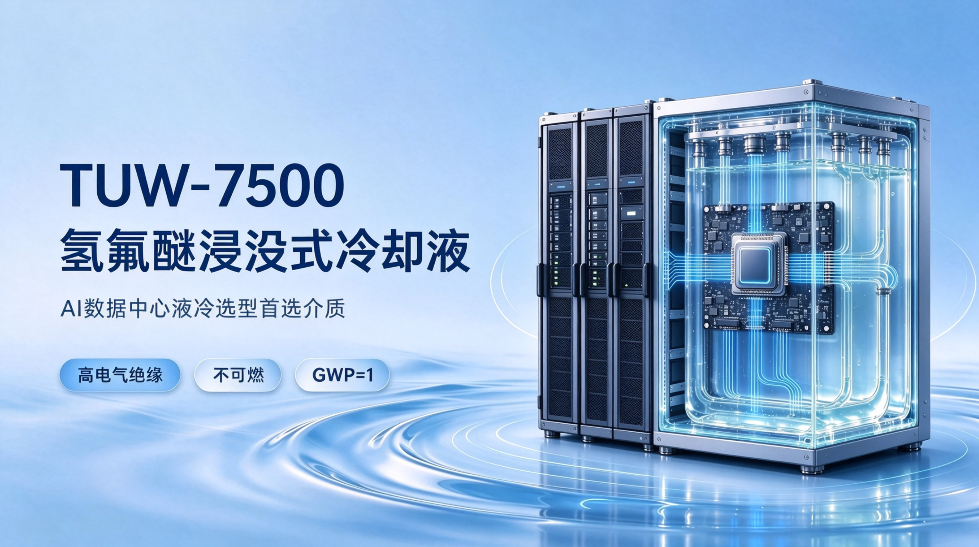
As AI server rack power density breaks 30 kW, TUW-7500 hydrofluoroether delivers a GWP of just 1, becoming the preferred medium for single-phase immersion cooling. This article details its insulating, non-flammable, and environmentally friendly properties along with deployment verification points.
AI Server Rack Power Breaches 30 kW: Why TUW-7500 Hydrofluoroether Becomes the Preferred Immersion Cooling Medium