
From Thermal Shock to Package Leak Testing: A Detailed Look at TUW-3283 in Electronic Reliability Verification
2026-10-09
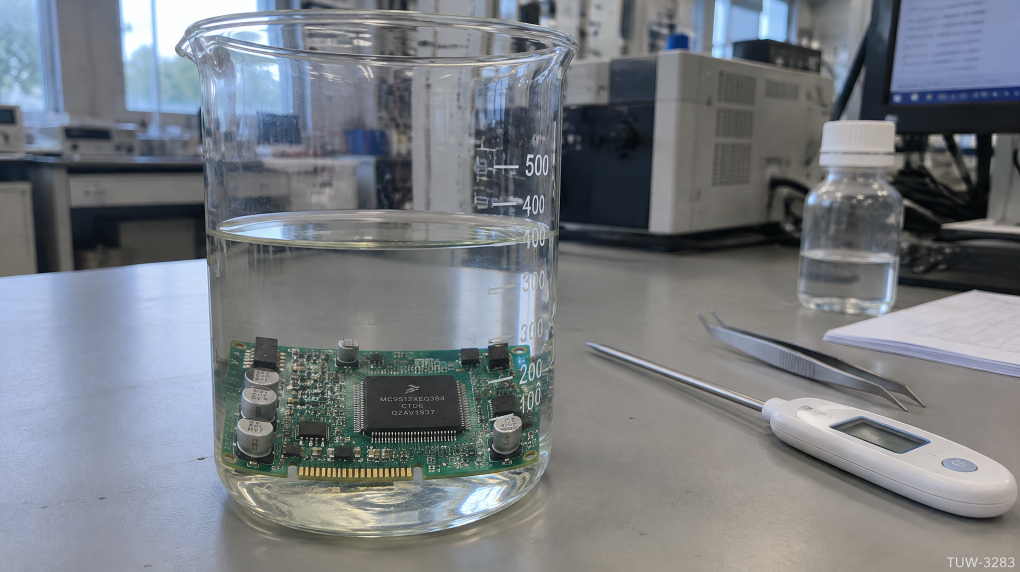
From design to mass production, a chip passes through dozens of reliability tests. Among them, thermal shock and package hermeticity (leak) testing are two standard verifications that are almost always required. These two tests appear not to take part directly in production, yet they directly determine whether a product can pass automotive and military-grade certification.
The key consumable behind these two tests is perfluorocarbon fluid. If the medium in the test bath is insufficient in purity or too narrow in temperature range, the test data cannot be trusted, and the device under test may even be contaminated. Taking TUW-3283 as an example, this article explains the application of perfluorocarbon fluids in reliability verification.
1. Why Thermal Shock Testing Requires Perfluorocarbon Fluid
The purpose of thermal shock testing is to verify the structural reliability of a device under abrupt temperature changes. The test equipment has two baths, a hot bath and a cold bath, and the device under test is transferred rapidly between them, typically from -55°C to +125°C, within a transfer time of no more than 10 seconds.
This test imposes four hard requirements on the bath fluid:
-
Wide temperature range: the cold bath must not freeze below -55°C, and the hot bath must not boil above 125°C
-
Low viscosity: the fluid must respond quickly during temperature switching, and viscosity changes must not cause an uneven temperature field
-
Chemical inertness: no reaction with device surfaces, solder or packaging materials
-
Non-flammability: the hot bath may exceed 100°C, and the medium must not become a fire hazard
Conventional media such as glycerin and glycol silicone oils are either too narrow in temperature range, too viscous at low temperature, or incompatible with certain plastic packages. Perfluorocarbon fluids are close to the optimal solution on all four dimensions.
2. Parameter Matching of TUW-3283 in Thermal Shock Testing
Table 1 Parameter matching of TUW-3283 in thermal shock testing
|
Test requirement
|
TUW-3283 parameter
|
Matching performance
|
|
Cold bath temperature
|
Pour point -65°C
|
Covers -55°C or even lower
|
|
Hot bath temperature
|
Boiling point 128°C
|
Covers the +125°C upper test limit
|
|
Response speed
|
Kinematic viscosity 1.32 cSt
|
Low viscosity ensures rapid heat exchange
|
|
Temperature field uniformity
|
Specific heat capacity 1.431 J/g·°C
|
High specific heat reduces temperature fluctuation
|
|
Device compatibility
|
Extremely high chemical inertness
|
No corrosion of solder or packages
|
|
Safety
|
No flash point
|
Non-flammable in high-temperature environments
|
The fluid range formed by a 128°C boiling point and a -65°C pour point covers exactly the thermal shock test standards of most consumer electronics (-40°C to +85°C) and automotive electronics (-55°C to +125°C).
3. Application in Package Hermeticity Leak Testing
3.1 Why Sealed Cavities Require 100% Hermeticity Testing
MEMS microphones, accelerometers, RF modules and optoelectronic devices all operate inside sealed cavities. If a package has a micro-leak, moisture and oxygen will slowly enter the cavity, causing electrode corrosion and performance drift. Therefore, 100% hermeticity testing is mandatory after packaging.
3.2 Four Requirements of Bubble-Method Leak Testing on the Medium
The most common leak detection method is the bubble method: a heated device is immersed in the leak detection fluid; if the package has a leak hole, the air inside expands with heat and escapes through the hole, forming continuous bubbles on the liquid surface.
This method places very specific requirements on the leak detection fluid:
-
Extremely low surface tension: otherwise the fluid cannot penetrate micron-scale leak holes and the missed-detection rate rises
-
Chemical inertness: no corrosion of devices or leads
-
Fast evaporation and no residue: the device must not be contaminated after testing
-
High transparency: bubbles are easy to observe
TUW-3283 has a surface tension of only 12.7 dyn/cm, among the lowest of common liquids, and can penetrate extremely small gaps. The high purity achieved through electrolytic production ensures no residue after evaporation, so tested devices can move directly to the next process step without cleaning.
4. Why Test Media Must Be Purer Than Production Fluids
Some may ask: both are perfluorocarbon fluids, so why are purity requirements for test use even higher than for production use?
4.1 Test Fluids Contact the Final Product Directly
The reason is that the fluid on the production line circulates inside equipment but does not contact the final product directly, whereas test fluid directly immerses the devices under test, devices that will be delivered to the customer once testing is complete.
4.2 Misjudgment Risk from Residual Impurities and the Purity Floor
If the test fluid contains volatile impurities or high-boiling residues:
-
water marks or oil films may be left on device surfaces and misjudged as package defects
-
particles may precipitate during temperature cycling and attach to leads or contacts
-
once the medium itself is contaminated, repeatability of subsequent test results deteriorates
Therefore, perfluorocarbon fluids for reliability testing should at minimum meet: purity >=99%, moisture <=50 ppm, acid value <=10 ppm and evaporation residue <=100 ppm. The quality indicators of TUW-3283 are controlled exactly to this standard.
5. Extended Applications in Other Reliability Tests
Beyond thermal shock and package leak testing, TUW-3283 is also used in the following reliability tests:
5.1 Temperature Cycling Test
Similar to thermal shock but with a slower transition rate, typically cycling several hundred times between -40°C and +125°C. TUW-3283 serves as the constant-temperature bath medium to provide a stable temperature field.
5.2 High-Temperature Reverse Bias (HTRB)
Power devices are subjected to reverse bias voltage at high temperature to verify long-term reliability. TUW-3283 serves as the heating bath medium, and its high insulation supports live electrical testing.
5.3 Dielectric Withstand Voltage Test
The sample is immersed in TUW-3283 and subjected to high voltage to verify insulation performance. A dielectric strength of 44 kV and a resistivity of 10¹⁴ Ω·cm ensure the test environment itself does not leak current.
6. Economic Value of One Fluid for Multiple Uses
For third-party testing laboratories or IDM fabs, stocking several fluorinated fluids at once carries high management costs. A single medium, TUW-3283, covers thermal shock, temperature cycling, package leak testing and insulation testing, reducing fluid variety, inventory management and waste disposal costs.
In semiconductor fabs, TUW-3283 can also serve as the temperature control medium for etch tools, so the test center and the production floor use the same fluid, further reducing material management complexity.
7. Usage and Maintenance Recommendations
-
Regularly check the appearance and odor of the medium; if discoloration or an unusual smell appears, take a sample for analysis
-
The medium in the thermal shock bath runs at high temperature for long periods; checking acid value and moisture every six months is recommended
-
The medium in the leak test bath is easily contaminated by oils carried in by devices; regular filtration or replacement is recommended
-
Store in sealed containers to reduce moisture absorption and evaporation loss
Shenzhen Huayi Brothers focuses on the supply of electronic fluorinated fluids and fluorine-containing functional liquids, providing customers with product documentation, sample testing and application discussions. For sample testing, please contact us through the panel on the right.
In-depth Application of Electronic Fluorinated Fluids in Semiconductor Manufacturing: A Full Analysis of TUW Series from Equipment Temperature Control to Precision Cleaning
Why Supercomputers and Military Electronics Can't Do Without TUW-770, the "Extreme-Temperature All-Rounder" Fluorocarbon Fluid
Related Article
This article introduces the product positioning and core characteristics of TUW 2704 fluoropolymer electronic coating agent, compares its differences with traditional conformal paint, and explains its applications in PCB moisture and corrosion protection as well as the selection logic for scenarios such as new energy and high-density boards.
PCB Protection Solution Selection: TUW 2704 Nano Conformal Coating vs. Traditional Conformal Paint

3M has discontinued FC-3283 — how should wafer fabs choose a domestic replacement? This article details the TUW-3283 electrochemical fluorination product's parameter alignment with FC-3283, the selection logic, and a four-step switchover process to help you complete your domestic substitution smoothly.
TUW-3283 Electronic Fluorinated Fluid: A Domestic Replacement Guide for Wafer Fabs After the FC-3283 Phase-out

What's the difference between HFE and PFC? Which one to pick for cooling, cleaning, and testing? This article compares 14 TUW-series products in a single master table and gives scenario-based selection recommendations.
One Table to Rule Them All: How to Choose Between HFE and PFC — The Complete TUW Series Electronic Fluorinated Fluid Selection Guide
As AI server rack power density breaks 30 kW, TUW-7500 hydrofluoroether delivers a GWP of just 1, becoming the preferred medium for single-phase immersion cooling. This article details its insulating, non-flammable, and environmentally friendly properties along with deployment verification points.
AI Server Rack Power Breaches 30 kW: Why TUW-7500 Hydrofluoroether Becomes the Preferred Immersion Cooling Medium