
AI Server Rack Power Breaches 30 kW: Why TUW-7500 Hydrofluoroether Becomes the Preferred Immersion Cooling Medium
2026-10-28
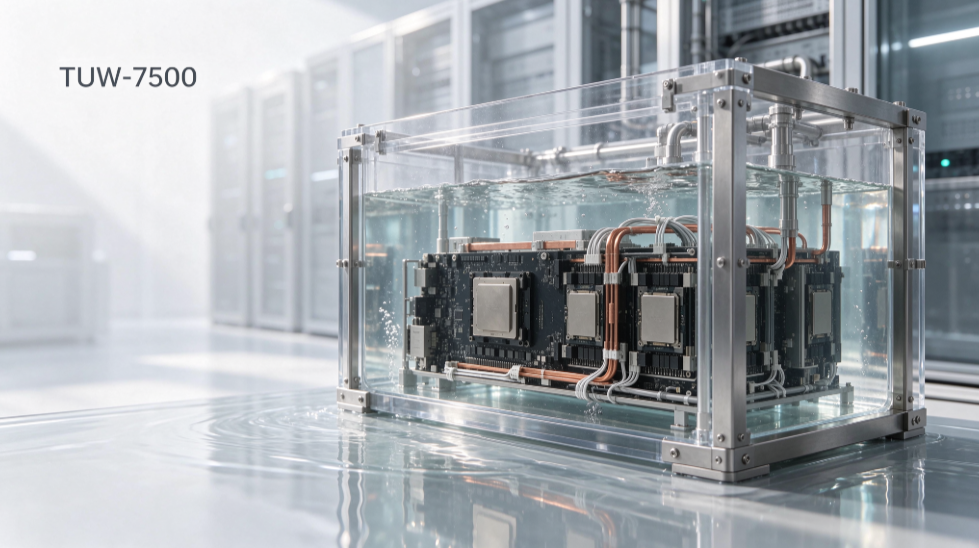
In 2023 an AI server drew 500 W to 1 kW. By 2026 a single GPU exceeds 1200 W, and an 8-GPU server rack easily passes 30 kW of power density. Air cooling relies on fans to drive convective airflow, and at this heat flux it no longer copes: rack hot spots routinely exceed 90 °C, and fans account for more than 30% of total power consumption.
Liquid cooling has moved from premium option to mandatory one. Among all liquid cooling approaches, immersion cooling is regarded as the ultimate solution because it delivers the highest heat removal efficiency. Whether immersion cooling actually works, however, hinges on one easily overlooked link: choosing the right coolant.
1 Hard Requirements for Coolant in Immersion Cooling
Immersing an entire server in liquid sounds simple, but the liquid must satisfy all of the following at once:
1.1 Electrical Safety Comes First: Dielectric Strength and Non-Flammability
High dielectric insulation: it is in direct contact with the motherboard, CPU and memory and must not cause a short circuit
Non-flammable: a rack is full of electricity, so a burning liquid means disaster
1.2 Thermal Performance Determines Cooling Efficiency: Wide Temperature Range and Low Viscosity
Wide temperature range: liquid all the way from room temperature at start-up to the high temperature at full load
Low viscosity: pumping power must stay low; a fluid that is too viscous drives pump consumption up sharply
1.3 Long-Term Operation Depends on Material Compatibility and Environmental Metrics
Material compatibility: must not corrode copper busbars, swell rubber seals or change PCB impedance
Low GWP: data centers must disclose ESG data, so environmental indicators matter more and more
Hydrocarbon oils burn, water does not insulate well enough and silicone oils conduct heat poorly, so the industry converged on the fluorinated fluid category.
2 What TUW-7500 Is
TUW-7500 is a hydrofluoroether (HFE) electronic fluorinated fluid, chemically nonafluoroisobutyl methyl ether. Its basic parameters are listed below.
2.1 Basic Parameters
|
Item
|
Parameter
|
|
Product model
|
TUW-7500
|
|
Chemical name
|
Nonafluoroisobutyl methyl ether
|
|
Molecular formula
|
C5H3F9O
|
|
Appearance
|
Transparent liquid
|
|
Molecular weight
|
332.09
|
|
Boiling point
|
134 °C
|
|
Density (25 °C)
|
1.626 g/mL
|
|
Melting point
|
-93 °C
|
|
Flash point
|
None
|
|
ODP
|
0
|
|
GWP
|
1
|
2.2 GWP = 1 as an Environmental Label
GWP = 1 is the most prominent environmental label of TUW-7500. For comparison, perfluorocarbon fluids (PFC) typically have GWPs in the hundreds to thousands, while the GWP of TUW-7500 is only 1, among the lowest of all electronic fluorinated fluids. For data centers that must report carbon neutrality and ESG performance, this metric is critical.
3 How It Works in Single-Phase Immersion Cooling
3.1 Operating Mode of Single-Phase Immersion
Immersion liquid cooling comes in single-phase and two-phase variants. TUW-7500 is mainly used for single-phase immersion, where the liquid stays liquid and does not boil.
The working process is as follows: the whole server is immersed in a rack filled with TUW-7500; the liquid contacts CPUs, GPUs, VRMs and other heat sources directly and carries heat away by convection. A pump at the bottom of the rack draws the hot liquid out, an external dry cooler or cooling tower cools it down, and it is then returned to the rack. The loop is fully closed.
3.2 Heat Transfer Efficiency and Operational Stability
Because the specific heat capacity of a liquid far exceeds that of air (water is about 3500 times that of air, and fluorinated fluids are several times higher as well), heat transfer efficiency is far above air cooling. There are almost no hot spots inside the rack, servers run stably at lower temperatures, and chip lifetime is longer.
4 Why TUW-7500 Fits This Application
4.1 Safety Dimension: Dielectric and Non-Flammable
Electrical insulation safety: the coolant sits in direct contact with a live motherboard, so dielectric strength must be high enough. TUW-7500 is a dielectric liquid, so servers need no extra sealing and can be immersed as they are.
Non-flammability removes fire risk: fire protection is a major cost item in data centers. Hydrocarbon coolants are flammable and require gas suppression systems; TUW-7500 has no flash point, does not burn or explode, so the fire protection class can be lowered and insurance premiums fall.
4.2 Environmental Dimension: GWP = 1 and Carbon Neutrality
GWP = 1 meets ESG requirements: AI data centers run by major internet companies have firm carbon-neutrality timelines. Choosing a cooling medium with GWP = 1 is itself part of carbon footprint management.
4.3 Engineering Dimension: Low-Temperature Adaptability and Fluid Regeneration
-93 °C melting point suits cold winters: in northern data centers the liquid may solidify after a winter shutdown. TUW-7500 melts at -93 °C, so it will not freeze even if hall insulation fails, and restart is safe.
Distillable and reusable: after long operation the fluid may pick up dust or trace moisture; TUW-7500 can be purified by distillation and reused, which lowers total lifecycle cost.
5 Comparison with Other Cooling Media
5.1 Side-by-Side Comparison of Four Media
|
Comparison dimension
|
TUW-7500
|
Hydrocarbon oil
|
Silicone oil
|
Perfluorocarbon (PFC)
|
|
Dielectric insulation
|
Excellent
|
Average
|
Good
|
Excellent
|
|
Flammability
|
Non-flammable
|
Flammable
|
Low flammability
|
Non-flammable
|
|
GWP
|
1
|
Low
|
Low
|
Hundreds to thousands
|
|
Material compatibility
|
Good
|
Swells seals
|
Average
|
Excellent
|
|
Boiling point
|
134 °C
|
≈300 °C
|
≈300 °C
|
Varies by grade
|
|
Purchase cost
|
Medium-high
|
Low
|
Medium
|
High
|
|
Typical application
|
AI data center immersion cooling
|
Conventional industrial cooling
|
Transformers
|
Semiconductor extreme temperature control
|
5.2 Where TUW-7500's Balance Lies
TUW-7500 achieves a good balance among safety, environmental performance and material compatibility. PFC also performs well, but its GWP is too high and is increasingly restricted by regulation.
6 What to Validate Before Deployment
Choosing TUW-7500 for immersion cooling does not mean filling the rack and starting up. The following validation must be done:
6.1 Material and Component Compatibility Validation
Material compatibility: soak tests with the server CPU thermal pads, rubber seals and cable jackets
6.2 Measured Thermal and Pumping Performance
Heat transfer performance: measure chip temperatures at different loads in a test rack
Pumping power: confirm the pump selection matches the density and viscosity of the fluid
6.3 Leakage and Personnel Safety Management
Leak response: design a leak collection and fluid top-up plan
Personnel operating rules: fluorinated fluids are not toxic, but ventilation protection is still required during handling
7 Extended Applications
Beyond data centers, TUW-7500 can also be used for:
7.1 Power Electronics and Energy Storage Cooling
Power conversion system (PCS) liquid cooling: heat removal for power electronics modules
7.2 High-Power Equipment and Harsh Environments
High-power laser equipment cooling: heat removal at high power density of the laser
High and low temperature test baths: constant-temperature medium for laboratories
Avionics cooling: heat removal for airborne equipment in extreme environments
Shenzhen Huayi Xiongdi (深圳华益兄弟) focuses on electronic fluorinated fluids and fluorine-containing functional fluids, and provides product documentation, sample testing and application solution exchange.
One Table to Rule Them All: How to Choose Between HFE and PFC — The Complete TUW Series Electronic Fluorinated Fluid Selection Guide
TUW-7100 Electronic Fluorinated Fluid: One Solution for Precision Cleaning, Thermal Cooling & Drying
Related Article
This article introduces the product positioning and core characteristics of TUW 2704 fluoropolymer electronic coating agent, compares its differences with traditional conformal paint, and explains its applications in PCB moisture and corrosion protection as well as the selection logic for scenarios such as new energy and high-density boards.
PCB Protection Solution Selection: TUW 2704 Nano Conformal Coating vs. Traditional Conformal Paint

3M has discontinued FC-3283 — how should wafer fabs choose a domestic replacement? This article details the TUW-3283 electrochemical fluorination product's parameter alignment with FC-3283, the selection logic, and a four-step switchover process to help you complete your domestic substitution smoothly.
TUW-3283 Electronic Fluorinated Fluid: A Domestic Replacement Guide for Wafer Fabs After the FC-3283 Phase-out

What's the difference between HFE and PFC? Which one to pick for cooling, cleaning, and testing? This article compares 14 TUW-series products in a single master table and gives scenario-based selection recommendations.
One Table to Rule Them All: How to Choose Between HFE and PFC — The Complete TUW Series Electronic Fluorinated Fluid Selection Guide
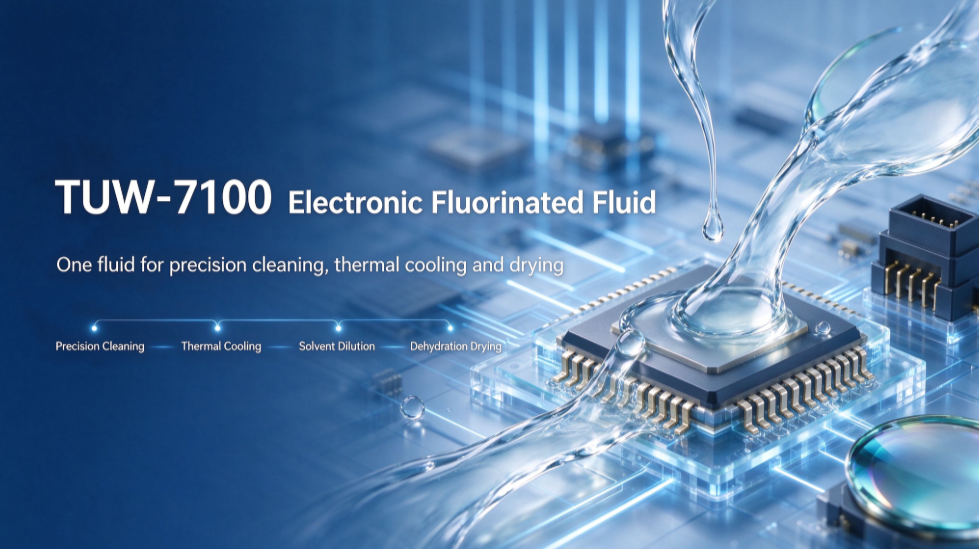
TUW-7100 covers precision cleaning, thermal cooling, solvent dilution, and dehydration drying in a single fluid. This article details its physical properties and the cost-saving value of "one fluid, multiple uses."
TUW-7100 Electronic Fluorinated Fluid: One Solution for Precision Cleaning, Thermal Cooling & Drying