
TUW-40 High-Temperature Perfluorocarbon Fluid: -55°C to 155°C Wide Temperature Range — Temperature Control for Etching and Ion Implantation High-Temperature Operations
2026-10-19
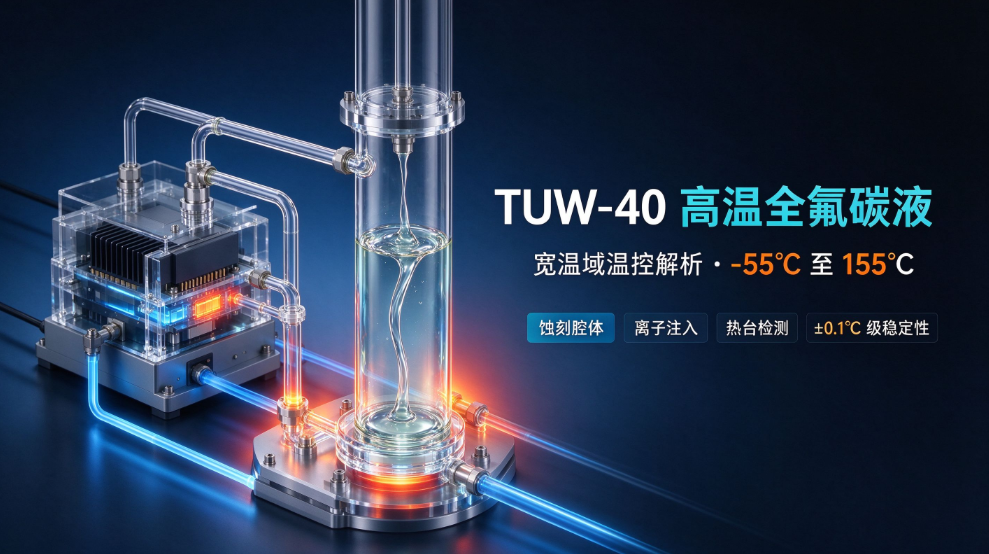
Not every thermal control point in semiconductor manufacturing runs near room temperature. Beamline components of an ion implanter, the hot zones of an etch chamber and the thermal stages of metrology tools operate above 100°C for long periods. As advanced nodes demand temperature stability at the ±0.1°C level, high-temperature duty places requirements on boiling point, thermal stability, electrical insulation and material compatibility far beyond those of ambient cooling. Ordinary coolants either lack a sufficient boiling point and vaporise in the loop to form gas pockets, or decompose at high temperature and contaminate the whole loop, ultimately raising the total operating cost of the thermal control system.
1. High-Temperature Duty: The Hard Part of Semiconductor Thermal Control
1.1 Which Thermal Control Points Stay Above 100°C
Across the three core equipment families of etch, ion implantation and metrology, several thermal control points run hot for long periods: chamber walls and the electrostatic chuck (ESC) generate continuous heat under plasma bombardment; beamline components of the ion implanter heat up markedly under high-energy ion bombardment, and temperature drift directly causes dose non-uniformity and junction depth deviation; thermal shock stages and constant-temperature stages of metrology tools must switch precisely across a wide temperature range. Together these points define the high-temperature thermal control envelope of semiconductor equipment.
1.2 Why Ambient Coolants Cannot Hold a High-Temperature Loop
Forcing an ambient coolant into a high-temperature loop creates three typical problems: insufficient boiling point, so the fluid vaporises at the hot end, forms gas pockets and causes pump cavitation and interrupted heat transfer; poor thermal stability, so it decomposes under prolonged high temperature and produces conductive residues or volatile impurities that contaminate the whole loop; and frequent fluid replacement, because performance drifts quickly and requires top-up or full batch renewal, which raises overall cost.
1.3 Performance Requirements for High-Temperature Thermal Fluids
The requirements high-temperature duty places on a heat transfer fluid can be grouped into six core metrics, each answering a specific equipment pain point:
Table 1 Performance requirements for a high-temperature thermal fluid and the value TUW-40 delivers
|
Requirement
|
Equipment pain point
|
TUW-40 value
|
|
High boiling point, wide range
|
Continuous operation above 100°C without vaporisation
|
Liquid phase from -55°C to 155°C, boiling point 155–160°C
|
|
Thermal stability
|
Decomposition and performance drift under prolonged heat
|
Single component: no degradation, no fractionation, no expiry
|
|
Electrical insulation
|
Proximity to electrodes and high-voltage beamline parts
|
Dielectric strength 40 KV, volume resistivity 1.58×10¹¹ Ω·cm
|
|
Chemical inertness
|
Corrosive gases and etch by-products
|
Non-reactive, no conductive residues
|
|
Low volatility
|
Chamber contamination, frequent top-up
|
High boiling point, low evaporation loss, saturated water content only 50 ppm
|
|
Material compatibility
|
Aging of tubing, seals, pumps and valves
|
Non-corrosive to aluminium, stainless steel, copper, ceramics and seals
|
2. TUW-40: A Single-Component Perfluorocarbon High-Temperature Heat Transfer Fluid
2.1 Product Positioning and Benchmark
TUW-40 is a transparent, colourless single-component perfluorinated compound, benchmarked directly against 3M Novec 40 electronic fluid. As a heat transfer medium it offers excellent chemical inertness, electrical insulation, thermal conductivity and very low surface tension, and is used mainly for thermal control of semiconductor manufacturing equipment. Its defining feature is a single composition with no degradation and no expiry: because it is a single compound, its composition does not change or fractionate over time, which minimises fluid loss and performance drift.
2.2 Key Physical Properties
The key physical properties of TUW-40, and what each means for high-temperature thermal control, are as follows:
Table 2 Key physical properties of TUW-40 and their thermal-control significance
|
Parameter
|
TUW-40 value
|
Significance for thermal control
|
|
Liquid temperature range
|
-55°C to 155°C
|
Covers cold start and high-temperature duty end to end
|
|
Boiling point
|
155–160°C
|
No vaporisation in the hot loop, lower evaporation loss
|
|
Pour point
|
-55°C
|
No freezing or pump blockage on cold starts
|
|
Density
|
1.82 g/mL (25°C)
|
Immiscible with water, so water separates as a layer
|
|
Kinematic viscosity
|
3.18 cSt
|
Moderate pumping resistance, smooth flow in microchannels
|
|
Surface tension
|
12.63 dyn/cm
|
Good penetration of microchannels, high heat transfer efficiency
|
|
Dielectric strength
|
40 KV
|
Safe next to live components
|
|
Volume resistivity
|
1.58×10¹¹ Ω·cm
|
Reliable insulation, extremely low leakage current
|
|
pH
|
7 (neutral)
|
Non-corrosive to metals and seals
|
|
Flash point
|
None
|
Intrinsically safe in fire terms
|
|
NFPA flammability
|
Class 0
|
Non-flammable, colourless, odourless, non-toxic
|
|
GWP (100-year)
|
175
|
Far lower environmental burden than conventional PFC
|
|
Saturated water content
|
50 ppm
|
Low water content, avoids loop corrosion
|
2.3 Seven Core Advantages
-
Single-component stability: no degradation, no fractionation, no expiry: as a single compound, its composition does not change or fractionate with operating time, which minimises fluid loss and performance drift, so long-term operation needs no frequent top-up or full batch replacement.
-
Wide range from -55°C to 155°C, liquid phase throughout: a pour point as low as -55°C and a boiling point of 155–160°C keep the fluid liquid from cold start to stable high-temperature operation, so the loop never forms gas pockets.
-
High boiling point and low volatility, no vaporisation in the hot loop: the boiling point sits tens of degrees above normal etch and ion implantation duty, so evaporation loss above 100°C is small, top-up volume falls, and cavitation and pump idling at the hot end are avoided.
-
Excellent electrical insulation, safe next to live parts: dielectric strength reaches 40 KV and volume resistivity 1.58×10¹¹ Ω·cm, so leakage current stays extremely low near beam electrodes and RF power supplies.
-
Strong chemical inertness and good material compatibility: non-corrosive to aluminium, stainless steel, copper, ceramics and seals; no decomposition under prolonged high temperature and no conductive residues or volatile impurities, protecting loop cleanliness and device yield.
-
No flash point, non-flammable, intrinsically safe: NFPA flammability Class 0, no flash point, colourless, odourless and non-toxic, removing fire and occupational health risk at high temperature.
-
Distillable and reusable, low total cost of ownership: spent fluid can be regenerated by distillation and reused, so long-term operating cost is lower than with single-use media; 100-year GWP is 175, far below conventional PFC.
3. TUW-40 in Semiconductor Equipment Applications
3.1 Etch Tools: Chamber and Electrode Thermal Control
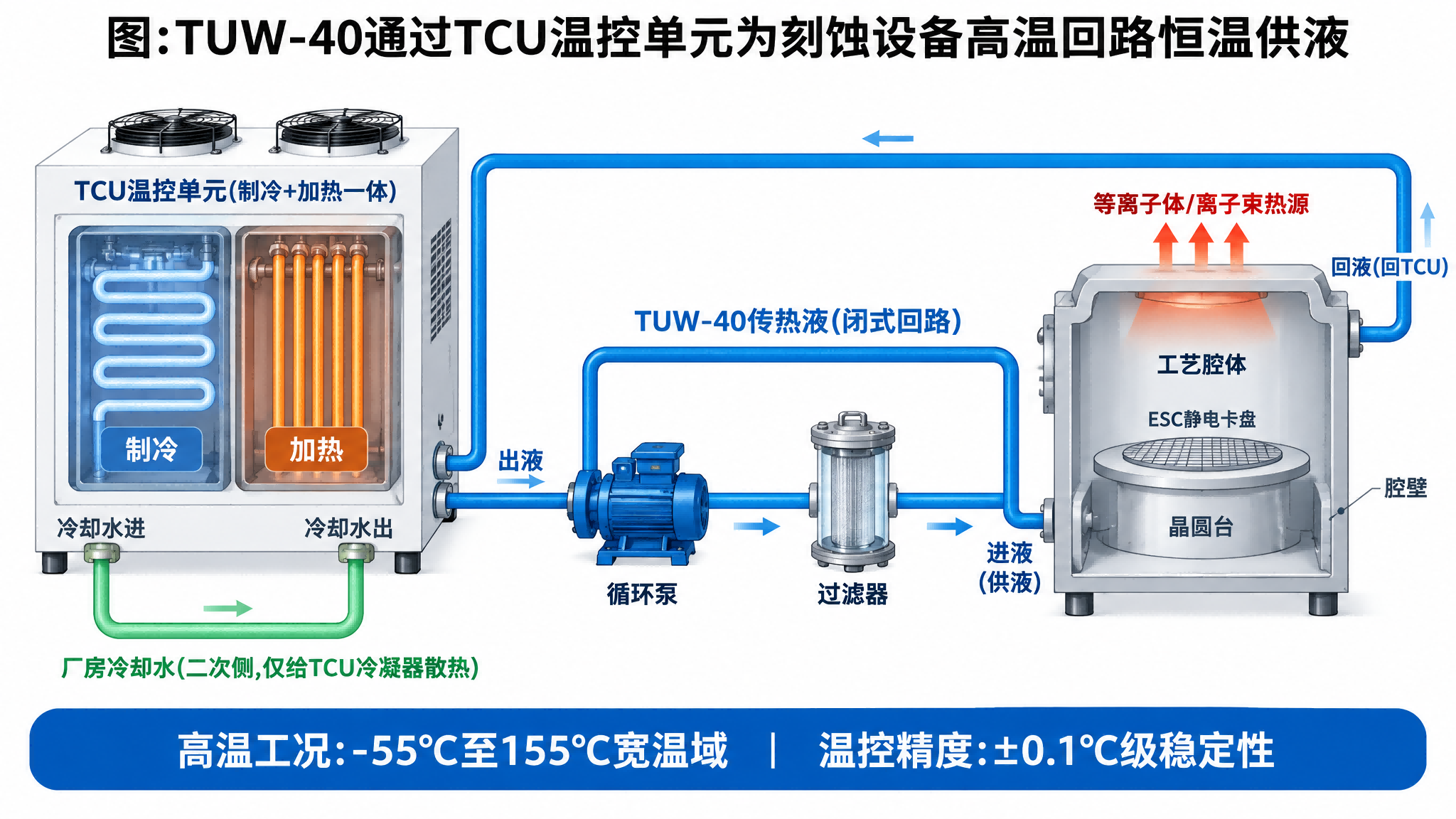
In etch processes, chamber walls, the ESC and the wafer stage generate large amounts of heat under plasma bombardment. TUW-40 is pumped into the equipment cooling loop by an external chiller/TCU thermal control unit to hold critical component temperatures stable. Its wide temperature range keeps the fluid liquid from cold start to stable high-temperature operation, so the loop needs no frequent fluid change. The high boiling point prevents gas pockets in the hot chamber zone, and control accuracy can reach the ±0.1°C level.
3.2 Ion Implanters: Beamline Component Temperature Stability
Beamline components of an ion implanter heat up markedly under high-energy ion bombardment, and temperature drift causes non-uniform dose and junction depth deviation. The chemical inertness and thermal stability of TUW-40 ensure no conductive residues or volatile impurities during long operation and maintain loop insulation. Its 40 KV dielectric strength allows safe use immediately next to high-voltage parts such as beam electrodes.
3.3 Metrology Tools: Thermal Shock and Constant-Temperature Stages
Metrology tools such as thermal shock stages and constant-temperature stages need precise control across a wide temperature range, and they benefit equally from the 155°C upper limit and the low volatility of TUW-40. Liquid phase throughout, from the -55°C low end to the 155°C high end, keeps the fluid state stable during testing and does not affect temperature cycling accuracy.
4. Selection Guide: TUW-40 versus TUW-3283
Within the TUW family, TUW-3283 and TUW-40 are both semiconductor thermal control fluids, and the choice turns on the duty temperature window:
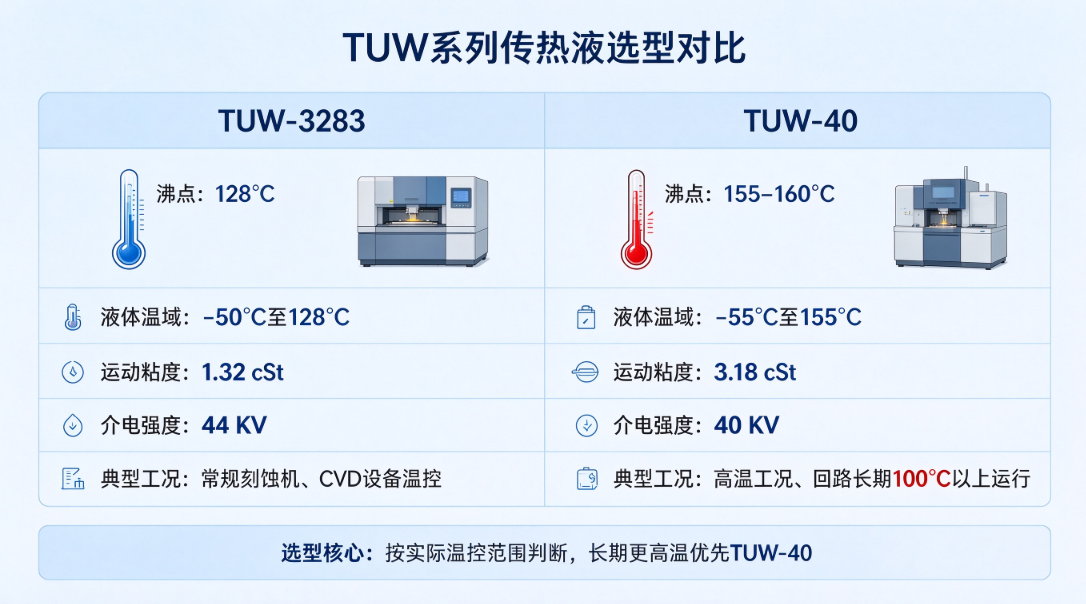
for the thermal control of conventional etch tools and CVD equipment, the -50°C to 128°C range of TUW-3283 is usually sufficient; where higher temperatures must be covered, or the loop runs above 100°C for long periods, TUW-40 is the better fit. Both emphasise single-component stability and high purity, so evaluate them against the actual temperature range of the tool and the supply cost.
5. Quality and Supply: The Huayi Brothers Approach
When purchasing, request the batch COA and check key indicators such as purity, water content and acid value. Shenzhen Huayi Brothers specializes in electronic fluorinated liquids and fluorine-based functional fluids; for TUW-40 we provide product documentation, sample testing and discussion of application solutions. For sample testing, please use the consultation link on the right.
PCB Nano Conformal Coating Selection: TUW-2704 & TUW-1700 vs. Traditional Conformal Coating
TUW-7200 Electronic Fluorinated Fluid: Precision Cleaning, Hermeticity Leak Testing, Thermostatic Bath — One Fluid for Three Uses, NO PFAS Domestic Alternative
Related Article
This article introduces the product positioning and core characteristics of TUW 2704 fluoropolymer electronic coating agent, compares its differences with traditional conformal paint, and explains its applications in PCB moisture and corrosion protection as well as the selection logic for scenarios such as new energy and high-density boards.
PCB Protection Solution Selection: TUW 2704 Nano Conformal Coating vs. Traditional Conformal Paint

3M has discontinued FC-3283 — how should wafer fabs choose a domestic replacement? This article details the TUW-3283 electrochemical fluorination product's parameter alignment with FC-3283, the selection logic, and a four-step switchover process to help you complete your domestic substitution smoothly.
TUW-3283 Electronic Fluorinated Fluid: A Domestic Replacement Guide for Wafer Fabs After the FC-3283 Phase-out

What's the difference between HFE and PFC? Which one to pick for cooling, cleaning, and testing? This article compares 14 TUW-series products in a single master table and gives scenario-based selection recommendations.
One Table to Rule Them All: How to Choose Between HFE and PFC — The Complete TUW Series Electronic Fluorinated Fluid Selection Guide
As AI server rack power density breaks 30 kW, TUW-7500 hydrofluoroether delivers a GWP of just 1, becoming the preferred medium for single-phase immersion cooling. This article details its insulating, non-flammable, and environmentally friendly properties along with deployment verification points.
AI Server Rack Power Breaches 30 kW: Why TUW-7500 Hydrofluoroether Becomes the Preferred Immersion Cooling Medium