
TUW-7200 Electronic Fluorinated Fluid: Precision Cleaning, Hermeticity Leak Testing, Thermostatic Bath — One Fluid for Three Uses, NO PFAS Domestic Alternative
2026-10-16
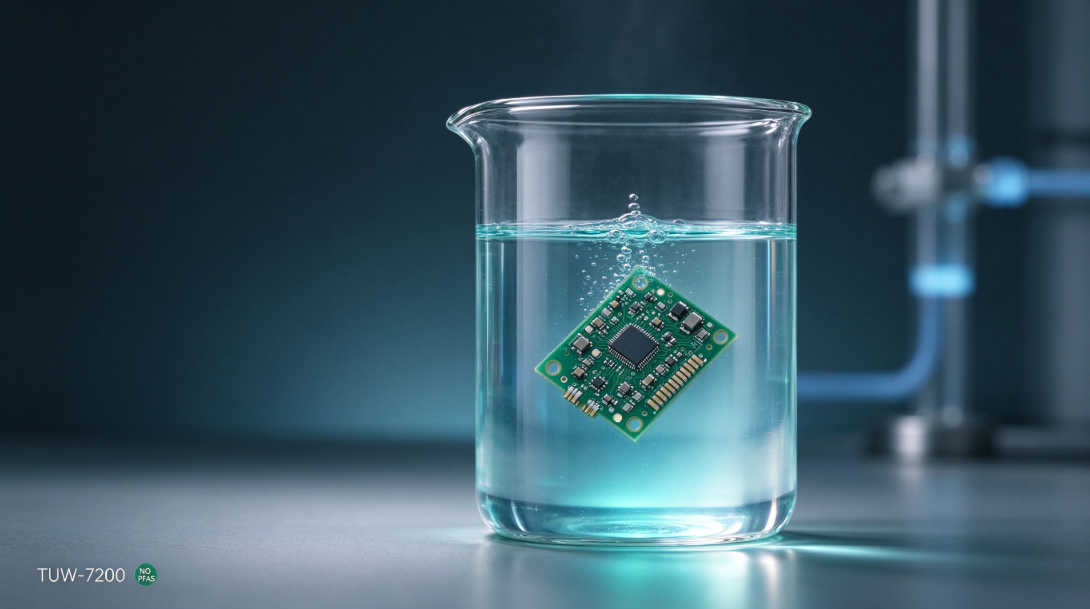
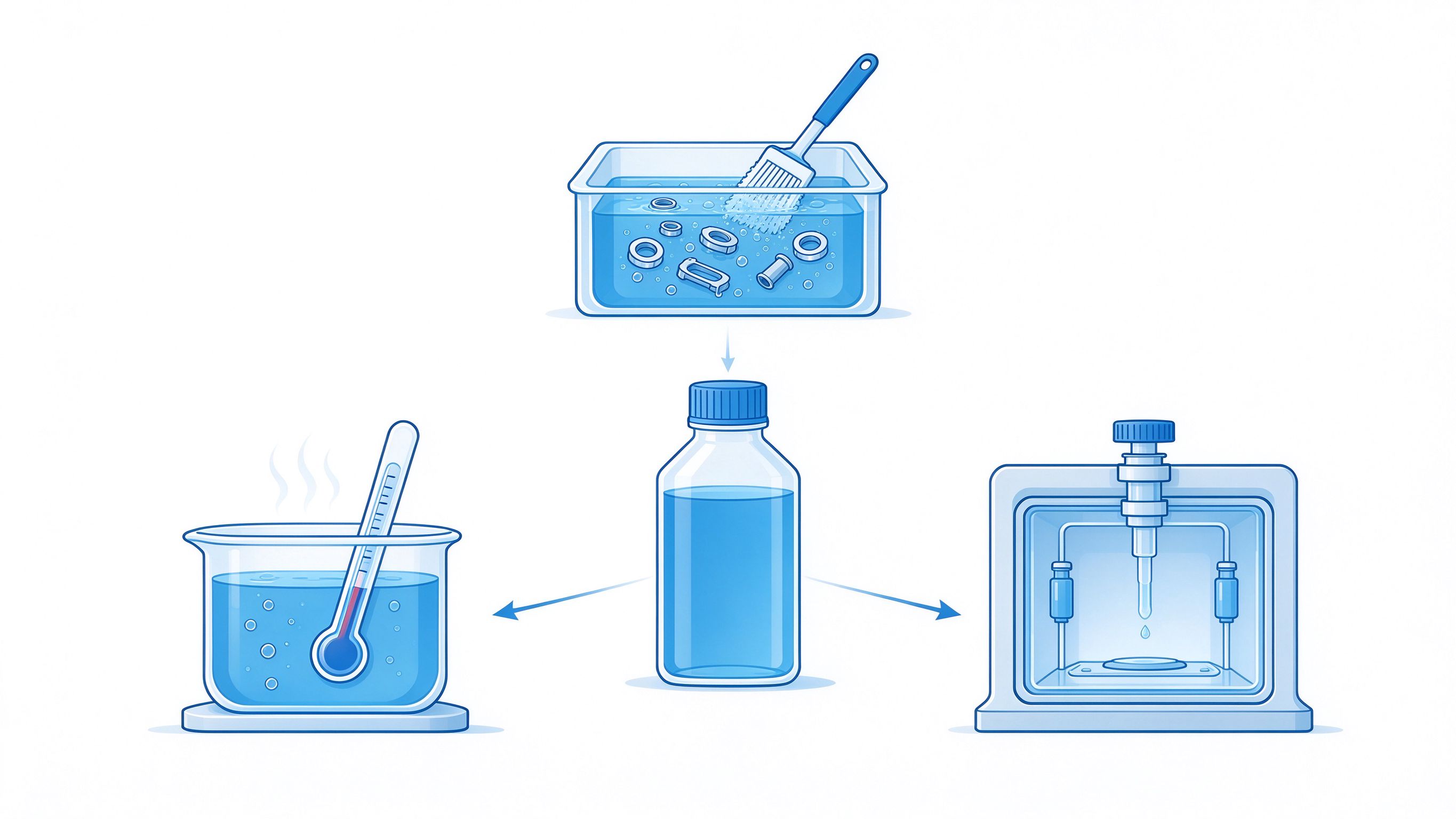
A piece of equipment, a circuit board, a test system: each usually needs more than one liquid. Cleaning needs a cleaning agent, leak detection needs a test fluid, and temperature control needs a thermostatic fluid. When a single medium covers all of these needs, procurement, inventory and management costs drop significantly. TUW-7200 is exactly that kind of multi-purpose electronic fluorinated fluid.
1. What Is TUW-7200
TUW-7200 is a thermally stable perfluorinated fluid, benchmarked against 3M Novec 7200. It targets precision cleaning and test-media applications, and it belongs to the PFAS-free (NO PFAS) family of alternatives. It offers excellent chemical inertness and is non-toxic, odourless and non-flammable, with no flash point, low surface tension, good thermal conductivity and no VOC.
2. Main Applications: Precision Cleaning, Airtightness Testing, Thermostatic Fluids and Extraction Solvents
2.1 Precision Cleaning
As an electronic cleaning agent and a precision cleaning agent, TUW-7200 removes grease, flux residues and ionic contaminants from precision parts; as an oil and grease cleaner, it handles the oil and grease involved in equipment maintenance. Low surface tension ensures penetration cleaning of fine structures, and evaporation without residue ensures cleanliness after cleaning.
2.2 Airtightness Test Fluid
Airtightness testing, also called leak detection, needs a medium that does not evaporate, stays chemically stable and leaves the part under test unaffected. The low volatility, chemical inertness and high density of TUW-7200 make it an ideal airtightness test fluid: the medium is not lost during testing and does not react with seals, so results are stable and reliable and the fluid can be reused.
2.3 Thermostatic Fluid and Cooling Medium
TUW-7200 works as a thermostatic fluid and a cooling medium: it holds an accurate temperature in a thermostatic bath and carries heat away from equipment in a cooling loop. Its small viscosity change at low temperature and its good thermal conductivity keep the temperature-control loop responsive and the heat exchange efficient.
2.4 Extraction Solvent and Other Uses
TUW-7200 also serves as an extraction solvent for recovering target components from mixtures; its high insulation also supports use as a test medium in voltage testing. One liquid for many uses significantly lowers chemical procurement and inventory management costs.
3. Environmental Profile and Safety
TUW-7200 belongs to the NO PFAS alternative route: ODP is zero and it does not deplete the ozone layer; GWP is low and cuts the greenhouse contribution sharply compared with conventional PFCs; and the fluid has no flash point and does not burn, so it is safe to use. The product meets RoHS and other environmental requirements and can satisfy the compliance needs of export markets such as Europe, where PFAS controls are tightening.
4. Product Features
The properties of TUW-7200 determine its stable performance in precision cleaning, airtightness testing and temperature control:
4.1 Material Compatibility and Dielectric Performance
Excellent material compatibility, moderate solubility
Good dielectric performance (dielectric constant 7.3 @ 1 kHz, dielectric strength 40 kV)
4.2 Thermal Conductivity, Thermal Stability and Low-Temperature Behaviour
Good thermal conductivity, thermal stability and chemical stability
Small viscosity change at low temperature, pour point down to -138 °C
4.3 Regeneration, Use and Environmental Safety
Drying removes water without leaving water marks
The fluid can be regenerated by distillation and reused
Low environmental burden: colourless, odourless, non-toxic, ODP = 0, low GWP
No flash point, non-flammable, safe to use
5. Technical Data
TUW-7200 main technical data are as follows (typical values):
|
Parameter
|
Value
|
|
Boiling range
|
76 °C
|
|
Appearance
|
Colourless liquid
|
|
Density
|
1.42 g/mL
|
|
Surface tension
|
13.63 mN/m
|
|
Dielectric constant (@1 kHz)
|
7.3
|
|
Dielectric strength
|
40 kV
|
|
Thermal conductivity
|
0.075 W/m·K
|
|
Specific heat (@ 25 °C)
|
1.22 J/g·°C
|
|
Pour point
|
-138 °C
|
|
Kinematic viscosity (23 °C)
|
0.58 mm²/s
|
|
Average molecular weight
|
264
|
|
Flash point
|
None
|
|
ODP
|
0
|
|
GWP
|
55
|
|
CAS
|
163702-06-5
|
All values above are typical. The actual batch follows the certificate of analysis (COA).
6. Choosing Between TUW-7200 and TUW-7300
TUW-7200 and TUW-7300 both belong to the HFE family and differ in application focus: TUW-7200 concentrates on cleaning, airtightness testing and thermostating, while TUW-7300 balances temperature control and cleaning in semiconductor equipment. For test equipment and laboratory work, choose TUW-7200 first; where equipment temperature control also needs cleaning, TUW-7300 fits better. Shenzhen Huayi Brothers focuses on electronic fluorinated fluids and fluorine-based functional liquids; for sample testing, click the enquiry link on the right.
TUW-40 High-Temperature Perfluorocarbon Fluid: -55°C to 155°C Wide Temperature Range — Temperature Control for Etching and Ion Implantation High-Temperature Operations
HFE Eco-Friendly Solvents TUW-347 & TUW-458: The "Invisible Assistants" for Drying, Dust Removal, and Non-Condensable Gas Elimination
Related Article
This article introduces the product positioning and core characteristics of TUW 2704 fluoropolymer electronic coating agent, compares its differences with traditional conformal paint, and explains its applications in PCB moisture and corrosion protection as well as the selection logic for scenarios such as new energy and high-density boards.
PCB Protection Solution Selection: TUW 2704 Nano Conformal Coating vs. Traditional Conformal Paint

3M has discontinued FC-3283 — how should wafer fabs choose a domestic replacement? This article details the TUW-3283 electrochemical fluorination product's parameter alignment with FC-3283, the selection logic, and a four-step switchover process to help you complete your domestic substitution smoothly.
TUW-3283 Electronic Fluorinated Fluid: A Domestic Replacement Guide for Wafer Fabs After the FC-3283 Phase-out

What's the difference between HFE and PFC? Which one to pick for cooling, cleaning, and testing? This article compares 14 TUW-series products in a single master table and gives scenario-based selection recommendations.
One Table to Rule Them All: How to Choose Between HFE and PFC — The Complete TUW Series Electronic Fluorinated Fluid Selection Guide
As AI server rack power density breaks 30 kW, TUW-7500 hydrofluoroether delivers a GWP of just 1, becoming the preferred medium for single-phase immersion cooling. This article details its insulating, non-flammable, and environmentally friendly properties along with deployment verification points.
AI Server Rack Power Breaches 30 kW: Why TUW-7500 Hydrofluoroether Becomes the Preferred Immersion Cooling Medium