
TUW-7300 HFE Electronic Fluorinated Fluid: In-Depth Analysis of Dual Applications in Semiconductor Equipment Temperature Control and Precision Cleaning
2026-10-23
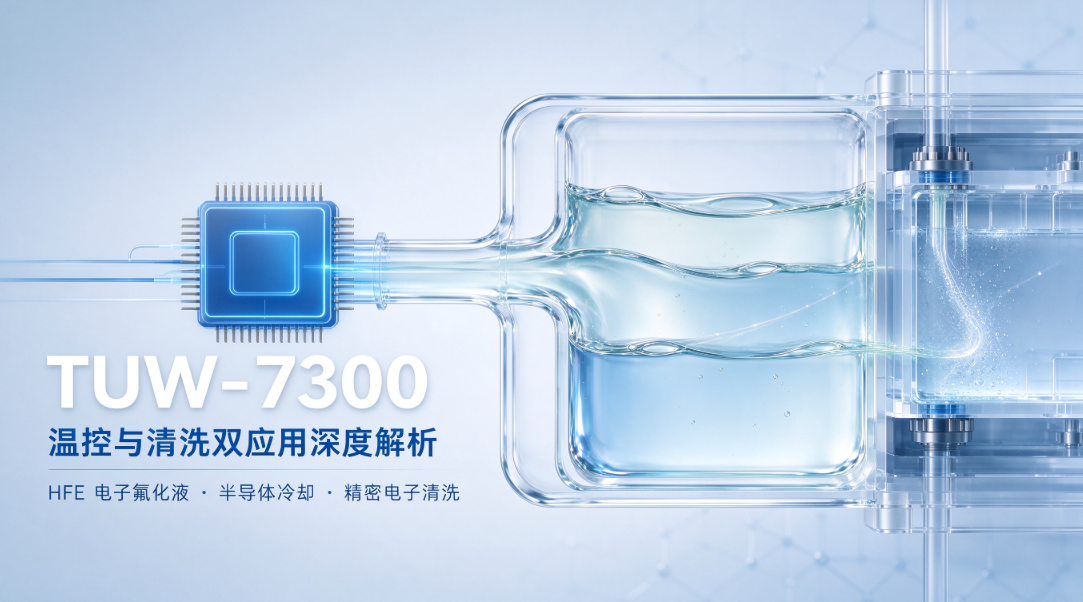
In semiconductor manufacturing and precision electronics manufacturing, electronic fluorinated liquids are moving from a generic heat-transfer medium to a key material that affects equipment stability and process yield. Unlike wet chemicals that act directly on the wafer surface, electronic fluorinated liquids work mainly at the equipment level, performing two core functions: equipment thermal control and cooling, and precision component cleaning.
Electronic fluorinated liquids fall into two major categories: PFPE (perfluoropolyether) coolants and HFE (hydrofluoroether) cleaning fluids. The former are built on a perfluoroether chain and offer outstanding thermal stability and chemical inertness, making them the preferred medium for thermal control of high-end equipment; the latter serve as environmentally friendly precision cleaning agents, known for low surface tension, low residue and good material compatibility.
Within the HFE line, most products specialize either in thermal control or in cleaning. TUW-7300 is unusual: it covers both tracks, serving as a cooling medium and constant-temperature fluid for semiconductor equipment while also acting as a cleaning agent for precision electronic components. This one-fluid, two-use character makes it particularly practical on production lines with frequent equipment maintenance and process changes.
1. HFE Electronic Fluorinated Liquids and TUW-7300 Product Positioning
1.1 Two Technical Routes in Electronic Fluorinated Liquids
In semiconductor equipment thermal management and precision cleaning systems, electronic fluorinated liquids follow two technical routes:
PFPE (perfluoropolyether) is built on a perfluoroether chain. The high bond energy of the C-F bond gives the material outstanding chemical inertness and thermal stability, making it the preferred medium for thermal control of high-end semiconductor equipment; through closed-loop Chiller/TCU circuits it delivers precise temperature control to etch chambers, CVD/PVD deposition equipment, test equipment and vacuum systems.
HFE (hydrofluoroether) is used mainly as an environmentally friendly precision cleaning agent, with low surface tension, low residue, good material compatibility and fast drying. It suits cleaning of semiconductor equipment parts, vacuum chambers, valves, shower heads, optical components and precision electronics.
TUW-7300 belongs to the HFE family, but strengthens thermal control performance on top of a conventional HFE cleaning fluid, making it a versatile product for both thermal control and cleaning scenarios.
1.2 TUW-7300: a Hydrofluoroether Product Benchmarked against 3M Novec 7300
TUW-7300 is a thermally stable hydrofluoroether (HFE) electronic fluorinated liquid, directly benchmarked against 3M Novec 7300. It offers good chemical inertness, is non-toxic and odorless, non-flammable, has low surface tension, excellent thermal conductivity, and contains no VOC.
Compared with TUW-7200, TUW-7300 is more clearly positioned for semiconductor cooling applications (the product is classified as semiconductor cooling) while fully retaining precision cleaning capability. It is one of the models with the strongest thermal control attributes in the HFE family.
2. Thermal Control Scenarios: Semiconductor Equipment Cooling and Constant-Temperature Applications
2.1 Stringent Requirements for Semiconductor Equipment Thermal Control
In semiconductor manufacturing, equipment such as etch, deposition, test and vacuum systems must keep stable temperatures at the process chamber, electrostatic chuck, wafer stage and key moving parts during operation. In dry etching, for example, small fluctuations in chamber temperature directly affect etch rate, selectivity and profile accuracy, and in turn the electrical performance and yield of the device.
A thermal control fluid for semiconductor equipment must meet several requirements at the same time:
-
Low-temperature fluidity: from the cold return of the chiller to the hot outlet of the process chamber, the medium stays liquid throughout
-
Thermal stability: no decomposition and no sediment formation during long high-temperature operation
-
Electrical insulation: the thermal control loop sits close to high-voltage RF electrodes and beam components
-
Chemical inertness: long-term contact with metal chambers, seals and O-rings without corrosion or swelling
-
Low volatility: less loss and less contamination of the process environment
2.2 How the TUW-7300 Thermal Control Loop Works
As a cooling medium, TUW-7300 can be used in a closed-loop Chiller/TCU (temperature control unit) circuit for the temperature control loop of semiconductor equipment; as a constant-temperature fluid, it can be used in process baths and test platforms that require precise temperature control.
In a closed-loop system, TUW-7300 is driven by a pump and, after passing through filters and heat exchangers, enters the process chamber, ESC electrostatic chuck, wafer stage and chamber walls of the semiconductor equipment. It absorbs the heat generated during the process and returns to the temperature control unit, completing the closed loop.
2.3 Core Advantages in Thermal Control Performance
The core advantages of TUW-7300 in thermal control scenarios appear in three areas:
-
Small viscosity change at low temperature: smooth loop circulation under low-temperature conditions, low pump resistance and fast heat-transfer response.
-
Excellent thermal conductivity: efficient heat transfer, so heat moves quickly from the process area to the temperature control unit.
-
Outstanding chemical inertness: long-term operation without corroding loop materials or forming sediment, long service life for piping and seals, and low maintenance cost.
3. Cleaning Scenarios: Precision Electronics and Low-Residue Oil Removal
3.1 Industry Pain Points in Precision Cleaning
As semiconductor process nodes keep advancing, cleaning requirements for equipment parts and precision electronic components continue to rise. Chamber parts, valves, optical components and advanced packaging components face ever stricter demands on residue control, material corrosion and dryness after cleaning.
Facing components with complex structures, conventional cleaning agents often suffer from high surface tension, poor penetration, high residue and insufficient material compatibility, and struggle to meet the cleanliness requirements of advanced processes.
3.2 TUW-7300 Cleaning Methods and Penetration Capability
TUW-7300 can be used as a precision electronics cleaning agent and an oil-removal cleaning agent. Its low surface tension lets it penetrate micro-gaps and remove grease, particles and organic residues; after evaporation it leaves no residue, which suits electronic components with high cleanliness requirements.
Depending on the shape, size and contamination type of the parts to be cleaned, TUW-7300 can be applied in several ways:
-
Immersion cleaning: for parts with complex shapes and many gaps; soaking lets the fluid contact every surface
-
Spray cleaning: high-pressure spraying removes particles and loose contaminants, suitable for large-area parts
-
Wipe cleaning: for sensitive parts such as optical components and precision electronics that should not be immersed
With no VOC and no flash point, TUW-7300 is an environmentally friendly alternative to conventional organic solvents.
3.3 Typical Cleaning Targets and Contaminants Removed
Table 1 Typical cleaning targets and contaminants removed
|
Cleaning target
|
Typical contaminants
|
Cleaning method
|
TUW-7300 value
|
|
Semiconductor equipment chamber parts
|
Oil, particles, organic residues
|
Immersion, spray
|
Good penetration into complex structures, low residue
|
|
Valves and piping components
|
Trace metal contamination, particles, oil
|
Spray, precision cleaning
|
Material compatible, lower corrosion risk
|
|
Optical components / precision electronics
|
Fingerprints, particles, organic contamination
|
Wipe, spray
|
No damage to parts, fast drying
|
|
PCB / connectors / package components
|
Flux residues, organic contamination
|
Immersion, vapor degreasing
|
Low surface tension, environmentally friendly alternative
|
4. Airtightness Testing and Extraction Applications
4.1 Testing Medium for Airtightness Testing
In airtightness testing, TUW-7300 can serve as the test medium, using its low volatility and chemical inertness to keep results stable. Low evaporation potential means the liquid level changes little during the test, so judgment accuracy is not affected by rapid evaporation; chemical inertness ensures no corrosion or contamination of the tested part.
4.2 Extraction Temperature Control and Solvent Applications
In extraction scenarios, TUW-7300 can serve as an extraction temperature-control fluid and an extraction solvent, for temperature control of solvent extraction processes and for extraction of target components. As a temperature-control fluid, its excellent thermal conductivity and wide temperature adaptability keep the extraction system temperature stable; as a solvent, its chemical inertness and selective dissolving power allow specific components to be extracted.
5. TUW-7300 Core Performance Parameter Matrix
Table 2 TUW-7300 core performance parameter matrix
|
Performance requirement
|
Corresponding equipment pain point
|
TUW-7300 value
|
|
Chemical inertness
|
Long-term contact with metal chambers and seals must not cause corrosion or swelling
|
Non-toxic, odorless, non-flammable, good material compatibility
|
|
Low surface tension
|
Poor penetration into complex gaps, incomplete cleaning
|
Low surface tension and low evaporation potential, penetrates gaps, little residue after evaporation
|
|
Thermal conductivity
|
Insufficient heat transfer efficiency, slow thermal response
|
Excellent thermal conductivity, efficient heat transfer
|
|
Electrical insulation
|
Proximity to high-voltage electrodes, electrical safety risk
|
Excellent electrical insulation, suitable for environments with live parts
|
|
Low-temperature fluidity
|
Viscosity rises at low temperature, higher circulation resistance
|
Small viscosity change at low temperature, good low-temperature fluidity
|
|
Environmental compliance
|
Conventional solvents have high VOC and non-zero ODP
|
ODP = 0, low GWP, no VOC, meets environmental regulations
|
|
Economics
|
High consumption cost of cleaning fluid and coolant
|
Distillable and regenerable, reuse lowers cost
|
6. TUW Family Comparison and Selection Guide
Within the TUW series of HFE electronic fluorinated liquids, TUW-7100, TUW-7200 and TUW-7300 form a complete product matrix that runs from general purpose to specialized use. Selection should be matched to the core application:
Table 3 Comparison of the TUW family
|
Model
|
Positioning
|
Core applications
|
Differentiator
|
|
TUW-7100
|
All-rounder
|
Chamber cleaning, FOUP cleaning, immersion cooling
|
Nonafluorobutyl methyl ether, widest range of uses
|
|
TUW-7200
|
Cleaning + testing + constant temperature
|
Electronic cleaning, airtightness testing, constant-temperature bath
|
More focused on test scenarios
|
|
TUW-7300
|
Thermal control + cleaning dual application
|
Semiconductor cooling, precision electronic cleaning
|
Clearer cooling positioning
|
7. Conclusion and Supply Solution
As the representative product of the thermal control plus cleaning dual application in the HFE electronic fluorinated liquid family, TUW-7300 inherits the cleaning advantages of HFE materials, namely low surface tension, low residue, environmental friendliness and non-toxicity, while strengthening thermal conductivity and low-temperature fluidity. This enables it to handle the long-term operation requirements of semiconductor equipment thermal control loops.
As international majors gradually withdraw from the fluorinated coolant market, domestic electronic fluorinated liquids face a historic development opportunity. Shenzhen Huayi Brothers specializes in the supply of electronic fluorinated liquids and fluorine-based functional fluids. TUW-7300 is benchmarked directly against 3M Novec 7300 and offers semiconductor equipment manufacturers a reliable domestic alternative. For sample testing or technical discussion, please contact us.
TUW-7100 Electronic Fluorinated Fluid: One Solution for Precision Cleaning, Thermal Cooling & Drying
PCB Nano Conformal Coating Selection: TUW-2704 & TUW-1700 vs. Traditional Conformal Coating
Related Article
This article introduces the product positioning and core characteristics of TUW 2704 fluoropolymer electronic coating agent, compares its differences with traditional conformal paint, and explains its applications in PCB moisture and corrosion protection as well as the selection logic for scenarios such as new energy and high-density boards.
PCB Protection Solution Selection: TUW 2704 Nano Conformal Coating vs. Traditional Conformal Paint
3M has discontinued FC-3283 — how should wafer fabs choose a domestic replacement? This article details the TUW-3283 electrochemical fluorination product's parameter alignment with FC-3283, the selection logic, and a four-step switchover process to help you complete your domestic substitution smoothly.
TUW-3283 Electronic Fluorinated Fluid: A Domestic Replacement Guide for Wafer Fabs After the FC-3283 Phase-out

What's the difference between HFE and PFC? Which one to pick for cooling, cleaning, and testing? This article compares 14 TUW-series products in a single master table and gives scenario-based selection recommendations.
One Table to Rule Them All: How to Choose Between HFE and PFC — The Complete TUW Series Electronic Fluorinated Fluid Selection Guide
As AI server rack power density breaks 30 kW, TUW-7500 hydrofluoroether delivers a GWP of just 1, becoming the preferred medium for single-phase immersion cooling. This article details its insulating, non-flammable, and environmentally friendly properties along with deployment verification points.
AI Server Rack Power Breaches 30 kW: Why TUW-7500 Hydrofluoroether Becomes the Preferred Immersion Cooling Medium