
Why Supercomputers and Military Electronics Can't Do Without TUW-770, the "Extreme-Temperature All-Rounder" Fluorocarbon Fluid
2026-10-05
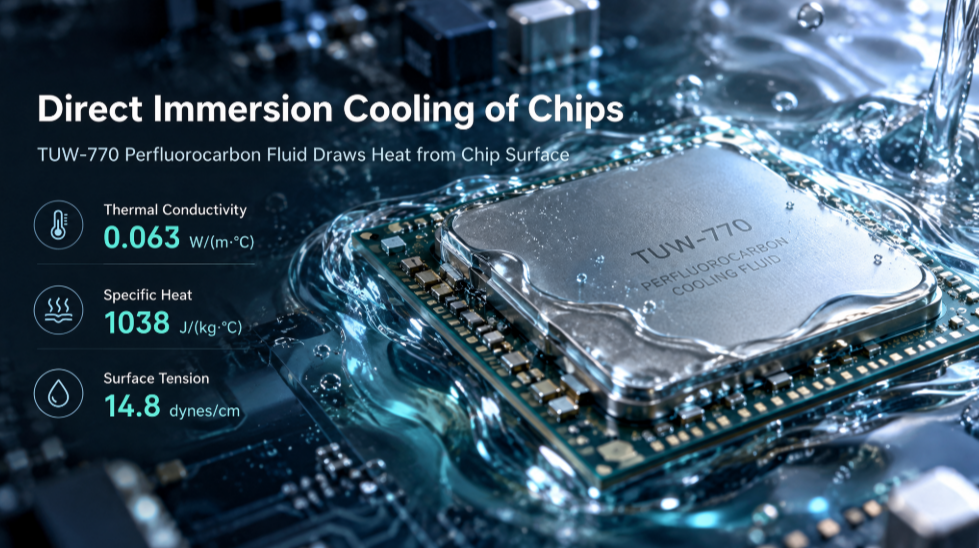
In a supercomputer cabinet, a single CPU may draw more than 500 W, and dozens of chips in one cabinet run at full load at the same time, giving a total power density 5 to 10 times that of an ordinary data center. Military electronics are even more extreme: a computer inside a tank must work in a cabin from -40°C to +85°C, and electronics inside a missile must withstand aerodynamic heating above 125°C.
These scenarios share one thing in common: extremely high requirements on cooling reliability, where overheating means mission failure or even loss of the equipment. Conventional cooling media will either freeze, boil or chemically decompose under such extreme conditions. TUW-770 perfluorocarbon fluid is designed for scenarios in which nothing may go wrong.
1. What Positioning TUW-770 Occupies
1.1 A Perfluorocarbon Fluid Positioned Against FC-770
TUW-770 is benchmarked against 3M Fluorinert FC-770 and belongs to the perfluorocarbon (PFC) family. Its positioning is not the best cost-performance ratio, but stable reliability across an extreme temperature range and harsh chemical environments.
1.2 Why PFC Instead of HFE
As a perfluorocarbon fluid, TUW-770 has a pour point as low as -127°C and a boiling point of 95°C at atmospheric pressure, covering the entire liquid-phase working range from extreme cold start to high-temperature full load. Why not use hydrofluoroether? Because although HFE has a low GWP, it is inferior to PFC in extremely wide temperature ranges and long-term high-temperature stability. Military and supercomputing customers are willing to pay a premium for absolute reliability.
2. Core Advantages of PFC in Extreme Scenarios
Table 1 Core performance of PFC in extreme scenarios
|
Property
|
TUW-770 performance
|
Why it matters
|
|
Chemical inertness
|
Reacts with almost no material; compatible with most metals, plastics and elastomers
|
No corrosion of chips, solder joints or seals in long-term contact
|
|
Temperature adaptability
|
Pour point -127°C, boiling point 95°C, stable liquid over a wide range
|
Works from cold start to high-temperature full load
|
|
Electrical insulation
|
Dielectric strength >40 kV (0.1 inch gap), dielectric constant 1.9, resistivity >3×10¹⁴ ohm·cm
|
Direct contact with live components without short-circuit risk
|
|
Thermal stability
|
Strong carbon-fluorine bonds, calculated critical temperature 238°C, no decomposition at sustained high temperature
|
No performance degradation after years of continuous operation
|
|
Safety
|
No flash point, non-flammable, ODP=0
|
Very low fire risk around high-power equipment
|
3. Application in Supercomputers
3.1 Direct Contact Cooling: A Shorter Heat Transfer Path
Many of the top supercomputers on the TOP500 list use direct contact cooling, in which CPUs and accelerator cards are immersed directly in the cooling fluid. This approach offers the shortest heat transfer path and eliminates local hot spots that air cooling cannot address.
3.2 Immersion Heat Transfer for Chips, Power Modules and Memory
The role of TUW-770 in supercomputers: direct immersion heat exchange for CPUs and GPUs, where heat from the chip surface is carried away by the liquid; heat dissipation for power modules (VRM), eliminating local hot spots on the MOSFETs that supply the graphics card; cooling of server memory and network cards, the corners that air cooling cannot reach at high density.
In terms of data, TUW-770 has a thermal conductivity of 0.063 W/(m·°C) and a specific heat of 1038 J/(kg·°C); combined with a kinematic viscosity of only 0.79 cSt and a low surface tension of 14.8 dynes/cm, it quickly penetrates the fine gaps between chips and heat sinks and removes local hot spots as well. A supercomputer runs at full load 365 days a year, and the cooling medium must not fail midway. The thermal stability and chemical inertness of PFC are a necessity here, not a bonus.
4. Application in Military Electronics
4.1 Four Types of Extreme Environments Facing Military Electronics
The working environment of military electronics is far harsher than that of commercial products: cabin temperatures of -40°C to +85°C with severe vibration in tanks and armored vehicles; rapid switching from high-altitude cold to aerodynamic heating in airborne equipment; high salt fog and high humidity for shipborne equipment; dust, moisture and salt fog protection for field communication vehicles.
4.2 The Cooling Medium Itself Must Not Become a Failure Source
The wide temperature range and chemical inertness of TUW-770 mean that, in these environments, the cooling medium itself will not become a failure source. A device may fail because a chip or a sensor has failed, but never because the coolant froze or the coolant corroded the piping. The extremely low pour point of -127°C ensures reliable cold-start operation, and the absence of a flash point provides a safety margin in high-temperature and battle-damage scenarios.
5. Extended Applications in Semiconductor Equipment
Beyond supercomputing and military applications, TUW-770 is also used for: constant-temperature cooling of semiconductor etch tools and ion implanters (for higher temperature requirements, see TUW-3283 and TUW-40); cooling of high-voltage transformers and high-power power electronic devices; high- and low-temperature media for thermal shock test baths; heat dissipation for power amplifiers in radar and RF equipment. With a stable liquid phase at a 95°C boiling point and a low surface tension of 14.8 dynes/cm, it is also suitable for drying and cleaning precision components, and can be recycled through distillation.
6. A Balanced View of PFC Limitations
Two limitations of PFC fluids should be stated frankly:
6.1 Higher GWP and Discontinued Overseas Models
First, GWP is relatively high. The global warming potential of perfluorocarbon fluids is typically an order of magnitude higher than that of hydrofluoroethers. Some overseas PFC models have already been discontinued or had output restricted. If your application has strict carbon emission requirements, HFE alternatives should be evaluated.
6.2 Higher Price, but Reliability Comes First
Second, the price is higher. Raw materials and manufacturing costs for PFC exceed those of HFE. But for scenarios such as supercomputing and military applications, the cost of the medium accounts for a very small share of the whole system, and reliability comes first.
7. The Value of Domestic TUW-770
Against the background of tightening supply of overseas FC-770, the value of domestic TUW-770 lies in: stable supply, produced domestically and unaffected by overseas discontinuation; short lead times, deliverable in weeks without waiting months for sea freight; fast technical service response, with local teams able to support on site; controllable cost, with import intermediaries removed.
For long-cycle military projects and supercomputing center construction, it is advisable to evaluate domestic substitution early and establish dual supply sources. Shenzhen Huayi Brothers focuses on the supply of electronic fluorinated fluids and fluorine-containing functional liquids, providing customers with product documentation, sample testing and application discussions. For sample testing, please contact us.
From Thermal Shock to Package Leak Testing: A Detailed Look at TUW-3283 in Electronic Reliability Verification
Can't Get PCBA Flux Residue Clean? A Complete Comparison of TUW's Five Azeotropic Cleaners, from Light to Heavy
Related Article
This article introduces the product positioning and core characteristics of TUW 2704 fluoropolymer electronic coating agent, compares its differences with traditional conformal paint, and explains its applications in PCB moisture and corrosion protection as well as the selection logic for scenarios such as new energy and high-density boards.
PCB Protection Solution Selection: TUW 2704 Nano Conformal Coating vs. Traditional Conformal Paint
3M has discontinued FC-3283 — how should wafer fabs choose a domestic replacement? This article details the TUW-3283 electrochemical fluorination product's parameter alignment with FC-3283, the selection logic, and a four-step switchover process to help you complete your domestic substitution smoothly.
TUW-3283 Electronic Fluorinated Fluid: A Domestic Replacement Guide for Wafer Fabs After the FC-3283 Phase-out

What's the difference between HFE and PFC? Which one to pick for cooling, cleaning, and testing? This article compares 14 TUW-series products in a single master table and gives scenario-based selection recommendations.
One Table to Rule Them All: How to Choose Between HFE and PFC — The Complete TUW Series Electronic Fluorinated Fluid Selection Guide
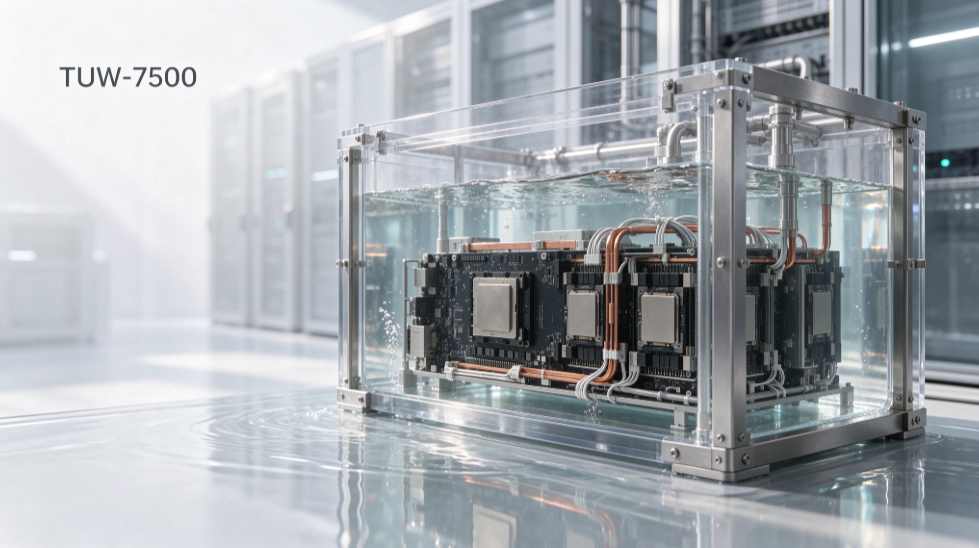
As AI server rack power density breaks 30 kW, TUW-7500 hydrofluoroether delivers a GWP of just 1, becoming the preferred medium for single-phase immersion cooling. This article details its insulating, non-flammable, and environmentally friendly properties along with deployment verification points.
AI Server Rack Power Breaches 30 kW: Why TUW-7500 Hydrofluoroether Becomes the Preferred Immersion Cooling Medium