TUW-5018/5058 and TUW-2704/1700: Selection Guide to Four Fluorinated Nanocoatings
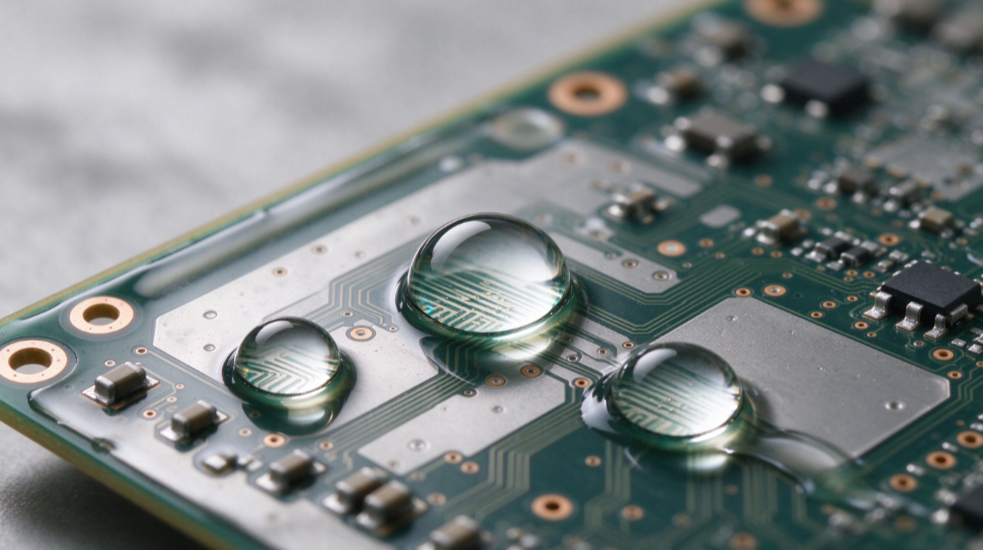
Customers ask about four coating models more often than any others: 5018, 5058, 2704 and 1700. Huayi Brothers carries a matching replacement for each one, namely TUW-5018, TUW-5058, TUW-2704 and TUW-1700. Set side by side, the four split into two schools of thinking on solids content, film thickness and process window, and they differ in price as well.
This article draws no sweeping conclusion. It answers four questions: where the physical properties differ, what problem each product solves, how to choose by project type, and what to verify before switching.
1. Where do the four products differ in physical properties?
1.1 How solids content maps to film thickness
TUW-5018 uses a colorless transparent system that takes either dip or spray application, and it suits scenarios needing a transparent appearance and uniform coverage. TUW-5058 carries 15% to 25% solids and reaches tack-free in about 30 minutes, which keeps it close to the habits of conventional conformal coating. TUW-2704 holds 4% solids at a film thickness of 0.1 to 4 microns, and TUW-1700 holds 2% solids at 0.1 to 1.0 micron.
High solids build a thick film in one pass and deliver better mechanical protection, yet they invite sagging and demand more masking. Low solids give a thin film with little thermal penalty and easy rework.
1.2 Key parameters side by side
The table below lines up solids content, film thickness, cure conditions and typical use for all four products. Choose film thickness first, then the application method, and compare cost last.
One caution: high-solids and low-solids systems call for different surface energy and pretreatment. Mix the two families on one board and the interface tends to lose adhesion.
Table 1. Key parameters of the four coatings
|
Item
|
TUW-2704
|
TUW-1700
|
TUW-5018
|
TUW-5058
|
|
System
|
Fluoropolymer + HFE
|
Fluoropolymer + HFE
|
Fluorine coating system
|
Fluorine coating system
|
|
Solids content
|
4 wt%
|
2 wt%
|
Per TDS
|
15%-25%
|
|
Film thickness
|
0.1-4 μm
|
0.1-1.0 μm
|
Thin film
|
Thin film (relatively thicker)
|
|
Tack-free / cure
|
No cure required
|
No cure required
|
Per process instructions
|
Tack-free in about 30 min
|
|
Dry-film heat resistance
|
175℃/24 h
|
175℃/24 h
|
Per TDS
|
Per TDS
|
|
Application
|
Spray, dip, selective coating
|
Spray, selective coating
|
Dip, spray
|
Dip, spray
|
|
Appearance
|
Transparent
|
Transparent, near-invisible
|
Colorless transparent
|
Colorless transparent
|
|
Positioning
|
Automotive grade, high protection
|
Consumer electronics, invisible protection
|
General board-level protection
|
Higher protection level, volume coating
|
Note: confirm heat resistance, insulation and film thickness for each model against the corresponding TDS and measured data.
2. What problem does each product solve best?
2.1 TUW-5018 and TUW-5058
The transparency of TUW-5018 suits appearance-critical parts and the area around display modules, and it also fits any case where the coating coverage needs inspection. TUW-5058 pairs high solids with a fast tack-free time, so it fits board-level protection on simple structures that need a certain film thickness.
Both products follow the logic of replacing conventional conformal coating: similar application methods and minimal change to the production line.
2.2 TUW-2704 and TUW-1700
TUW-2704 spans a wide film-thickness range, needs no cure and withstands 175 degrees Celsius, which suits automotive control boards and power modules that must balance heat dissipation against protection. TUW-1700 goes down to 0.1 micron and fits oil isolation on consumer electronics modules.
Both products follow a subtractive logic: they do not chase thickness, they solve the problem at the interface.
3. How do you choose by project type?
3.1 Trade-offs across three project types
For board-level protection where the line keeps brushing or dip coating, choose TUW-5058 or TUW-5018 first. For high power density, heat-sensitive designs with many connectors, choose TUW-2704 first. For module-level, ultra-thin, oil- and liquid-resistant work, choose TUW-1700 first.
When a project carries both board-level and module-level needs, do not force one product to cover everything. Two products in separate zones work more reliably.
3.2 Selection table
The table below recommends a product and matching process for each project type. Cost is not the only variable: count process steps, masking hours and rework cost as well.
When you total the cost, fold in masking hours, oven energy, rework hours and yield loss. Many projects find the thin coating cheaper once they run the full sum.
Table 2. Selection by project type
|
Project type
|
First choice
|
Backup
|
Rationale
|
|
Automotive ECUs, BMS, OBC
|
TUW-2704
|
TUW-5058
|
Needs heat resistance and coverage under BGA
|
|
Phones, watches, TWS
|
TUW-1700
|
TUW-5018
|
Sensitive to appearance and tolerances
|
|
Industrial control boards, power modules
|
TUW-5058
|
TUW-2704
|
Protection level first, low appearance demand
|
|
Small batches, many variants, irregular boards
|
TUW-5018
|
TUW-1700
|
Dip coating delivers high coverage
|
|
Brand model specified by the customer, benchmark data required
|
Map one-to-one to the brand model
|
—
|
Same-family benchmarking, certification and customer spec constraints
|
|
Cost-sensitive volume production
|
TUW-5018/TUW-5058
|
TUW-1700
|
Unit price and supply stability
|
Note: projects exported to the EU must also confirm the compliance statement of the coating system.
4. What should you verify before switching?
4.1 Four verification items
Adhesion: run a cross-cut or pull-off test to confirm bonding to the substrate and to any existing coating interface.
Coverage integrity: use fluorescence or UV inspection to find blind spots, shadowed areas and the base of connectors.
Electrical performance: measure insulation resistance and withstand voltage to confirm you introduce no leakage path.
Reliability: retest after 85/85 damp heat and thermal cycling, and watch for cracking, delamination and discoloration.
4.2 Switching sequence
Start with a small comparison batch on the same line, and put film thickness, coverage and yield for both products in one table. Then pick one model for volume ramp and keep the other as backup.
The dependable way to bring a replacement in is dual sourcing: run the volume-proven model as primary and the other product in the same family as backup, so a single source never becomes a single point of failure.
Shenzhen Huayi Brothers specializes in electronic fluorinated liquids and fluorinated functional fluids. For sample testing or selection advice on a specific process, use the consultation button on the right.
Rack Power Above 100 kW: Why TUW-7500 Hydrofluoroether Works as an Immersion Cooling Medium
Related blog