TUW-770 Perfluorocarbon Fluid: Direct-Contact Cooling with Very Low Temperature Start-Up and High Dielectric Withstand
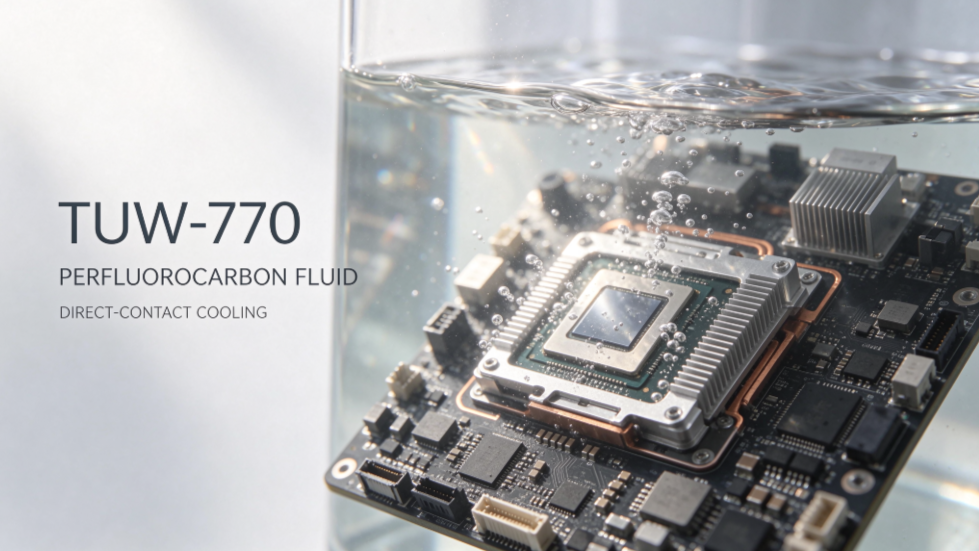
Low-temperature machine rooms, high-altitude and field deployments of military equipment, and the local hot spots created by high power density push the coolant towards two extremes: it must still flow tens of degrees below zero, and it must still insulate at tens of kilovolts. TUW-770 perfluorocarbon fluid sits exactly in that intersection, with a pour point of -127 °C and dielectric strength above 40 kV, combined with non-flammability, chemical inertness and very low viscosity.
The sections below cover the selection logic, product advantages, technical data, applications, system configuration and selection limits.
1. Why HPC and Military Electronics Need This Class of Fluid
1.1 Cold start cannot stop, high voltage cannot leak
HPC clusters may run in low-temperature machine rooms, at altitude or in polar environments. If the cooling loop solidifies or its viscosity spikes at low temperature, the pump overloads, flow drops and hot-spot temperatures run away. The fluid has to stay pumpable tens of degrees below zero.
Military electronics, by contrast, often place high-voltage components inside sealed enclosures. Space is tight, there is no room for large electrical clearances, and the fluid itself has to carry the insulation duty. Insufficient dielectric strength or volume resistivity brings leakage, creepage and breakdown.
Few fluids satisfy both ends. A low pour point demands a regular molecular structure with little tendency to crystallise; high insulation demands a non-polar, high-purity medium with low water content. Perfluorocarbon fluids fall naturally into that intersection.
1.2 Non-flammability and inertness decide whether the system passes certification
On ships, in vehicles and inside sealed cabinets, the flammability of the medium directly determines whether the system passes safety certification. Perfluorocarbon fluids do not burn and do not oxidise; in long-term contact with metals, engineering plastics and elastomers they neither leach nor corrode, which keeps the design envelope clear.
2. Six Core Advantages of TUW-770
-
Extreme low-temperature flow: a pour point of -127 °C covers every ground-level and high-altitude low-temperature environment; cold starts need no concern about solidification blocking the loop, which is what makes low-temperature immersion and cold-plate circuits practical.
-
Dielectric headroom: dielectric strength >40 kV, dielectric constant 1.9 and volume resistivity >3×10¹⁴ Ω·cm leave safe spacing even when high-voltage parts sit close together, and allow direct immersion of power devices and high-voltage modules.
-
Low viscosity, low pumping power: 0.79 cSt kinematic and 1.359 cP absolute viscosity mean low flow resistance, high circulation rates and passage through microchannels and narrow gaps, so hot-spot heat is removed quickly.
-
Non-flammable, no flash point, zero ODP: sealed cabinets, ship and vehicle environments pass safety review directly, and the fluid carries no ozone-depletion liability.
-
Chemical inertness and low hygroscopicity: water solubility of only 14 ppmw keeps moisture under control in long service, so insulation does not degrade through slow moisture uptake; no corrosion of metals or plastics keeps fluid properties stable over the service life.
-
Low surface tension: 14.8 dyn/cm wets strongly, filling porous structures and component gaps and preventing local heat-transfer dead zones.
3. Key Technical Parameters
Table 1 lists the full property set. When selecting, check three groups first: the pour point sets the low-temperature limit, the dielectric values set the safety margin, and the 25 °C vapour pressure governs system pressure and evaporation control. Treat the rest as design inputs.
Table 1 Main technical parameters of TUW-770
|
Parameter
|
Value
|
|
Average molecular weight
|
399 g/mol
|
|
Appearance
|
Colourless, transparent
|
|
Boiling point (1 atm)
|
95 °C
|
|
Pour point
|
-127 °C
|
|
Critical temperature (calculated)
|
238 °C
|
|
Vapour pressure (25 °C)
|
6.568×10³ Pa
|
|
Latent heat of vaporisation (at boiling)
|
85.9 J/g
|
|
Liquid density
|
1793 kg/m³
|
|
Kinematic viscosity
|
0.79 cSt
|
|
Absolute viscosity
|
1.359 cP
|
|
Liquid specific heat
|
1038 J/(kg·°C)
|
|
Liquid thermal conductivity
|
0.063 W/(m·°C)
|
|
Surface tension
|
14.8 dyn/cm
|
|
Water solubility
|
14 ppmw
|
|
Dielectric strength (0.1 in gap)
|
>40 kV
|
|
Dielectric constant (1 kHz)
|
1.9
|
|
Resistivity (ASTM D-257)
|
>3×10¹⁴ Ω·cm
|
|
ODP / flash point
|
0 / none
|
Note: typical values; refer to the TDS and the batch COA.
At 95 °C the boiling point is mid-range among perfluorocarbon fluids, so the fluid evaporates fairly quickly in an open environment. The system must therefore be built as a sealed loop with condensation recovery, otherwise make-up costs rise noticeably. The same boiling point brings a convenience: two-phase boiling heat transfer works at atmospheric pressure without extra pressurisation.
4. Typical Applications
TUW-770 fits where three conditions hold at once: low temperature, high insulation and direct contact. The table below gives the application, the way it is used and the value it delivers.
Table 2 Typical applications of TUW-770
|
Application
|
How it is used
|
Key value
|
|
Supercomputers and compute clusters
|
Single-phase immersion or direct cold-plate cooling; two-phase boiling heat transfer also possible
|
Low viscosity supports high flow; high insulation lets the fluid sit against boards and power supplies
|
|
Military and aerospace electronics
|
Immersion cooling of sealed modules; cabinet-level circulation
|
Wide temperature range, non-flammable, chemically inert, passes safety certification
|
|
High-voltage transformers and power devices
|
Direct immersion
|
Dielectric strength >40 kV; smaller clearances and smaller volume
|
|
Radar and power modules
|
Local spray or cold-plate loops
|
Low surface tension wets narrow gaps; uniform hot-spot temperature
|
|
Semiconductor equipment temperature control
|
Temperature-control loops for etching, ion implantation and CVD
|
Uniform temperature without contaminating the clean environment
|
|
Thermal shock and reliability testing
|
Heat-transfer medium in thermal shock baths
|
Pour point -127 °C: no solidification in the cold stage, fast temperature transitions
|
For HPC the core requirement is flow rate and heat-exchanger type: immersion tanks care about low viscosity and insulation, cold-plate loops care about pressure drop and temperature rise. Both use the same fluid; only the pump and heat exchanger change.
For military electronics the core requirement is passing certification: non-flammability, no flash point and chemical inertness remove flammability risk and material-compatibility risk from the design.
For testing the core requirement is temperature span: a -127 °C pour point removes the need for a second fluid in the cold bath, one fluid covers the whole thermal cycle and the test data stay consistent.
Note: two-phase operation requires a pressure and condenser design check; run a small-scale test before scaling to the full loop.
5. How to Configure the System for Stable Operation
5.1 Loop and sealing
Use a fully sealed loop with an expansion tank and a condenser to control evaporation losses. Specify fluorine-resistant seals (PTFE, FFKM); ordinary nitrile rubber swells in long-term contact.
5.2 Pump and heat exchanger
Size the pump for a low-viscosity medium and check the available net positive suction head. Size the heat exchanger at 1.2 times the peak heat load to leave margin for fouling and load swings.
5.3 Insulation monitoring and cold start
Leave adequate electrical clearance in circuits near high-voltage parts, and check the dielectric strength and water content of the fluid at fixed intervals. These two readings degrade before anything else and give earlier warning than a temperature alarm.
A pour point of -127 °C means normal low-temperature environments need no preheating. Only in deep-cold duty below -80 °C is a low-flow preheating circulation advisable, letting viscosity fall before applying full load and avoiding pump overload from rising viscosity.
6. Where the Limits Are
6.1 Three unsuitable applications
-
Long-term loops above 120 °C: with a 95 °C boiling point, vapour pressure rises quickly and system pressure becomes difficult to manage; use a higher-boiling grade instead.
-
Open cleaning baths: evaporation is fast, losses and make-up are frequent and fluid cost escalates.
-
Cost-sensitive high-volume consumer applications: perfluorocarbon fluid carries a high unit price, so cost pressure is significant at large volumes.
6.2 How the models in the series divide the work
Define the temperature range first, then compare insulation and cost; the division becomes clear:
-
high-temperature loops take the higher-boiling TUW-40;
-
medium-temperature cleaning and leak testing take TUW-7200;
-
low-temperature duty with high insulation requirements is where TUW-770 applies.
Shenzhen Huayi Brothers supplies electronic fluorinated fluids and fluorinated functional fluids. For TUW-770 samples or a selection assessment for a specific process, use the consultation panel on the right.
TUW-40 High-Temperature Perfluorocarbon Fluid: -55 °C to 155 °C for Etch and Ion Implant Thermal Control
Related blog