TUW-40 High-Temperature Perfluorocarbon Fluid: -55 °C to 155 °C for Etch and Ion Implant Thermal Control
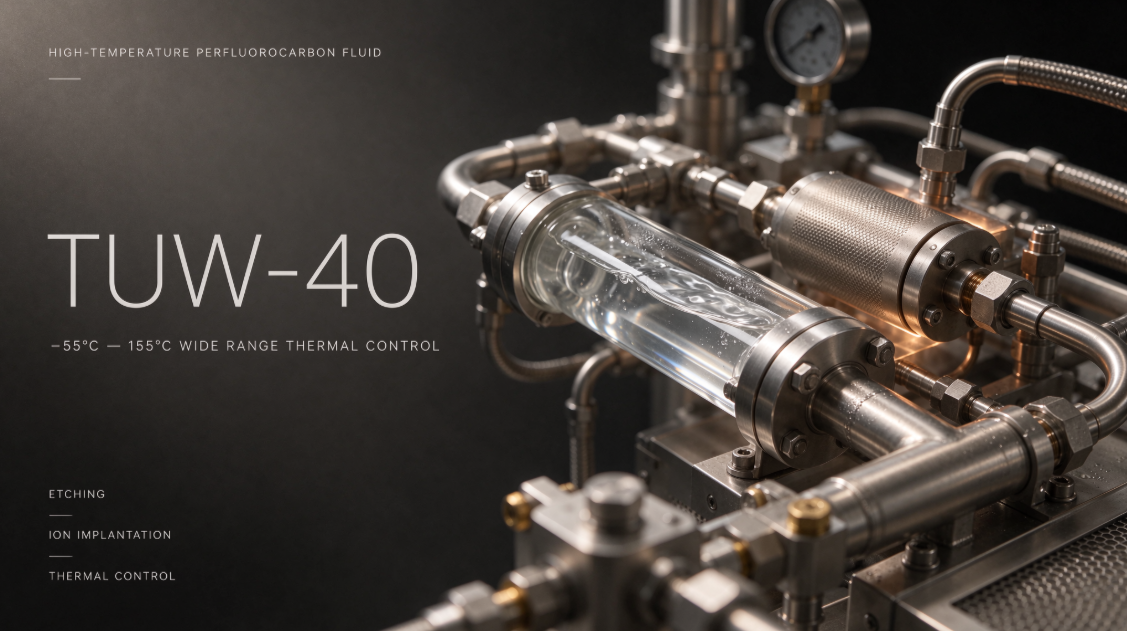
Etch tools, ion implanters and certain high-temperature test benches run their thermal control loops above 100 °C for long periods. In this duty, low-boiling hydrofluoroethers vaporise and lose stability, while ordinary coolants cannot meet both the high-temperature and the insulation requirement. That leaves high-boiling perfluorocarbon fluids as the practical option.
TUW-40 boils between 155 and 160 °C, has a pour point of -55 °C and a dielectric strength of 40 kV. This article answers four questions around it: what a high-temperature duty demands of the fluid, whether its properties are adequate, how it is used on etch and ion implant tools, and when it should not be used.
1. What does a high-temperature thermal control duty demand of the fluid?
1.1 Three hard requirements
The first is thermal stability: the fluid must circulate above 100 °C for long periods without decomposing, without coking and without an increase in acid value. The second is insulation: the loop usually contains high-voltage components, so dielectric strength and volume resistivity must keep a sufficient margin. The third is a low vapour pressure, which prevents heavy evaporation at high temperature and the pressure excursions and frequent top-up that come with it.
If any one of the three falls short, the consequence shows up as an equipment alarm, reduced heat-transfer efficiency or a collapse in insulation resistance, not as a fluid that still looks fine.
1.2 The low-temperature end cannot be ignored
When the equipment is stopped for maintenance, the loop cools to room temperature or below. If the pour point is not low enough, the fluid solidifies, blocks the piping and makes start-up difficult. A pour point of -55 °C leaves a margin for most plant environments, but outdoor equipment in cold regions still needs trace heating.
A fluid has to cover both the high and the low end before it genuinely suits a wide-temperature duty.
2. Are the properties of TUW-40 adequate?
2.1 Values of the key items
Boiling point 155-160 °C, pour point -55 °C, viscosity 3.18 cSt (5.8 cP), surface tension 12.63, density 1820 kg/m³, vapour pressure 14.6 kPa, heat of vaporisation 130 J/g, dielectric constant 3.82, volume resistivity 1.58×10¹¹ Ω·cm, dielectric strength 40 kV, molecular weight 550, GWP 175, and an NFPA flammability rating of 0.
A dielectric strength of 40 kV together with flammability class 0 is what gives it confidence in a high-temperature loop. Its viscosity of 3.18 cSt is higher than that of low-boiling media, so pump sizing has to allow for a higher shaft power. The vapour pressure of 14.6 kPa is a reminder that the system needs pressure management and cannot run wide open to atmosphere.
2.2 Main technical parameters
The table below gives the full parameter set of TUW-40. When selecting, first use the boiling point and vapour pressure to fix the pressure class of the system, then check whether the dielectric and volume resistivity values meet the safety requirements, and finally verify the pour point against the low-temperature start-up conditions.
The long-term item beyond the datasheet is thermal stability: an ageing test of more than 2000 hours at the working temperature, watching the change in acid value and dielectric strength, is the real threshold for a high-temperature loop.
Table 1 Main technical parameters of TUW-40
|
Parameter
|
Value
|
|
Chemical name
|
Perfluorinated compound (perfluoroamine)
|
|
CAS
|
86508-42-1
|
|
Boiling point
|
155-160 °C
|
|
Pour point
|
-55 °C
|
|
Density
|
1820 kg/m³ (relative density 1.82)
|
|
Kinematic viscosity
|
3.18 cSt
|
|
Absolute viscosity
|
5.8 cP
|
|
Surface tension
|
12.63 dyn/cm
|
|
Vapour pressure (25 °C)
|
14.6 kPa
|
|
Heat of vaporisation
|
130 J/g
|
|
Dielectric constant (@1 kHz)
|
3.82
|
|
Dielectric strength
|
40 kV
|
|
Volume resistivity (25 °C)
|
1.58×10¹¹ Ω·cm
|
|
Molecular weight
|
550
|
|
GWP (100-year)
|
175
|
|
Saturated water content
|
50 ppm
|
|
Flash point
|
None
|
Note: values are typical; refer to the TDS and the batch COA for specifics.
3. How is it used on etch tools and ion implanters?
3.1 The thermal control loop of an etch tool
The etch process is sensitive to temperature uniformity, and the loop usually has to hold the chamber or electrode temperature within ±1 °C of the setpoint. A high-boiling medium does not boil at high temperature and transfers heat steadily, so a plate heat exchanger together with a precision control valve keeps the fluctuation band narrow.
One point to watch is dielectric loss in a radio-frequency environment. A dielectric constant of 3.82 is on the high side compared with hydrofluoroethers, so the loop layout should avoid strong electric-field regions and be shielded where necessary.
3.2 Ion implantation and high-temperature benches
In an ion implanter the beam-line components generate concentrated heat, and fluorinated fluids are commonly used for local cooling or temperature holding. The high boiling point and low vapour pressure of TUW-40 suit a closed circulation loop and reduce top-up and vapour leakage. High-temperature test benches place more weight on the wide temperature range and on non-flammability.
The table below lists typical applications and how the fluid is used in each. Loop structures differ considerably between machines, so flow rates and heat exchanger types must be confirmed with the equipment maker rather than copied from another line.
Table 2 Typical applications of TUW-40
|
Application
|
Use
|
Value
|
|
Plasma etch equipment
|
Chamber, electrode and ESC cooling
|
Low evaporation at high temperature, stable temperature
|
|
Ion implantation equipment
|
Beam-line component and target chamber cooling
|
Insulating and chemically inert, no vacuum contamination
|
|
Inspection and metrology equipment
|
Constant-temperature stages, optical modules
|
Uniform temperature, no long-term deposition
|
|
High-temperature reliability testing
|
Thermostatic baths, thermal shock baths
|
Covers -55 to 155 °C, direct contact with the device under test
|
|
Package leak and insulation testing
|
Immersion leak detection, withstand-voltage test medium
|
Non-conductive, non-corrosive, easy to observe
|
Note: in high-temperature operation, confirm the long-term tolerance of the pump, seals and piping materials at that temperature.
4. When should TUW-40 not be selected?
4.1 Three unsuitable duties
Cleaning lines that need rapid drying: the boiling point is too high, evaporation is slow and the drying cycle is dragged out.
Projects with a hard GWP threshold: a GWP of 175 is relatively high and may fail review.
Outdoor equipment with frequent cold starts: a pour point of -55 °C combined with high viscosity means high start-up resistance.
4.2 Alternatives and complementary selection
For low-temperature duty, choose a grade with a lower pour point; for medium-temperature cleaning, a hydrofluoroether with a lower boiling point; for GWP-sensitive projects, a low-GWP medium. The place of a high-boiling perfluorocarbon fluid is clear: high-temperature, closed loops with demanding insulation requirements.
Write down the three conditions first - duty temperature, pressure class and insulation requirement - and the selection stops swinging back and forth.
Shenzhen Huayi Brothers focuses on electronic fluorinated fluids and fluorine-containing functional liquids. For sample testing or selection advice for a specific process, please use the consultation panel on the right.
How to Verify the Replacement of Electrolytic Perfluorocarbon Fluids: Five Indicators for TUW-3283 in Semiconductor Temperature Control Loops
Related blog