TUW-7300 Electronic Fluorinated Fluid: 98 °C Boiling Point and Over 25 kV Insulation, How to Balance Thermal Management and Cleaning
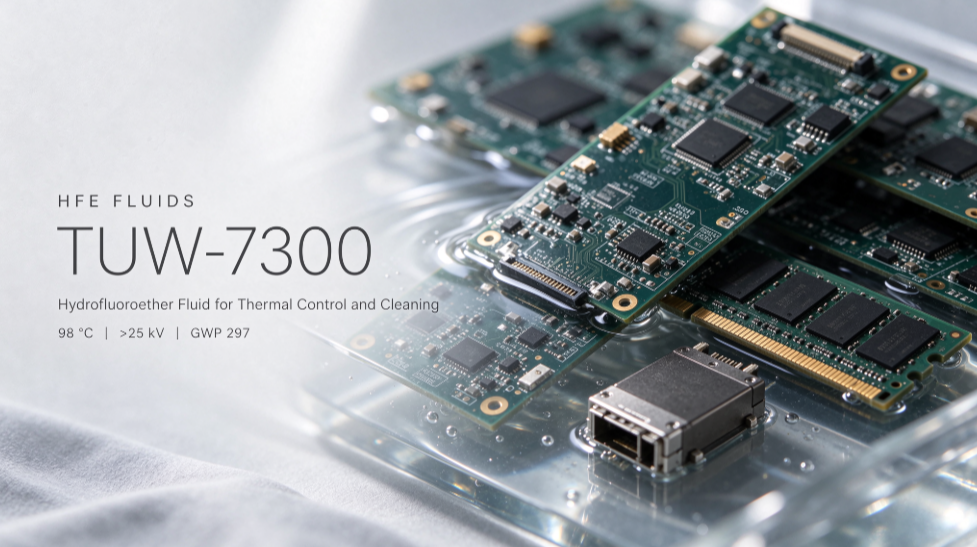
Choosing a fluorinated fluid often involves a trade-off: low-boiling liquids dry fast and clean efficiently, but offer limited insulation margin and high-temperature stability; high-boiling liquids insulate well and are thermally stable, but volatilize slowly and leave residues that are hard to handle.
TUW-7300 sits at a 98 °C boiling point with dielectric strength above 25 kV, which points to an attempt to balance the two. This article answers only four questions: what 98 °C means for thermal management and for cleaning, what level its physical properties reach, which line it belongs on, and when to choose another grade.
1 What does a 98 °C boiling point mean for thermal management and cleaning?
1.1 For thermal control loops: margin and thermal stability
Fluid in a thermal control loop usually runs in a closed circuit. What sets the ceiling is thermal stability and dielectric performance; the boiling point serves mainly as a reference for safety margin. At 98 °C the liquid does not boil under normal conditions in an atmospheric-pressure loop, so the system need not be designed as a pressure vessel and there is more freedom in choosing piping and pumps.
Adequate margin brings a second benefit: when a local hot spot spikes briefly, the liquid does not vaporize at once and form a vapor lock, so heat transfer is not interrupted.
1.2 For cleaning: drying cycle and residues
A 98 °C boiling point is higher than that of low-boiling cleaners, so volatilization is slower and the drying cycle needs hot air or vacuum assistance. The upside is fewer make-up additions, less odour and less loss in an open tank, which suits batch cleaning stability better.
For blind holes and multi-layer structures, slower volatilization is an advantage: the liquid has time to penetrate, and the residue can then be driven out by heating, leaving fewer white marks.
2 How good are the insulation and thermal properties of TUW-7300?
2.1 Four decisive indicators
Dielectric strength above 25 kV, dielectric constant 6.1, density 1.6 and specific heat 1.14 together with a kinematic viscosity of 1.18 mm²/s determine heat transfer capability in medium heat-flux loops. A pour point of -38 °C means low-temperature environments carry a freezing risk; outdoor installations in cold regions need trace heating or thermal insulation.
Molecular weight 350 and GWP 297 are items checked in compliance review. Compared with low-GWP media this value is on the high side; where a customer has a hard GWP threshold, this becomes a limiting factor.
2.2 Key features and the advantages they bring
The table below maps each feature of TUW-7300 to the problem it solves. In selection, first check whether the operating temperature ceiling and insulation requirements are covered, then check low-temperature start-up conditions against the pour point. A feature table only marks the capability boundary; material compatibility and ageing tests are still required before running the fluid on equipment, especially acid value changes under long-term high-temperature cycling.
Table 1 Key features of TUW-7300 and the advantages they bring
|
Feature
|
Specifics
|
Advantage
|
|
Non-flammable, no flash point
|
No flash point; hydrofluoroether (HFE) chemistry
|
Safe to use near live parts and heat sources, with no fire or deflagration risk
|
|
Ample insulation margin
|
Dielectric strength >25 kV; dielectric constant 6.1
|
Can contact live parts such as power supplies, busbars and optical modules directly; non-conductive over long cycling and no precipitation
|
|
No boiling at high temperature under atmospheric pressure
|
Boiling point 98 °C; pour point -38 °C
|
The loop need not be designed as a pressure vessel; brief hot-spot spikes do not vaporize into a vapor lock, so heat transfer continues
|
|
Fast heat-transfer response
|
Specific heat 1.14 J/(g·°C); kinematic viscosity 1.18 mm²/s; density 1.6 g/mL
|
Low viscosity keeps pumping power down; stable heat transfer in medium heat-flux loops; small vapor space in immersion service
|
|
Very low surface tension
|
15 mN/m
|
Penetrates micro-gaps, blind holes and multi-layer structures, leaving no cleaning blind spots
|
|
No residue after volatilization
|
Moderate solvency; dries on evaporation
|
No second rinse and no white marks; suits precision and optical parts
|
|
Good material compatibility
|
Chemically inert; stable with aluminium, copper and most plastics (confirm by immersion test)
|
Small acid value change under long-term hot cycling; fewer fluid changes and less piping corrosion
|
|
Environmental compliance
|
ODP 0; GWP 297
|
Does not deplete the ozone layer and passes routine compliance review; GWP is not the lowest tier, so customers with a hard threshold need another grade
|
|
Controllable medium-temperature drying cycle
|
Boiling point 98 °C, with ultrasonic, filtration and distillation recovery
|
Fewer make-up additions in open tanks, less odour and loss; high batch-to-batch cleaning consistency
|
Note: typical values; refer to the TDS and batch COA for specifics.
3 Should it go into a thermal loop or a cleaning tank?
3.1 When to prioritise the thermal loop
When the equipment contains live parts, the loop temperature is in the 60 to 90 °C range and long service life with few fluid changes is required, the insulation margin and thermal stability of TUW-7300 fit better. Its low viscosity also keeps pumping power under control.
If the loop contains aluminium, copper and various plastics, run an immersion test first to confirm there is no precipitation or discoloration.
3.2 When to prioritise a cleaning tank, and the supporting setup
When the contaminants are mainly medium-polarity oils and flux, and the line can accept a slower drying cycle, the fluid can serve as the main cleaning medium. In that case pair it with ultrasonics, filtration and distillation recovery, and control water content and particles.
The table below lists typical applications and the supporting setup, so process conditions can be compared directly.
Table 2 Typical applications of TUW-7300
|
Application
|
How it is used
|
Why it fits
|
|
Semiconductor and display equipment thermal control
|
Closed loop cooling of chambers, power supplies and optical modules
|
Insulation, chemical inertness and wide temperature coverage
|
|
Medium-temperature precision cleaning
|
Immersion, ultrasonic, spray
|
The 98 °C boiling point gives a wider vapour zone and a stable drying cycle
|
|
Lubricant deposition carrier
|
Dissolve the lubricant, apply the coating and let the solvent evaporate
|
Moderate solvency and no residue after evaporation
|
|
Electronic testing and burn-in
|
Thermal control medium on test benches
|
Non-conductive and no deposits build-up over time
|
|
Optical and precision parts cleaning
|
Manual wiping or ultrasonic
|
Low surface tension penetrates micro-gaps
|
Note: where the process also demands strong solvency (heavy oils, polishing pastes), pair this grade with an azeotropic cleaning grade.
4 When to choose it and when to choose another grade
4.1 Three signals that it fits
Operating temperatures are moderate, atmospheric-pressure operation is required and insulation margin is ample.
Cleaning and thermal management need to share one medium on the same shop floor, so fluid inventory and records stay simple.
Make-up frequency and evaporation loss are the current pain points.
4.2 Three cases for switching grades
For lines that need fast drying, choose a lower-boiling hydrofluoroether; for high-temperature loops above 120 °C, choose a high-boiling perfluorinated compound; where the customer has a strict GWP threshold, choose a lower-GWP grade.
Settle these three points before discussing price and lead time, and the cost of reworking and replacing fluid after a wrong choice is avoided.
Shenzhen Huayi Brothers specialises in electronic fluorinated fluids and fluorine-based functional liquids. For sample testing or grade selection for a specific process, please contact us.
TUW-7200 Electronic Fluorinated Liquid: An Alternative to Novec 7200, One Fluid for Cleaning, Leak Testing and Thermostatic Baths
Related blog