TUW-7200 Electronic Fluorinated Liquid: An Alternative to Novec 7200, One Fluid for Cleaning, Leak Testing and Thermostatic Baths
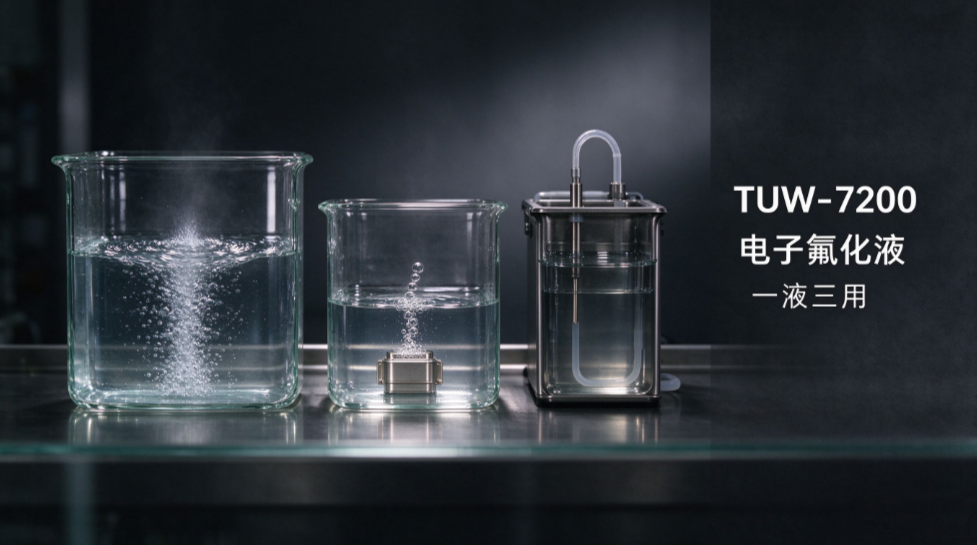
On a production line, the cleaning tank, the leak-test tank and the thermostatic bath usually each use a different fluid: modified alcohol or a hydrofluoroether for cleaning, a low-surface-tension fluid for leak testing, and a high-boiling medium for the bath. Three fluids mean three sets of records, three fluid changes and three waste streams.
TUW-7200 comes up for discussion because its boiling range, surface tension and dielectric performance all sit inside the intersection of the three applications. This article answers four questions: why one fluid can serve three uses, where its property limits lie, how it is run in each of the three processes, and what has to be controlled when a single fluid is shared.
1 Why can one fluid handle cleaning, leak testing and thermostating?
1.1 What each application actually requires
Cleaning calls for solvency and penetration: only a low surface tension reaches into slits and blind holes, and only a moderate boiling point dries quickly without evaporating too fast. Leak testing calls for low surface tension plus stable viscosity and wetting behaviour, so the fluid enters a tiny leak path and leaves a visible seep or bubble at the leak point. A thermostatic bath calls for a boiling point high enough, a viscosity that changes gently with temperature, and adequate specific heat, so that bath temperature stays stable.
All three share the same requirements: low surface tension, chemical inertness and non-conductivity. That is exactly the property base of hydrofluoroether fluids; the differences lie only in the chosen boiling point and solvency.
1.2 Where the requirements overlap
TUW-7200 has a boiling range of 76 °C, dielectric constant 7.3, dielectric strength 40 kV, surface tension 13.63 mN/m, density 1.42, viscosity 0.58 mm²/s, pour point -138 °C, GWP 55 and thermal conductivity 0.075 W/(m·K). Its boiling point sits in the mid-to-low range: it does not evaporate as fast as a low-boiling fluid, nor is it as hard to dry as a high-temperature medium.
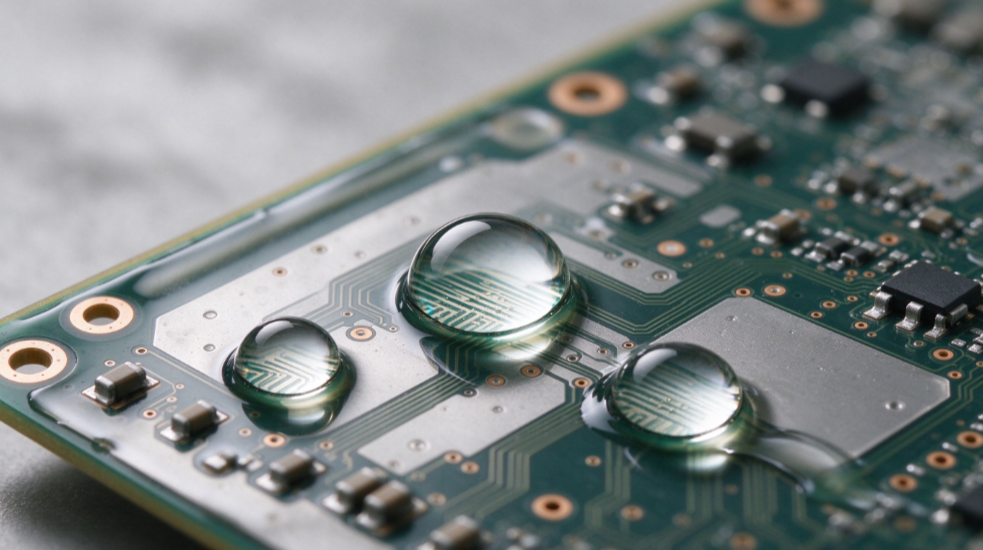
A surface tension of 13.63 mN/m is clearly below that of water, and its penetration into micro-cavities is sufficient to support both leak testing and cleaning.
2 Where do the property limits of TUW-7200 lie?
2.1 Conditions it can handle
Mid-to-low temperature cleaning, rapid drying of electronic parts, hermeticity leak testing and thermostatic circulation from ambient to moderate temperature all fall inside its window. The low viscosity of 0.58 mm²/s keeps pumping and circulation losses small, and a pour point of -138 °C means it will not solidify in low-temperature environments, which suits plants in cold regions and low-temperature test stations.
With a dielectric strength of 40 kV and a dielectric constant of 7.3, it can contact live parts directly for cleaning and leak testing, without cutting the power or dismantling first.
2.2 Key technical parameters
The table below lists the main parameters of TUW-7200. When selecting, confirm the operating temperature range and the contaminant type first, then check whether the dielectric values meet the applicable safety requirements.
One point needs stating: a boiling range of 76 °C means the fluid evaporates faster in an open tank than a high-boiling medium. Open use therefore needs vapour recovery or a lid, otherwise top-up frequency rises noticeably.
Table 1 Key technical parameters of TUW-7200
|
Parameter
|
Value
|
|
Chemical class
|
Hydrofluoroether (HFE)
|
|
CAS
|
163702-06-5
|
|
Boiling range
|
76 °C
|
|
Appearance
|
Colourless liquid
|
|
Dielectric constant (@1 kHz)
|
7.3
|
|
Dielectric strength
|
40 kV
|
|
Surface tension
|
13.63 mN/m
|
|
Density
|
1.42 g/mL
|
|
Specific heat (@25 °C)
|
1.22 J/(g·°C)
|
|
Thermal conductivity
|
0.075 W/(m·K)
|
|
Kinematic viscosity (23 °C)
|
0.58 mm²/s
|
|
Pour point
|
-138 °C
|
|
Average molecular weight
|
264
|
|
Flash point
|
None
|
|
ODP / GWP
|
0 / 55
|
Note: values are typical; refer to the TDS and the batch COA.
3 How is it used in each of the three processes?
3.1 Cleaning and drying window
Cleaning is normally combined with ultrasonics or spraying: an ultrasonic frequency around 40 kHz works well on narrow slits, and holding the temperature at 35 to 45 °C raises solvency without excessive evaporation. After cleaning, take the part out and dry it a second time in the vapour zone or a hot-air zone, so that no fluid remains in blind holes to form white marks.
For the three contaminant types, flux, oil and particles, the solvency of TUW-7200 is moderate. Heavy oil contamination is better handled with a pre-treatment step or an azeotropic cleaning grade; do not try to compensate by extending the immersion time.
3.2 Leak testing versus bath operation
Leak testing usually uses immersion or the pressure-decay method: the low surface tension lets the fluid enter micro-holes, and a leak appears as a continuous stream of bubbles or a seep mark, which is easy to judge visually. A thermostatic bath, by contrast, needs a circulation pump and temperature control; match the bath volume to the thermal capacity of the load, or the temperature will collapse once the load is immersed.
The table below gives operating points and cautions for the three application types; the same fluid needs quite different supporting arrangements in each of them.
Table 2 Three applications of TUW-7200
|
Application
|
Process
|
Suitable parts
|
Cautions
|
|
Precision cleaning
|
Immersion, ultrasonic, spray, vapour degreasing
|
PCBA, connectors, optical parts, precision metal parts
|
For heavy oil contamination, pre-clean with an azeotropic grade of higher solvency
|
|
Hermeticity leak test
|
Immersion method, pressurisation with bubble observation
|
Packaged devices, connectors, sensors, seals
|
Dry or blow off with air after testing to keep residue out of blind holes
|
|
Bath medium
|
Circulating thermostatic bath, thermal shock platform
|
Chips, modules, material samples for high and low temperature testing
|
Watch moisture ingress; check acid value and water content at regular intervals
|
Note: before using one fluid across processes, confirm the cross-contamination risk; separate tanks per workstation are recommended.
4 What must be managed when one fluid is shared?
4.1 Closing the cross-contamination loop
Sharing a model does not mean sharing one tank of fluid. What actually saves cost is consolidated purchasing and stock plus a unified test method, not physically mixing three uses together.
Fluid from cleaning carries flux and particles and must not be returned straight to the thermostatic bath.
Fluid from leak testing has touched oily part surfaces; before it is returned it must be filtered and checked for water content.
For the three applications, use separate reservoir tanks and share only the fluid model at the top-up stage.
4.2 Records and fluid-change criteria
Keep a separate record for each use, logging top-up volume, water content, particles, colour and any change in cleaning result. Change or regenerate the fluid when white marks appear on cleaned parts, when leak-test sensitivity drops, or when bath temperature fluctuation grows.
Unify the criteria for all three applications into a single table, so that operators apply them the same way.
Shenzhen Huayi Brothers specialises in electronic fluorinated liquids and fluorine-based functional fluids. For sample testing or selection advice for a specific process, please use the consultation panel on the right.
Related blog