Why Your Phone Screen Stops Feeling Smooth: What AF Anti-Fingerprint Coating Does and Why It Fails
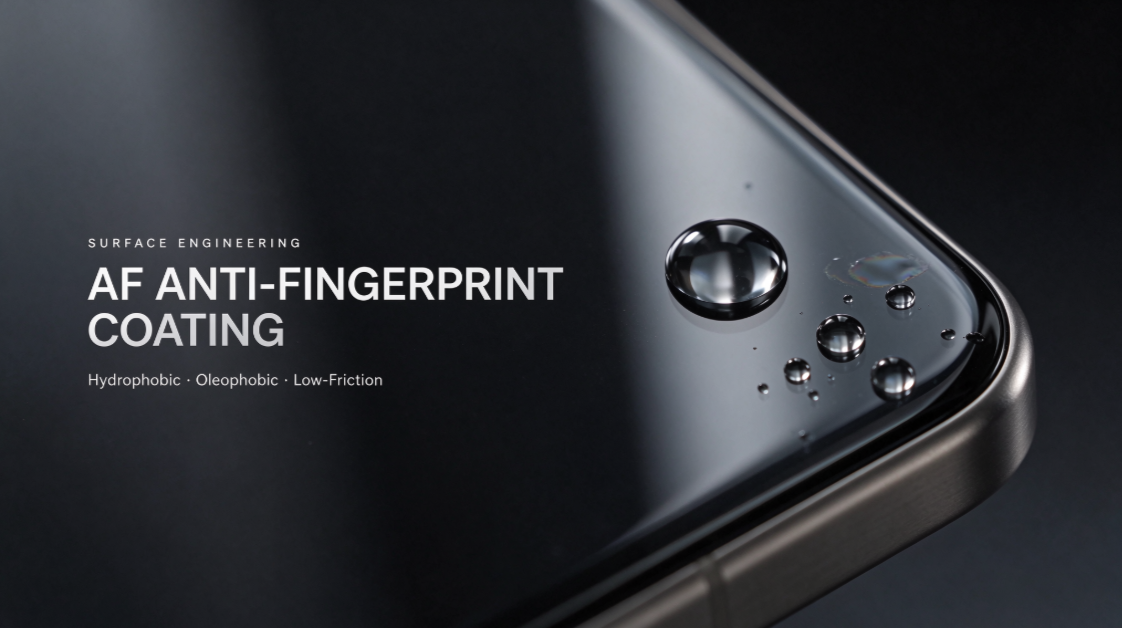
A new phone stops feeling smooth after a while: your finger drags across the glass, and sweat and oil no longer wipe away cleanly. What has worn off is the AF anti-fingerprint coating.
It is extremely thin and invisible to the eye, yet it directly determines how the screen feels and how hard it is to clean. This article covers what it actually protects against, how to read its physical parameters, how it is applied to phones, and when it fails.
1. What Does the AF Coating Actually Protect Against?
1.1 It Is Not the Fingerprint but the Trace It Leaves
The fingerprint itself wipes off easily. What is hard to remove is the oil inside it, which spreads into a film on the glass surface. Oil has a far lower surface tension than water, so it readily wets glass and adheres, forming a hazy oil layer.
The AF coating brings the glass surface energy down to a very low level, so oil and sweat form a large contact angle on it and cannot spread; one wipe takes them away. That is the real mechanism behind anti-fingerprint performance.
1.2 Smoothness Comes from the Friction Coefficient
Low surface energy also reduces the dynamic coefficient of friction, so the resistance felt by the finger drops, and that is where the smooth feel comes from. Smoothness and oleophobicity are two manifestations of the same surface property, not two separate things.
AF performance therefore cannot be judged by whether marks wipe off alone; the consistency of the sliding feel has to be assessed as well.
2. How to Read the Physical Parameters
2.1 Three Core Metrics
The water contact angle reflects hydrophobicity and the oleic acid contact angle reflects oleophobicity, and higher is better for both; lower surface energy is better; film thickness, normally at nanoscale, governs abrasion life; the dynamic friction coefficient reflects feel.
Abrasion cycles, measured with steel wool or an eraser, and the change in transmittance are also evaluated. Together these two determine whether the coating can survive the product's service life.
2.2 Typical Parameter Ranges
The table below lists industry-typical parameter ranges for AF coatings. It is intended for understanding orders of magnitude and for selection; actual values follow the supplier's TDS and measured data.
A higher contact angle is not automatically better: too high a value impairs fingerprint sensing and the adhesion of screen protectors, so projects usually balance oleophobic performance against optical and lamination requirements.
Table 1 Typical parameter ranges for AF anti-fingerprint coatings
|
Parameter
|
Typical range
|
Remarks
|
|
Film thickness
|
5-20 nm (vacuum evaporation); 10-50 nm (wet coating)
|
Varies with process and concentration
|
|
Water contact angle
|
110°-120°
|
Below 105° is generally regarded as insufficient protection
|
|
Oleic acid contact angle
|
60°-75°
|
Indicates oleophobic performance
|
|
Surface energy
|
10-15 mN/m
|
Lower means less adhesion
|
|
Dynamic friction coefficient
|
0.10-0.25
|
Affects perceived smoothness
|
|
Refractive index
|
1.35-1.40
|
Must match the substrate to limit interference colour
|
|
Curing conditions
|
120 °C/30 min or UV curing
|
Set by the material system
|
|
Adhesion
|
Cross-hatch test 5B
|
Surface preparation determines adhesion
|
|
Abrasion (reference)
|
#0000 steel wool, 1 kg load, 500-2000 cycles
|
Judged by contact-angle retention
|
|
Damp heat
|
65 °C/90 %RH, 96 hours
|
Judged by the drop in contact angle
|
Note: the ranges above are common industry values intended for selection reference; actual values follow the TDS of the product used and the measured results.
3. How Is It Applied to Phones?
3.1 Where and How It Is Applied
It is mainly applied to the outer surface of cover glass, and sometimes to lens covers, back glass and watch crystals as well. Vacuum evaporation is the mainstream process, while spraying and dip coating are used for small parts and rework.
Surface preparation decides the outcome: plasma cleaning removes organic contaminants and activates the surface so that the coating adheres evenly, and in evaporation the thickness is controlled by the amount of material and the process time, typically at nanoscale.
3.2 Application Matrix
The table below lists typical applications and how their requirements differ. Products vary in abrasion cycles and optical impact, so a single set of parameters does not fit everything.
For screen protector products in particular, the compatibility between the AF layer and OCA or UV adhesives directly affects lamination yield.
Table 2 Typical applications of AF coatings
|
Application
|
Function
|
Key concerns
|
|
Phone cover glass
|
Oil and water repellency, easy cleaning, smooth feel
|
Abrasion cycles and contact-angle retention
|
|
Tablet and laptop touchscreens
|
Fewer fingerprints, better writing feel
|
Friction matching with the stylus
|
|
Camera windows
|
Anti-smudge, stops fingerprints from affecting imaging
|
Must not reduce transmittance
|
|
Automotive centre displays
|
Resists sweat and cleaners
|
Chemical and weathering resistance
|
|
Smart locks and appliance panels
|
Anti-smudge, easy to wipe
|
Resistance to household cleaners
|
|
Optical lenses
|
Water and oil repellency, easy cleaning
|
Compatibility with the coating stack
|
Note: for components involved in optical imaging, the effect of the coating on transmittance and image quality has to be evaluated.
4. When Does It Fail?
4.1 Wear Failure
Daily wiping, pocket friction and abrasion from case edges all consume the coating. The symptoms are a falling contact angle, rising sliding resistance and oil that becomes progressively harder to wipe off.
Abrasion cycles are the direct indicator of service life, and selection should convert the product's service years and wiping frequency into a required cycle count.
4.2 Failures Caused by Process and Cleaning
Contaminated surface preparation, insufficient evaporated thickness and improper curing leave the coating deficient from the start. Strong alkaline or abrasive cleaners, and prolonged wiping with alcohol, also accelerate coating consumption.
To establish whether the coating is the problem, measure the contact angle before discussing rework; do not judge by feel alone.
Shenzhen Huayi Brothers supplies electronic fluorinated liquids and fluorinated functional fluids. For sample testing or process-specific selection, contact us through the link on the right.
TUW-770 Perfluorocarbon Fluid: Direct-Contact Cooling with Very Low Temperature Start-Up and High Dielectric Withstand
Related blog