Does Fluorinated Liquid Need Replacing After One Use? Distillation Regeneration, Moisture Control and Change-Out Criteria
At its current price, disposing of fluorinated liquid after a single use does not hold up on cost. On a real production line, the biggest cost driver is not the purchase price but change-out frequency, waste disposal, and the yield swings caused by fluid degradation.
This article answers four questions: how the liquid degrades, how far distillation regeneration can go, how moisture is controlled, and when the liquid must be changed.
1. How Does Fluorinated Liquid Degrade Bit by Bit?
1.1 Four degradation pathways
First, moisture ingress, which lowers dielectric strength and generates acidic by-products. Second, accumulation of particles and metal swarf, which blocks filters and cooling channels. Third, oils and flux dissolving into the liquid, which changes surface tension and colour. Fourth, thermal decomposition from long-term high-temperature circulation, which shows up as rising acid value and a drifting distillation range.
The four pathways usually occur together, so judging from a single indicator easily leads to a wrong call.
1.2 Telling "dirty" from "degraded"
Dirty means foreign matter has entered and can be recovered by filtration, adsorption and distillation. Degraded means the molecular structure has changed, and no regeneration will bring back the original properties. The test is simple: draw a sample, distil it and measure the key properties. If they return inside the window, the liquid is dirty; if they do not, it is degraded.
2. How Far Can Distillation Regeneration Go?
2.1 Process and recovery rate
Vacuum distillation or thin-film distillation is the usual route: lowering the boiling point avoids thermal decomposition and separates the light fraction from the heavy one. For a single product grade, recovery typically reaches 85% or more, and the remaining bottoms are disposed of as waste.
Recovery depends on pre-treatment. If there is too much particulate and oil, the liquid must be filtered and separated before distillation; otherwise it cokes and plugs the packing.
2.2 Criteria table
The table below lists the key indicators for recovery and change-out together with reference thresholds. It serves both as the acceptance criteria for regeneration and as an input to the change-out decision.
The thresholds are references only. Build your own window from the equipment maker requirements and your own historical data rather than copying someone else numbers.
Table 1 Key indicators for recovery and change-out
|
Indicator
|
Test method
|
Normal range
|
Action if abnormal
|
|
Appearance and colour
|
Visual inspection, colorimetry
|
Clear and colourless, no suspended matter
|
If turbid or discoloured, filter first, then retest
|
|
Moisture
|
Karl Fischer titration
|
≤100 ppm (per the TDS)
|
If over the limit, dry with molecular sieve or vacuum dehydration
|
|
Acid value
|
Titration
|
Neutral to slightly acidic
|
A clear rise indicates decomposition; full bath replacement is advised
|
|
Dielectric strength
|
Breakdown voltage test
|
Not below 80% of new liquid
|
If clearly lower, retest and consider change-out
|
|
Boiling / distillation range
|
Distillation analysis
|
Within 2 °C of new liquid
|
A large deviation indicates fraction drift or contamination
|
|
Particle count
|
Liquid particle counter
|
Per the process cleanliness class
|
Retest after filtration; if still over the limit, change out
|
|
Recovery rate
|
Metered in and out volumes
|
Per equipment capability
|
If unusually low, check the condenser and vacuum
|
Note: these criteria are general management guidance. Specific values must be set against the product TDS and the company internal control standard.
3. How Is Moisture Controlled?
3.1 Three control points
Inlet: do not leave drums open for long periods, and use dry transfer lines. Circulation: fit a desiccant breather or run a closed loop to keep airborne moisture out. Testing: sample on schedule, and treat the liquid once the reading approaches half of the saturation value.
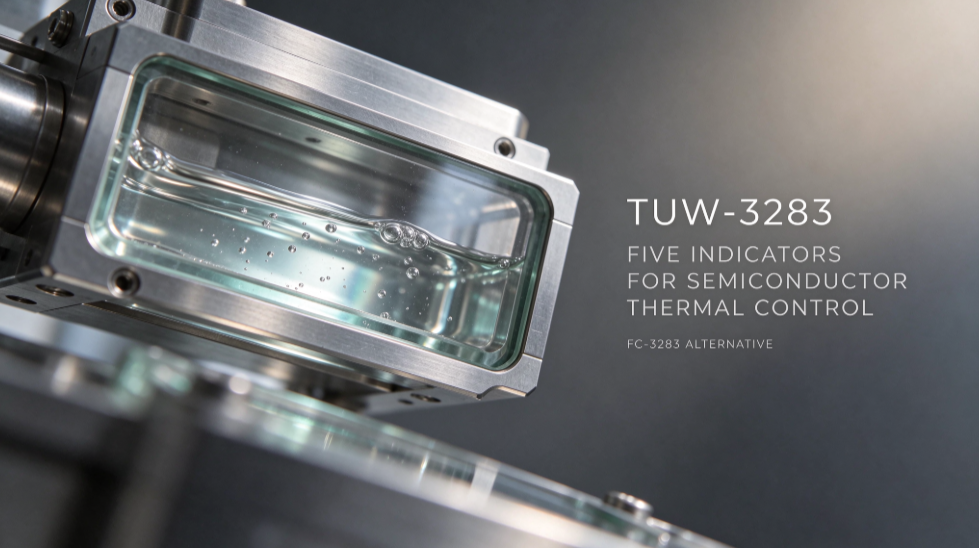
Take TUW-3283 as an example: its saturation moisture content is 50 ppm, and running practice should keep it below 10 ppm. Circuits with high insulation requirements need a tighter limit still.
3.2 Moisture removal methods
Molecular sieve, vacuum degassing and distillation all remove water. The choice depends on the water load and the downtime you can accept. Molecular sieve suits continuous in-line treatment, vacuum degassing suits batch treatment, and distillation also deals with particles and oil.
4. When Must the Liquid Be Changed?
4.1 Three hard criteria
Dielectric strength or volume resistivity falls below the lower limit required by the equipment and does not recover after regeneration.
Acid value keeps rising and the colour darkens markedly, with the distillation range drifting outside the window after distillation.
Recovery rate keeps falling and the bottoms fraction keeps rising, until the economics no longer hold.
4.2 Recovery strategy by line type
Continuously running immersion systems suit in-line bypass regeneration; batch cleaning tanks suit centralised collection and re-distillation; lines running many grades in small volumes should collect by grade to avoid mixing that makes regeneration impossible.
The table below maps line types to recovery strategy and supporting equipment. Weigh liquid volume and the cost of downtime first, then decide between in-house recovery and outsourcing.
Table 2 Recovery strategy by scenario
|
Scenario
|
Recovery method
|
Frequency
|
Points to watch
|
|
Open cleaning tank
|
In-line distillation or centralised recovery
|
Monthly
|
Keep the tank covered to reduce evaporation
|
|
Closed temperature-control loop
|
Bypass purification plus periodic change-out
|
Quarterly testing
|
Watch moisture and acid value; avoid changing out the whole bath
|
|
Immersion cooling tank
|
In-line filtration plus distilled top-up
|
Every six months
|
Monitor dielectric strength and particles to protect insulation
|
|
Leak testing and constant-temperature bath
|
Batch recovery, reused for cleaning
|
Per batch
|
Leak-test fluid carries high contamination risk; do not reuse across workstations
|
Note: before recovered liquid is used at another workstation, retest dielectric strength and moisture.
Shenzhen Huayi Brothers specialises in electronic fluorinated liquids and fluorine-based functional fluids. For sample testing or for selection against a specific process, click the link on the right to talk to us.
Related blog