AI Computing Power Surges: Is Immersion Cooling Becoming a Must‑Have for Data Centers? Full Analysis of Immersion Liquid Cooling and Electronic Fluorinated Fluids

Alternative Title: GPU Power Exceeds 700W: Why Electronic Fluorinated Fluids Are Indispensable for Immersion Liquid Cooling
The explosive growth of AI large models has pushed computing power into the spotlight, while bringing unprecedented thermal challenges to data centers. Power consumption of flagship GPUs has exceeded 700 W, and cabinet power density has soared from the traditional 8 kW to over 100 kW. Air‑cooling is reaching its physical limits for such heat loads. Liquid cooling, especially immersion liquid cooling where servers are directly “bathed” in coolant, is becoming standard for new‑build data centers. Behind this shift lies a critical engineering fluid: electronic fluorinated fluids.
1. From Air‑Cooling to Liquid Cooling: Why Thermal Management Is Evolving
As chip manufacturing processes shrink, heat flux per unit area keeps rising. Air features low specific heat capacity and thermal conductivity; air‑cooling tops out at roughly 10 W/cm² and can hardly handle high‑density heat generated by modern chips. Liquids deliver far higher specific heat capacity and thermal conductivity than air. Submerging hot electronic components in non‑conductive liquid can boost cooling efficiency by more than an order of magnitude.
Immersion liquid cooling falls into two main technical paths:
- Single‑phase immersion: The coolant stays in liquid state. Heat is removed via circulating pumps. It delivers simple system architecture and convenient maintenance.
- Two‑phase immersion: Heat is absorbed through liquid boiling and phase‑change. It offers superior cooling capacity yet comes with higher system complexity.
Regardless of the technical route, coolants must feature high dielectric insulation and zero corrosion to electronic components — this is the core advantage of electronic fluorinated fluids.
2. Why Electronic Fluorinated Fluids Are Ideal for Immersion Cooling
Electronic fluorinated fluids can make direct contact with live electronic hardware thanks to their key properties:
- Non‑conductive: High dielectric strength for safe direct contact with powered chips and circuit boards
- Non‑flammable: No flash point, eliminating fire hazards inside data centers
- Chemical inertness: No reaction with metals, plastics or solders; no corrosion or material swelling
- Balanced insulation & heat transfer: Low dielectric constant avoids signal interference, paired with good thermal conductivity and specific heat capacity
- Colorless, odorless and low‑toxicity: Safe for equipment and operation staff
Thanks to these characteristics, electronic fluorinated fluids have served as the de‑facto standard for direct‑contact electronic cooling for decades and are widely recognized working fluids for global data‑center liquid‑cooling solutions.
3. Performance Comparison of Two Representative Products
Table 1 Key Parameter Comparison: HFE‑7500 vs FC‑40 (PFC)
| Parameter | 7500 (HFE Hydrofluoroether) | FC‑40 (PFC Perfluorocarbon) |
|---|---|---|
| Chemical Family | Hydrofluoroether (HFE) | Perfluorocarbon (PFC) |
| Boiling Point | 128 °C | 165 °C |
| Pour Point | −100 °C | −57 °C |
| Liquid Density @25 °C | ~1.61 g/cm³ | ~1.86 g/cm³ |
| Kinematic Viscosity | 0.77‑1.24 cSt | ~2.2 cSt |
| Surface Tension | 16.2 mN/m | 16 mN/m |
| Dielectric Constant | Low | ~1.9 |
| Dielectric Strength (0.1‑inch gap) | >25 kV | >40 kV |
| GWP (Global Warming Potential) | 90, relatively eco‑friendly | Higher |
| Typical Applications | Single‑phase immersion cooling, electronic temperature control | Direct‑contact cooling, high‑temperature scenarios |
Note: Values represent typical performance. Refer to official TDS for exact specifications.
4. Application Scenarios & Selection Guidelines
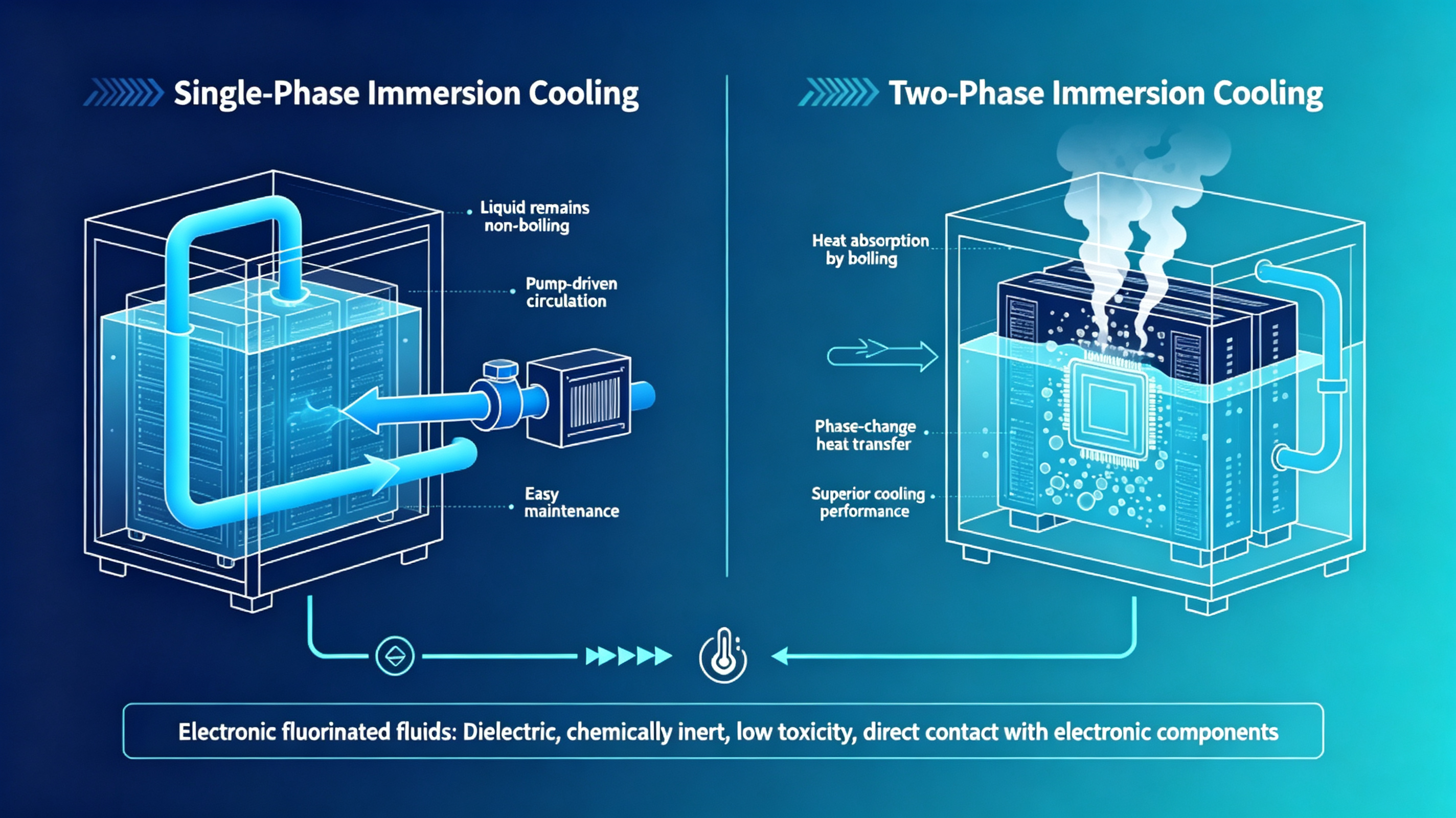
For single‑phase immersion cooling, HFE‑7500 stands out as the mainstream choice for AI servers and high‑power electronics due to its low GWP and environmental benefits. Its 128 °C boiling point provides sufficient thermal safety margin, while low viscosity supports efficient pump circulation. FC‑40 (PFC) features a higher boiling point of 165 °C, broader operating temperature range and superior chemical inertness. It fits applications requiring high thermal margin and long‑term operational stability. For two‑phase immersion cooling, fluorinated fluids with lower boiling points are generally selected as phase‑change media.
When selecting coolant, evaluate boiling point, density, GWP, supply‑chain stability and total cost of ownership. Huayi Brothers TUW‑series fluorinated fluids offer domestic alternatives to HFE‑7500 and FC‑40. They match the performance of imported counterparts while bringing stable supply and optimized overall costs.
If you are designing liquid‑cooling solutions for data centers, energy‑storage systems or high‑power electronic devices, please contact us for fluid‑selection consultation and sample testing support.
Related Article