
Perfluoropolyether (PFPE) Oil as Cosmetic Additive: Core Edge – Silky Slip Without Greasiness
2026-06-30

Statistics show that China’s market size of PFPE oil for cosmetic use reached USD 186 million in 2025, representing a year-on-year growth of 12.3% — far outpacing the global average growth rate. Leading domestic brands including Bloomage Biotech, Proya and Winona have taken the lead in incorporating PFPE oil into their flagship product lines. From barrier-repair serums to post-procedure medical soothing creams, fluorochemical technology is seamlessly entering consumers’ vanity counters in an understated yet transformative way.
The Molecular Mechanism Behind "Silky Slip Without Greasiness"
PFPE oil’s distinctive non-greasy silky texture is no marketing gimmick, but a physical property dictated by its molecular structure.
PFPE oil is a fully synthetic fluorinated polymer composed of carbon, fluorine and oxygen atoms, with its main molecular chain built from repeating –CF₂–CF₂–O– units. The carbon-fluorine (C-F) bond boasts an extremely high bond energy of 485 kJ/mol, vastly exceeding the carbon-hydrogen (C-H) bond (413 kJ/mol) and carbon-oxygen (C-O) bond (358 kJ/mol) found in conventional organic substances. This endows PFPE oil with exceptional chemical inertness and thermal stability.
More critically, PFPE oil features an ultra-low surface tension of merely 12–18 mN/m at 25°C, markedly lower than silicone oil (20–22 mN/m) and mineral oil (30–35 mN/m). This enables outstanding spreadability on the skin: once applied, it instantly forms an ultra-thin, uniform, breathable microporous film that delivers a velvety matte finish, eliminating the heavy, tacky sensation typical of traditional lipid oils.
To simplify: PFPE oil creates a silky touch thanks to superior spreadability and low friction coefficient; it leaves no greasy residue because its ultra-thin film avoids pore clogging and residual heaviness. Rabbit ear skin occlusion tests confirm PFPE oil scores 0 on the comedogenicity scale. A 21-day human patch test covering 108 subjects recorded an irritation index of only 0.2 (out of a full score of 5), vastly outperforming volatile silicone D5, which scores 1.8 for skin irritation.
Five Core Advantages Redefining Cosmetic Sensory Experience
As a cosmetic additive, PFPE oil offers far more benefits beyond its signature non-greasy slip:
-
Luxurious Skin Feel: Velvety Matte, Weightless & Non-Tacky Its ultra-low surface tension delivers exceptional spreadability. Upon application, a breathable film forms to create velvety softness without the sticky, heavy feel of conventional oils, meeting consumer demand for premium sensory texture.
-
Outstanding Stability: Heat, Oxidation & pH Resistant The high-energy C-F bond grants PFPE oil powerful chemical inertness. It maintains consistent physicochemical properties across a pH range of 3.5–8.5, with no precipitation, phase separation or viscosity loss under high-temperature filling at 85°C and low-temperature storage at -20°C, greatly extending product shelf-life stability.
-
Excellent Compatibility: Versatile with All Formulation Components PFPE oil exhibits superb miscibility with UV filters (avobenzone, octocrylene, etc.), vitamin derivatives (ascorbyl glucoside, etc.) and diverse emulsifier systems (sucrose esters, PEG-100 stearate, etc.). It integrates smoothly into existing formulas without altering the original formulation framework.
-
Protective Barrier with Breathability: Blocks Environmental Pollutants PFPE oil forms a breathable microporous film on the skin surface, blocking external contaminants while allowing water vapor to permeate. Research indicates it helps mitigate irritant contact dermatitis, making it ideal for post-aesthetic procedure repair and sensitive skin care.
-
Superior Safety Profile: Non-Comedogenic, Non-Irritating & Biologically Inert PFPE oil does not participate in sebum oxidation or clog pores. It has been recognized as a high-safety cosmetic ingredient via the EU SCCS safety assessment (SCCS/1634/21) and is officially listed in China’s Inventory of Existing Cosmetic Ingredients (2021 Edition) (No. 03155), with clear regulatory compliance pathways.
Full-Spectrum Application Across Skincare, Color Cosmetics & Hair Care
Cosmetic-grade PFPE oil is categorized into three mainstream viscosity grades: low viscosity (5 cSt), medium viscosity (100 cSt) and high viscosity (500 cSt), tailored for different formulation types:
| Application Category | Typical Products | PFPE Oil Functions | Recommended Addition Level |
|---|---|---|---|
| Facial Skincare | Serums, Creams, Lotions | Sensory modification, barrier protection, moisturization & water lock | 0.2%–1.0% |
| Post-Aesthetic Repair | Post-procedure soothing gels, special care creams | Breathable film formation, irritation reduction, accelerated skin recovery | 1.0%–3.0% |
| Sunscreens | Spray sunscreens, BB cushions | Enhanced spreadability, boosted water & sweat resistance | 0.5%–2.0% |
| Color Cosmetics | Lipsticks, Liquid Foundations, Eyeshadows | Waterproof & transfer-resistant, anti-cracking, long-lasting color retention | 0.5%–1.5% |
| Hair Care | Shampoos, Hair Conditioners | Improved smoothness, enhanced hair luster | 0.05%–0.3% |
Notably, PFPE oil forms ultra-fine, highly stable dispersions in glycerin. This property drastically simplifies mixing procedures for creams and lotions, enabling the production of stable single-phase translucent gels and multiple emulsion systems, unlocking broader innovation potential for cosmetic formulators.
Boiling Points Ranging from 40°C to 270°C What Factors Should You Prioritize When Selecting Fluorinated Liquids?
Potassium Perfluorobutanesulfonate: The "Invisible Guardian" for Flame Retardancy and Antistatic Properties of Engineering Plastics
Related Article
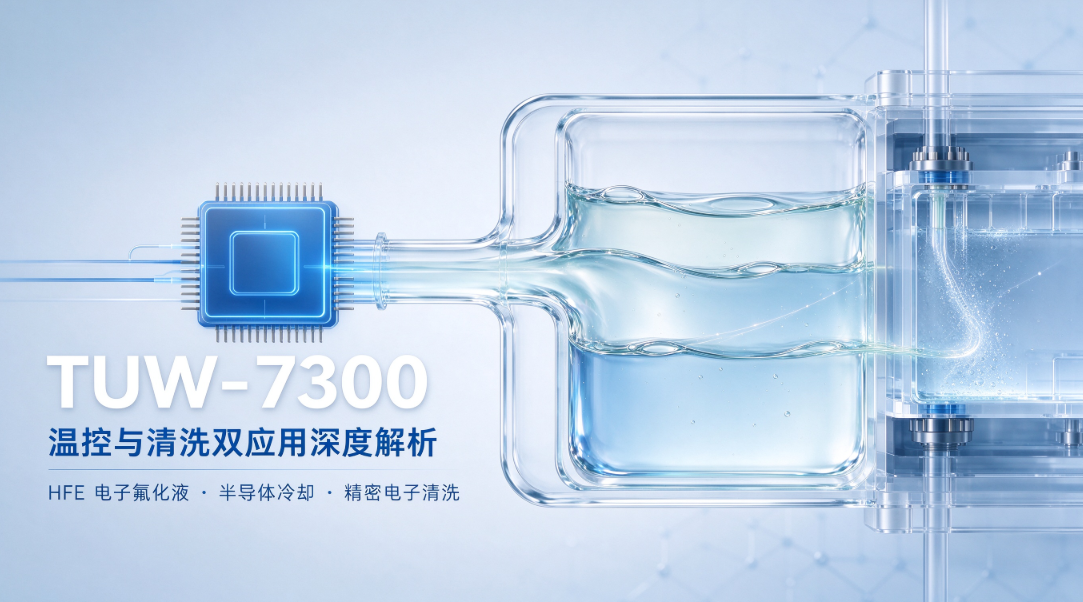
TUW-7300 is a thermally stable hydrofluoroether (HFE) electronic fluorinated fluid, benchmarked against 3M Novec 7300. It combines dual capabilities in semiconductor equipment temperature control and precision electronic cleaning. This article systematically analyzes the dual-scenario application value of TUW-7300, covering product positioning, temperature control applications, cleaning processes, performance parameters, and family product selection.
TUW-7300 HFE Electronic Fluorinated Fluid: In-Depth Analysis of Dual Applications in Semiconductor Equipment Temperature Control and Precision Cleaning

Traditional PCB conformal coating is thick, leaves BGA areas uncovered, and damages pads during rework. This article compares TUW-2704 and TUW-1700 fluoropolymer ultra-thin coatings on film thickness, rework, and protection, and provides selection guidance for NEV electronic control and consumer PCBs.
PCB Nano Conformal Coating Selection: TUW-2704 & TUW-1700 vs. Traditional Conformal Coating
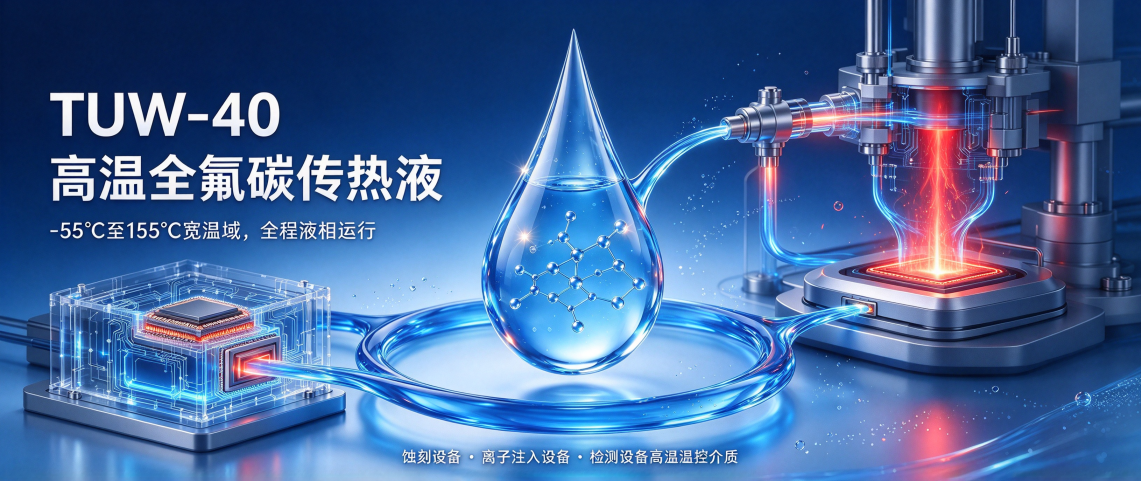
TUW-40 is a single-component perfluorinated heat-transfer fluid covering a liquid range of -55°C to 155°C. With a high boiling point and extremely low evaporation, it is designed for temperature control in etching equipment, ion implantation equipment, and inspection tools. This article details its physical properties, application scenarios, and positioning within the TUW series.
TUW-40 High-Temperature Perfluorocarbon Fluid: -55°C to 155°C Wide Temperature Range — Temperature Control for Etching and Ion Implantation High-Temperature Operations
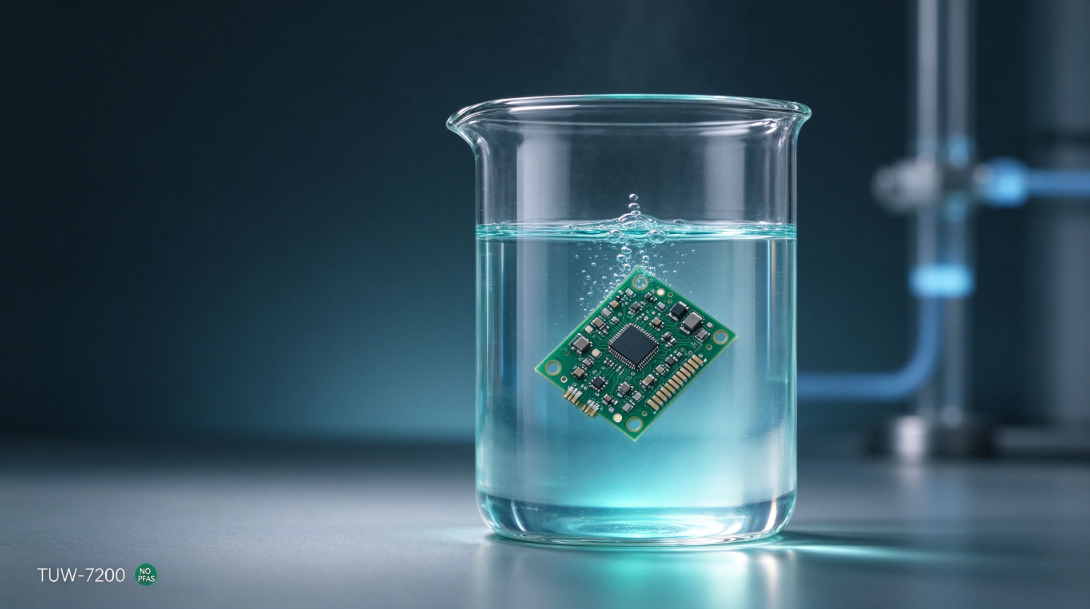
TUW-7200 is a thermally stable perfluorinated liquid that can be used as an electronic cleaning agent, precision cleaner, grease cleaner, cooling medium, hermeticity test fluid, thermostatic fluid, and extraction solvent. This article details its six uses and NO PFAS environmental attributes, and provides guidance on selecting a domestic alternative.
TUW-7200 Electronic Fluorinated Fluid: Precision Cleaning, Hermeticity Leak Testing, Thermostatic Bath — One Fluid for Three Uses, NO PFAS Domestic Alternative