
PCB Nano Conformal Coating Selection: TUW-2704 & TUW-1700 vs. Traditional Conformal Coating
2026-10-21
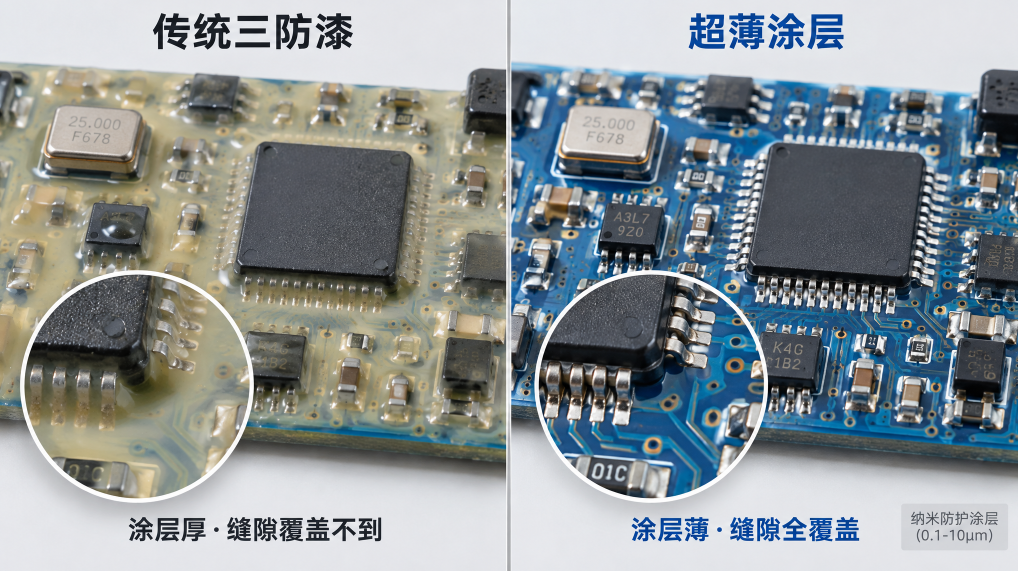
A new energy vehicle electronic control board, installed in the engine compartment, must withstand high temperatures, vibration, humidity, and salt spray all at once. The traditional approach is to spray a layer of conformal coating — polyurethane or acrylic — dozens of micrometers thick, wrapping the entire PCB.
But as automotive and consumer electronics keep pushing toward higher density, the weaknesses of conformal coating are surfacing: when component spacing shrinks below 0.5 mm, the coating cannot flow into the gaps; the underside of BGA packages stays uncovered; during rework, scraping off the thick layer easily damages the pads; and the thick coating also impedes heat dissipation.
That is where fluoropolymer ultra-thin coatings come in. TUW-2704 and TUW-1700 belong to this category — they use hydrofluoroether as the solvent, form a film as the solvent evaporates, require no additional curing, can be locally reworked with a cleaning agent, and are easily inspected under blue/UV light. This article compares them with traditional conformal coatings and explains which scenario calls for which.
1. How Fluoropolymer Coatings Work
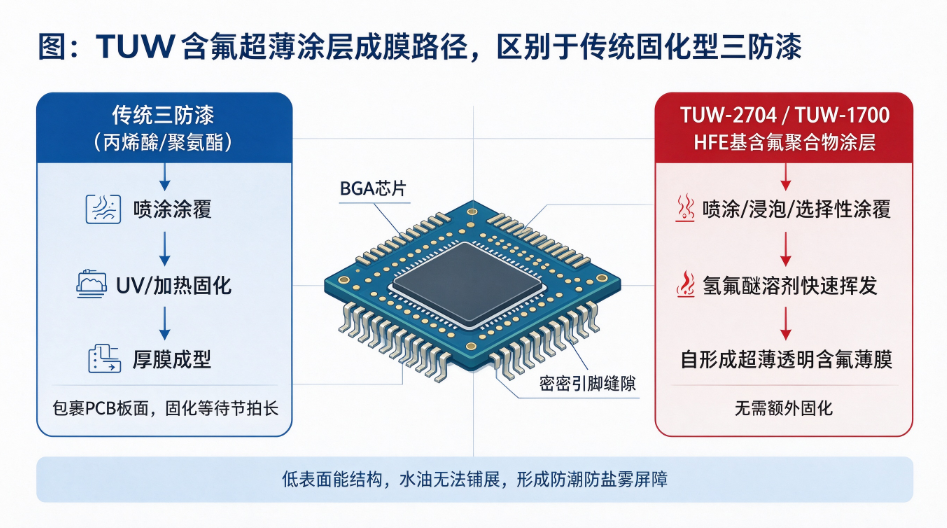
Both TUW-2704 and TUW-1700 are coating solutions formed by dissolving a fluoropolymer in a hydrofluoroether (HFE) solvent. During application, they are sprayed, dipped, or selectively coated onto the PCB; as the solvent evaporates quickly, the polymer forms an extremely thin, transparent film on the surface.
The defining feature of fluoropolymers is their extremely low surface energy — neither water nor oil can spread on the film. Although this film is only a few micrometers thick (or even 1 μm), it is enough to form a barrier against moisture, salt spray, and oil contamination.
The biggest difference from traditional conformal coating lies in the film-forming method: conformal coating requires thermal or UV curing, with a long waiting time before curing; TUW-2704 and TUW-1700 need no additional curing — the film forms as the solvent evaporates, so they can be seamlessly integrated into existing production lines and significantly shorten the protection process. Meanwhile, both the solvent and the polymer are highly safe, do not deplete the ozone layer, and comply with RoHS.
2. Side-by-Side Parameter Comparison
TUW-2704 and TUW-1700 are both HFE-based fluoropolymer coatings. The core parameters are compared below:
|
Parameter
|
TUW-2704
|
TUW-1700
|
|
Product positioning
|
Electronic coating agent (nano coating)
|
Electronic coating agent (nano coating)
|
|
Solvent system
|
Hydrofluoroether (HFE)
|
Hydrofluoroether (HFE)
|
|
Solid content
|
4 wt% fluoropolymer
|
2 wt% fluoropolymer
|
|
Coating thickness
|
0.1–4 μm
|
0.1–1.0 μm
|
|
Appearance
|
Transparent liquid
|
Transparent liquid
|
|
Density
|
1.52 g/mL
|
1.52 g/mL
|
|
Flash point
|
None
|
None
|
|
Dry film heat resistance
|
175°C / 24 hours
|
175°C / 24 hours
|
|
Curing method
|
No additional curing required
|
No additional curing required
|
|
Reworkability
|
Easy rework with cleaning agent
|
Easy rework with cleaning agent
|
|
Quality inspection
|
Clearly visible under blue/UV light
|
Clearly visible under blue/UV light
|
|
Environmental compliance
|
ODP = 0, RoHS compliant
|
ODP = 0, RoHS compliant
|
In short, TUW-2704 forms a thicker film and offers stronger protection; TUW-1700 is thinner, more transparent, and has less impact on appearance and dimensions.
3. Fundamental Differences from Traditional Conformal Coating
The core gaps between ultra-thin coatings and conformal coatings lie in thickness, coverage, and rework method:
|
Comparison dimension
|
Traditional conformal coating
|
TUW ultra-thin coating
|
|
Coating thickness
|
Dozens of micrometers
|
0.1–4 μm
|
|
Gap coverage
|
Cannot penetrate gaps below 0.5 mm
|
Low surface tension, naturally penetrates
|
|
Under-BGA area
|
Cannot cover
|
Can cover
|
|
Curing method
|
Requires thermal / UV curing
|
Solvent evaporation forms film, no curing needed
|
|
Rework
|
Grinding and stripping, easy to damage pads
|
Local removal with dedicated cleaning agent
|
|
Appearance
|
Visible coating
|
Nearly invisible
|
|
Heat dissipation impact
|
Thick coating blocks heat dissipation
|
Extremely thin, minimal thermal impact
|
|
Quality inspection
|
Visual / thickness gauge
|
Clearly visible under blue/UV light
|
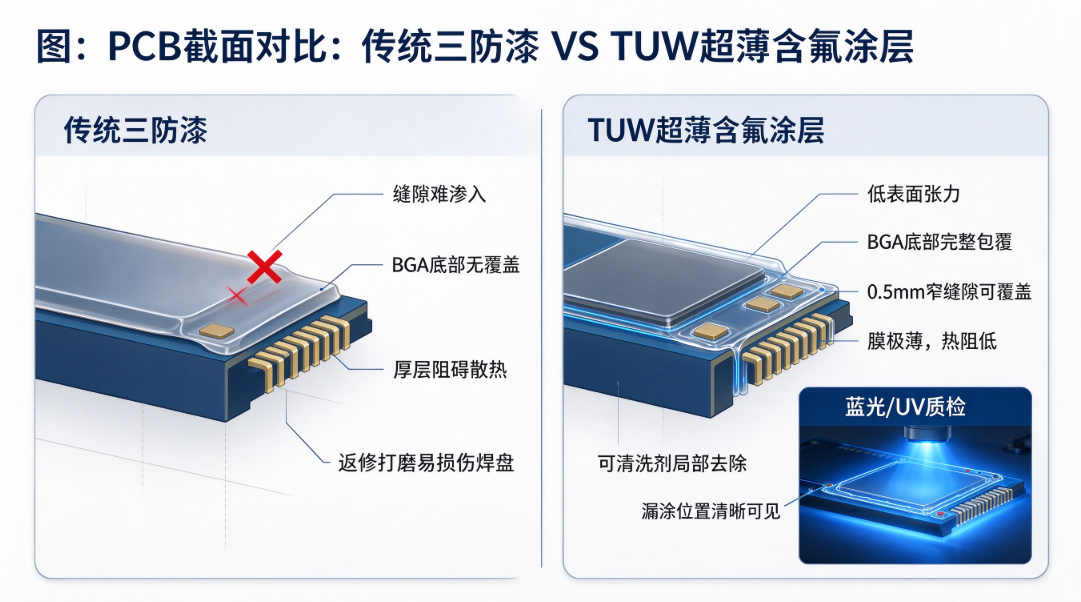
To be objective: ultra-thin coatings are not meant to replace conformal coatings, but to complement them. In scenarios involving heavy salt spray, long-term water immersion, or strong chemical corrosion, conformal coatings remain the primary choice. However, in the following scenarios, ultra-thin coatings offer unique advantages.
4. TUW-2704: Stronger Protection, Easy Rework
TUW-2704 has a solid content of 4% and a coating thickness of up to 4 μm — the stronger-protection option between the two. Its dry film heat resistance reaches 175°C / 24 hours, making it suitable for boards with high heat output and demanding protection requirements. Beyond thickness, it offers several practical advantages:
- Easy rework: Remove the coating locally with a dedicated cleaning agent — no need to grind the whole board like traditional conformal coating, and less risk of pad damage.
- Intuitive inspection: The coating is clearly visible under blue/UV light, making coverage uniformity and missed spots obvious for in-process quality control.
- No curing required: The film forms as the solvent evaporates, eliminating the curing oven and shortening production takt time.
- Thermal-electrical stability: Good thermal-electrical stability and insulation performance, with high insulation and weather resistance for long-term reliability.
- Flexible & superhydrophobic: The film is flexible and foldable, compatible with bendable FPCs; water and oil cannot spread on the surface.
Typical applications for TUW-2704 include:
- NEV electronic control units (VCU, BMS, OBC main boards) — high protection requirements but high component density on board, making traditional conformal coating difficult to apply.
- Charging pile control boards — outdoor installation, facing humidity and temperature-condensation cycles.
- Energy storage system BMS boards — long-term operation inside cabinets, requiring moisture protection without thick coating.
- 5G base station RF modules — tight component spacing, requiring uniform coating.
5. TUW-1700: Invisible Protection and the "Oil Barrier Zone"
TUW-1700 has a solid content of only 2% and a dry film thickness of 0.1–1 μm — true "invisible protection" that is nearly indistinguishable to the naked eye, minimizing impact on appearance, tolerances, and heat dissipation. Besides sharing the same easy rework, blue/UV visibility, no-curing, high-insulation and weather-resistant features of TUW-2704, it has one unique value: oil migration prevention.
Lubricating oil and flux residue inside a phone can crawl along the PCB surface to other areas and cause short circuits. After applying TUW-1700, oil cannot spread on the fluoropolymer film — essentially drawing an "oil barrier zone" on the PCB.
Typical applications for TUW-1700 include:
- Smartphone motherboards and camera modules — high appearance requirements, no visible coating allowed.
- Wearable devices (watches, earbuds) — extremely compact internal space, no room for thick coatings.
- Precision sensors — tolerance-sensitive, coating thickness must be controlled within 1 μm.
- Optical lens peripherals — must not affect optical performance.
6. Selection Guide
How to choose? Here is a simple decision tree:
- If your product operates in heavy salt spray, high humidity, or long-term water immersion (e.g., marine equipment, outdoor cabinets), stick with traditional conformal coating — ultra-thin coatings are not enough.
- If your product is a high-density PCB with tight component spacing and frequent rework (e.g., automotive electronics, consumer electronics), prioritize evaluating TUW-2704 or TUW-1700.
- If appearance requirements are extremely high and the coating must be invisible (e.g., inside phones), choose TUW-1700.
- If you need a certain thickness of protection but traditional conformal coating is difficult to apply, choose TUW-2704.
7. Usage Notes
- The PCB must be thoroughly cleaned before coating; otherwise, oil contamination will affect coating adhesion.
- The application method (spraying / dipping / selective coating) must be determined based on product shape and batch volume.
- It is recommended to validate protection performance through the 85/85 test (85°C / 85% RH, 1000 hours) and salt spray test.
- Coating thickness must be measured with a film thickness gauge in practice — do not estimate it from solid content alone.
- The dry film heat resistance upper limit is 175°C / 24 hours; long-term high-temperature conditions must be evaluated against actual operating temperatures.
Shenzhen Huayi Brothers focuses on supplying electronic fluorinated fluids and fluorine-based functional liquids, providing product documentation, sample testing, and application solution support.
TUW-40 High-Temperature Perfluorocarbon Fluid: -55°C to 155°C Wide Temperature Range — Temperature Control for Etching and Ion Implantation High-Temperature Operations
Related Article
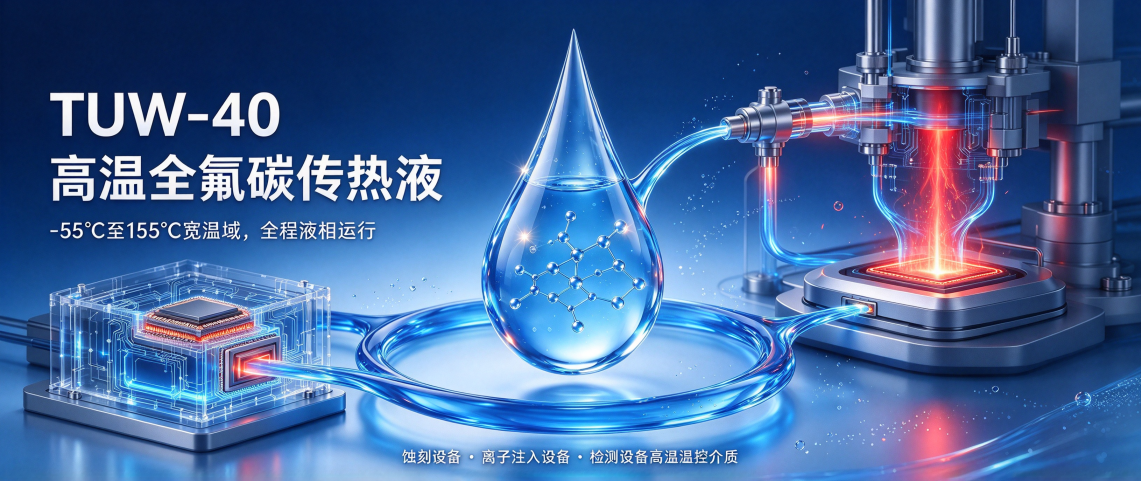
TUW-40 is a single-component perfluorinated heat-transfer fluid covering a liquid range of -55°C to 155°C. With a high boiling point and extremely low evaporation, it is designed for temperature control in etching equipment, ion implantation equipment, and inspection tools. This article details its physical properties, application scenarios, and positioning within the TUW series.
TUW-40 High-Temperature Perfluorocarbon Fluid: -55°C to 155°C Wide Temperature Range — Temperature Control for Etching and Ion Implantation High-Temperature Operations
TUW-7200 is a thermally stable perfluorinated liquid that can be used as an electronic cleaning agent, precision cleaner, grease cleaner, cooling medium, hermeticity test fluid, thermostatic fluid, and extraction solvent. This article details its six uses and NO PFAS environmental attributes, and provides guidance on selecting a domestic alternative.
TUW-7200 Electronic Fluorinated Fluid: Precision Cleaning, Hermeticity Leak Testing, Thermostatic Bath — One Fluid for Three Uses, NO PFAS Domestic Alternative
TUW-347 and TUW-458 are two hydrofluoroether (HFE) eco-friendly solvents commonly used for cleaning, drying, dust removal, and non-condensable gas elimination. TUW-458 can also serve as a synthesis feedstock and electrolyte additive. This article details the chemical identities, technical parameters, application scenarios, and selection differences between the two products.
HFE Eco-Friendly Solvents TUW-347 & TUW-458: The "Invisible Assistants" for Drying, Dust Removal, and Non-Condensable Gas Elimination
Electronic fluorinated fluids serve two core functions in semiconductor manufacturing: temperature control cooling for semiconductor equipment and precision component cleaning. This article systematically analyzes the in-depth application of electronic fluorinated fluids in semiconductor manufacturing, covering temperature control loops, cleaning processes, and domestic alternative solutions of TUW series.
In-depth Application of Electronic Fluorinated Fluids in Semiconductor Manufacturing: A Full Analysis of TUW Series from Equipment Temperature Control to Precision Cleaning