TUW-40 High-Temperature Perfluorocarbon Fluid: -55°C to 155°C Wide Temperature Range — Temperature Control for Etching and Ion Implantation High-Temperature Operations
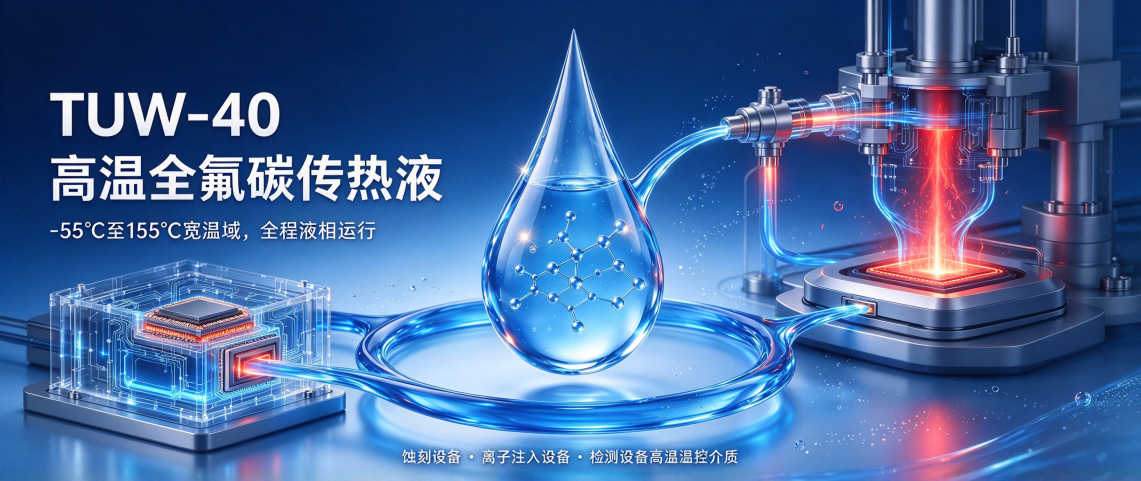
Not every temperature-control point in semiconductor manufacturing runs near room temperature. Beam-line components in ion implanters, high-temperature zones in etch chambers, and hot plates in metrology tools routinely operate above 100°C. As advanced nodes demand temperature stability of ±0.1°C, high-temperature circuits impose far more demanding requirements on the heat-transfer fluid than ordinary cooling: boiling point, thermal stability, dielectric strength, and material compatibility. Conventional coolants either boil and vapor-lock the loop, or degrade at high temperature and contaminate the circuit — driving up total cost of ownership.
1. High-Temperature Operation: The Hard Problem in Semiconductor Equipment Temperature Control
1.1 Which Temperature-Control Points Run Above 100°C
Across etch, ion implantation, and inspection tools, several temperature-control points operate continuously above 100°C: chamber walls and electrostatic chucks (ESC) in etch tools generate sustained heat under plasma bombardment; beam-line components in ion implanters heat significantly under high-energy ion bombardment, and temperature drift directly causes non-uniform implant dose and junction-depth variation; thermal-shock test platforms and constant-temperature stages in inspection equipment must switch precisely across a wide temperature range. Together these form the high-temperature temperature-control zone of semiconductor manufacturing equipment.
1.2 Why Room-Temperature Coolants Cannot Survive a High-Temperature Loop
Forcing a room-temperature coolant into a high-temperature loop creates three typical problems: (1) Insufficient boiling point — the fluid vaporizes at high temperature, forming vapor lock that causes pump cavitation and heat-transfer interruption; (2) Poor thermal stability — long-term high-temperature operation causes degradation, producing conductive residues or volatile impurities that contaminate the entire loop; (3) Frequent fluid changes — properties drift rapidly, requiring frequent top-ups or batch replacement, which paradoxically raises total cost of ownership.
1.3 Performance Requirements for High-Temperature Temperature-Control Fluids
|
Performance Requirement |
Equipment Pain Point |
TUW-40 Value |
|
High boiling point / wide temperature range |
Long-term operation above 100°C; must avoid vaporization |
Fully liquid from -55°C to 155°C; boiling point 155–160°C |
|
Thermal stability |
Degradation and property drift under sustained heat |
Single-component: no degradation, no fractionation, no shelf-life expiry |
|
Dielectric strength |
Adjacent to electrodes and high-voltage beam-line components |
Dielectric strength 40 kV; volume resistivity 1.58×10¹¹ Ω·cm |
|
Chemical inertness |
Corrosive gases and etch byproducts |
Non-reactive; produces no conductive residues |
|
Low volatility |
Chamber contamination; frequent make-up |
High boiling point, low evaporative loss; saturated water content only 50 ppm |
|
Material compatibility |
Aging of tubing, seals, pumps, and valves |
Non-corrosive to aluminum, stainless steel, copper, ceramics, and seals |
2. TUW-40: Single-Component Perfluorocarbon High-Temperature Heat-Transfer Fluid
2.1 Product Positioning and Benchmark
TUW-40 is a transparent, colorless, single-component perfluorinated compound, directly benchmarked against 3M Novec 40 electronic fluorinated fluid. As a heat-transfer medium, it offers excellent chemical inertness, electrical insulation, thermal conductivity, and extremely low surface tension — primarily used for temperature control in semiconductor manufacturing equipment. Its defining feature is single-component stability: it does not degrade, fractionate, or expire. Because it is a single compound, its composition does not change or fractionate over time, minimizing fluid loss and performance drift.

2.2 Key Physical Properties
|
Parameter |
TUW-40 Value |
Significance for Temperature Control |
|
Liquid temperature range |
-55°C to 155°C |
Covers cold startup through high-temperature operation |
|
Boiling point |
155–160°C |
No vaporization in high-temperature loops; low evaporative loss |
|
Pour point |
-55°C |
No freezing or pump blockage in winter cold startup |
|
Density |
1.82 g/mL (25°C) |
Immiscible with water; facilitates water-layer separation |
|
Kinematic viscosity |
3.18 cSt |
Moderate pumping resistance; smooth microchannel circulation |
|
Surface tension |
12.63 dyn/cm |
Excellent microchannel wetting; high heat-transfer efficiency |
|
Dielectric strength |
40 kV |
Safe adjacent to live components |
|
Volume resistivity |
1.58×10¹¹ Ω·cm |
Reliable insulation; extremely low leakage current |
|
pH |
7 (neutral) |
Does not corrode metals or seals |
|
Flash point |
None |
Intrinsically fire-safe |
|
NFPA flammability rating |
Class 0 |
Non-flammable; colorless, odorless, non-toxic |
|
GWP (100-year) |
175 |
Far lower environmental burden than traditional PFCs |
|
Saturated water content |
50 ppm |
Low water content; prevents loop corrosion |
2.3 Seven Core Advantages
- Single-component stability — no degradation, no fractionation, no shelf-life expiry. As a single compound, its composition does not change over operating time, minimizing fluid loss and performance drift; no frequent top-ups or batch replacement needed.
- Ultra-wide temperature range from -55°C to 155°C — fully liquid throughout. Pour point as low as -55°C and boiling point of 155–160°C means the fluid stays liquid from cold startup to high-temperature steady state, with no vapor lock in the loop.
- High boiling point, low volatility — no vaporization in high-temperature loops. The boiling point is tens of degrees above typical etch and ion implantation operating temperatures; evaporative loss is minimal above 100°C, reducing make-up volume and avoiding cavitation and pump dry-running.
- Excellent electrical insulation — safe adjacent to live components. Dielectric strength of 40 kV and volume resistivity of 1.58×10¹¹ Ω·cm ensure extremely low leakage current near beam-line electrodes, RF power supplies, and other live circuits.
- Strong chemical inertness, good material compatibility. Non-corrosive to aluminum, stainless steel, copper, ceramics, and seals; does not decompose or generate conductive residues or volatile impurities at high temperature, protecting loop cleanliness and device yield.
- No flash point, non-flammable — intrinsically safe. NFPA flammability class 0, no flash point, colorless, odorless, and non-toxic — eliminating fire safety and occupational health risks in high-temperature operation.
- Distillable for regeneration — low total cost of ownership. Waste fluid can be regenerated by distillation and reused; long-term operating cost is lower than single-use media. GWP (100-year) of 175 is far lower than traditional PFCs.
3. TUW-40 Applications in Semiconductor Equipment
3.1 Etch Equipment: Chamber and Electrode Temperature Control
During etch processes, chamber walls, electrostatic chucks (ESC), and wafer pedestals generate large amounts of heat under plasma bombardment. TUW-40 is pumped through external chillers / TCUs into the equipment cooling loop to maintain stable temperatures on key components. Its wide temperature range means the fluid stays liquid throughout cold startup to high-temperature steady state, with no need for frequent fluid changes. The high boiling point ensures no vapor lock in high-temperature chamber zones, enabling temperature stability of ±0.1°C.
3.2 Ion Implantation Equipment: Beam-Line Component Temperature Stability
Beam-line components in ion implanters heat significantly under high-energy ion bombardment; temperature drift leads to non-uniform implant dose and junction-depth variation. TUW-40's chemical inertness and thermal stability ensure no conductive residues or volatile impurities over long-term operation, maintaining loop insulation. The 40 kV dielectric strength allows safe use adjacent to high-voltage components such as beam-line electrodes.
3.3 Inspection Equipment: Thermal-Shock Testing and Constant-Temperature Stages
Inspection equipment (e.g., thermal-shock test platforms, constant-temperature stages) requires precise temperature control across a wide range, and benefits equally from TUW-40's 155°C upper limit and low-volatility characteristics. Fully liquid operation from -55°C to 155°C ensures stable fluid state throughout testing without affecting temperature-cycling precision.
4. Selection Guide: TUW-40 vs. TUW-3283
Within the TUW series, TUW-3283 and TUW-40 are both semiconductor temperature-control media. The core selection criterion is the operating temperature range:
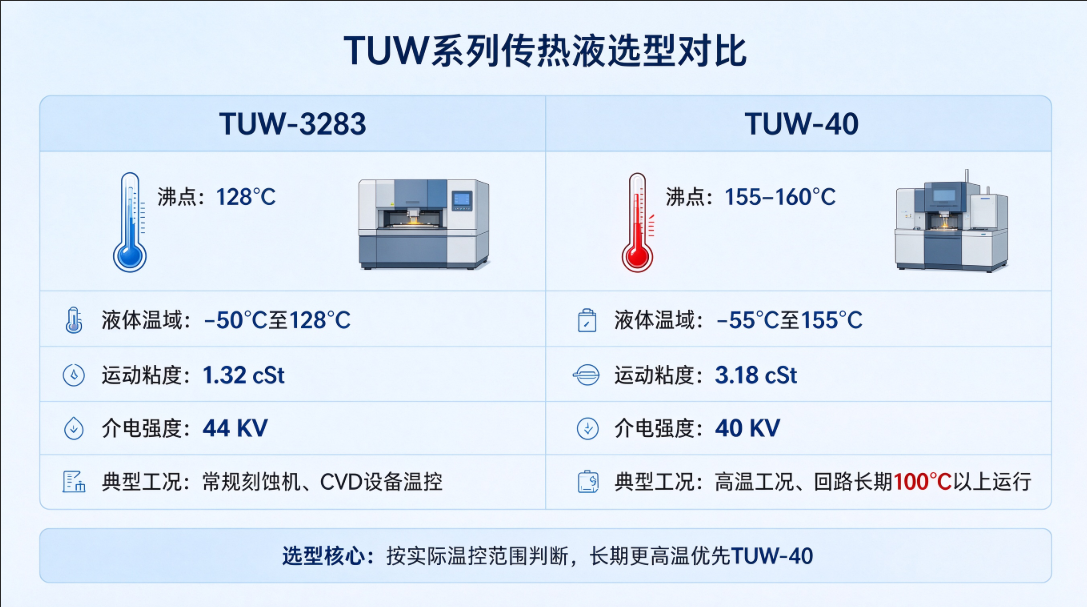
For conventional etch tools and CVD equipment temperature control, TUW-3283's -50°C to 128°C range is typically sufficient. When higher-temperature coverage is needed, or when the loop operates continuously above 100°C, TUW-40 is the more appropriate choice. Both emphasize single-component stability and high purity; evaluate based on actual equipment temperature-control range and supply cost.
5. Quality and Supply
When purchasing, request a batch COA and verify key indicators such as purity, moisture content, and acid value. Shenzhen Huayi Xiongdi specializes in electronic fluorinated fluids and fluorinated functional liquids. TUW-40 is available with product documentation, sample testing, and application-engineering support. For sample testing, please click the consultation button.
TUW-7200 Electronic Fluorinated Fluid: Precision Cleaning, Hermeticity Leak Testing, Thermostatic Bath — One Fluid for Three Uses, NO PFAS Domestic Alternative
Related Article