
Application of Hydrofluoroether Solvent 7200 in Precision Cleaning
2026-05-22
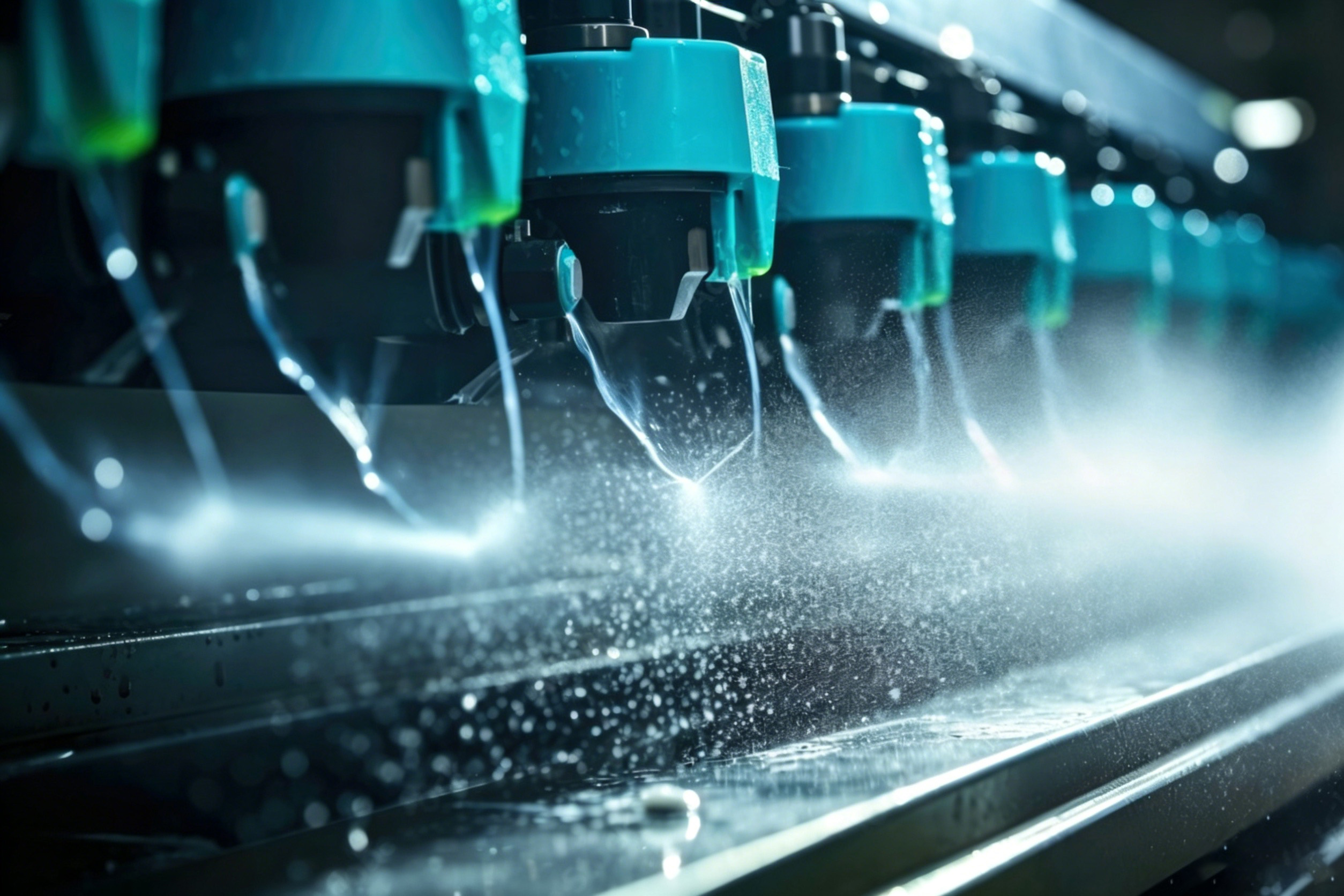
In modern industrial production, precision cleaning is a key link to ensure product quality and performance. Traditional cleaning agents such as CFC-113 (chlorofluorocarbon) have been phased out due to ozone layer depletion; chlorine-containing solvents and hydrocarbon cleaning agents have shortcomings including toxicity, flammability and residue issues. Against this backdrop, hydrofluoroether solvent 7200 (HFE-7200) has become a mainstream choice in the field of precision cleaning by virtue of its unique physicochemical properties.
I. Core Properties of Hydrofluoroether Solvent 7200
Hydrofluoroether solvent 7200 is a colorless, transparent and non-corrosive fluorinated liquid. Its main performance advantages are as follows:
Excellent Material Compatibility: It causes no swelling or corrosion to most plastics (such as polycarbonate and acrylic resin), elastomers and metal materials, and is suitable for precision cleaning of composite components with mixed materials.
Low Surface Tension (approximately 13.6 mN/m): It can quickly penetrate into tiny gaps, micropores and complex geometric structures of parts to thoroughly remove particulate matter, grease, flux and other contaminants.
Fast Volatilization and Residue-Free: With a boiling point of about 76°C, it has a moderate volatilization rate. Workpieces can be instantly dried after cleaning without additional drying procedures, leaving no white spots or marks on the surface.
Environmental Protection and Safety: It has zero ODP and low global warming potential (GWP), and contains no chlorine or bromine elements. It is non-flammable and low in toxicity, complying with RoHS, REACH and other environmental regulations.
Excellent Thermal Stability: It is not easy to decompose during cleaning and distillation recovery, and can be recycled for long-term use to reduce comprehensive costs.
II. Typical Application Scenarios
Electronics and Semiconductor Industry
It is used to remove flux, solder paste residues and silicone oil on the surface of wafers, chip packages and PCB boards. HFE-7200 will not damage sensitive low-k dielectric materials or chip passivation layers. Combined with ultrasonic cleaning or vapor phase cleaning processes, it can achieve sub-micron level cleanliness.
Optics and Precision Lenses
Optical lenses, filters, prisms and other optical components require a dust-free and stain-free surface. HFE-7200 can effectively remove fingerprints, release agents and dust-proof oil without damaging functional coatings such as anti-reflection coatings.
Aerospace and Precision Machinery
It is applied to remove anti-rust oil, polishing paste and assembly contaminants from precision components such as gyroscopes, fuel nozzles and hydraulic servo valves. The non-flammable property of HFE-7200 enables its safe use in open or closed systems, and it is compatible with aluminum alloys, titanium alloys and special rubber materials.
Medical and Laboratory Instruments
It is suitable for cleaning surgical instruments, minimally invasive catheters and injection molds. Its low toxicity, non-sensitizing property and extremely low residue risk meet biocompatibility requirements.
III. Advantages Over Traditional Cleaning Agents
|
Cleaning Agent Type
|
HFE-7200
|
Chlorinated Solvent
|
Hydrocarbon Cleaning Agent
|
Water-Based Cleaning Agent
|
|---|---|---|---|---|
|
Flammability
|
Non-flammable
|
Non-flammable
|
Flammable
|
Non-flammable
|
|
Toxicity
|
Low toxicity
|
Medium/High toxicity
|
Low toxicity
|
Low toxicity
|
|
Material Compatibility
|
Excellent
|
Poor
|
Good
|
Relatively poor
|
|
Drying Speed
|
Fast
|
Slow
|
Slow
|
Requires drying
|
|
ODP/GWP
|
0 / Low
|
Yes / High
|
0 / Low
|
0 / Low
|
|
Waste Liquid Disposal Cost
|
Low
|
High
|
Medium
|
High
|
IV. Cleaning Process Recommendations
HFE-7200 is compatible with various flexible cleaning modes:
Vapor Phase Cleaning: Boiling solvent vapor is used for condensation rinsing of workpieces, and the solvent can be recycled with a recovery system.
Ultrasonic Cleaning: It enhances the stripping effect on contaminants in blind holes and deep gaps.
Spraying or Immersion Cleaning: Suitable for batch production or online pipeline operation.
It is recommended to equip with a distillation recovery device, with a solvent recovery rate of over 95%, which effectively reduces the overall operating cost.
V. Safety and Operation Precautions
Although HFE-7200 is a low-toxic and non-flammable chemical, it is recommended to maintain good ventilation in the working area and avoid long-term inhalation of high-concentration vapor. Wear nitrile gloves and goggles during operation. Waste liquid shall be disposed of by professional institutions in accordance with local environmental protection regulations.
Conclusion
With its excellent cleaning performance, extensive material compatibility and environmental safety properties, hydrofluoroether solvent 7200 has become an indispensable high-end cleaning medium in the field of precision manufacturing. With the continuous improvement of industry requirements for product reliability and green manufacturing, HFE-7200 will continue to help customers achieve more efficient, cleaner and safer precision cleaning processes.
Vacuum Lubrication Solution for Extreme Working Conditions Fomblin® PFPE Perfluoropolyether Lubricants Featuring Chemical Inertness and High-temperature Stability
Solvay Galden® HT: PFPE Heat Transfer Fluid Solution with Wide Temperature Range from -70°C to 290°C
Related Article

Traditional PCB conformal coating is thick, leaves BGA areas uncovered, and damages pads during rework. This article compares TUW-2704 and TUW-1700 fluoropolymer ultra-thin coatings on film thickness, rework, and protection, and provides selection guidance for NEV electronic control and consumer PCBs.
PCB Nano Conformal Coating Selection: TUW-2704 & TUW-1700 vs. Traditional Conformal Coating
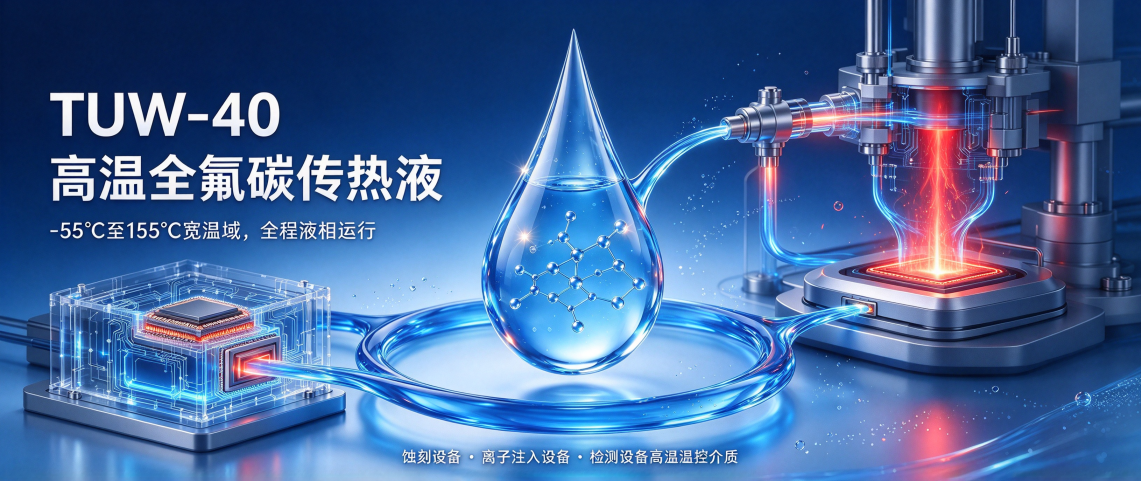
TUW-40 is a single-component perfluorinated heat-transfer fluid covering a liquid range of -55°C to 155°C. With a high boiling point and extremely low evaporation, it is designed for temperature control in etching equipment, ion implantation equipment, and inspection tools. This article details its physical properties, application scenarios, and positioning within the TUW series.
TUW-40 High-Temperature Perfluorocarbon Fluid: -55°C to 155°C Wide Temperature Range — Temperature Control for Etching and Ion Implantation High-Temperature Operations
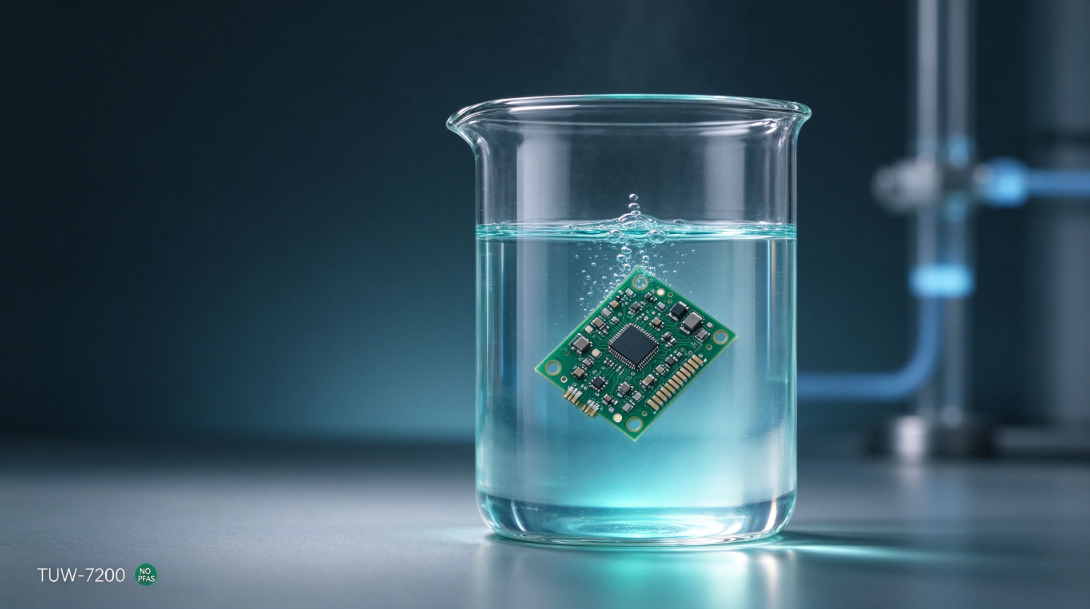
TUW-7200 is a thermally stable perfluorinated liquid that can be used as an electronic cleaning agent, precision cleaner, grease cleaner, cooling medium, hermeticity test fluid, thermostatic fluid, and extraction solvent. This article details its six uses and NO PFAS environmental attributes, and provides guidance on selecting a domestic alternative.
TUW-7200 Electronic Fluorinated Fluid: Precision Cleaning, Hermeticity Leak Testing, Thermostatic Bath — One Fluid for Three Uses, NO PFAS Domestic Alternative
TUW-347 and TUW-458 are two hydrofluoroether (HFE) eco-friendly solvents commonly used for cleaning, drying, dust removal, and non-condensable gas elimination. TUW-458 can also serve as a synthesis feedstock and electrolyte additive. This article details the chemical identities, technical parameters, application scenarios, and selection differences between the two products.
HFE Eco-Friendly Solvents TUW-347 & TUW-458: The "Invisible Assistants" for Drying, Dust Removal, and Non-Condensable Gas Elimination