
New developments in the US semiconductor industry under Trump's policy guidance
2024-12-26
With Trump's rise to power, he is inclined to drive U.S. companies to return to domestic production by increasing import tariffs and scaling back the size of government - issued subsidies. The goal is to strengthen the U.S. domestic semiconductor industry, reduce reliance on foreign semiconductor companies, and encourage the semiconductor industry to return to the United States. This way, American semiconductor companies like Intel are likely to benefit and gain more development opportunities.
The U.S. Department of Commerce has provided up to $407 million in direct funding subsidies to Amkor Technology Arizona, Inc. to enable the end - to - end chip production of the most advanced semiconductors in the United States. Additionally, it has awarded up to $1.61 billion in direct funding subsidies to Texas Instruments to support its multiple projects in Texas and Utah, which aim to increase the production of semiconductors crucial for the U.S. economy and national security.
The U.S. Department of Commerce has provided up to $407 million in direct funding subsidies to Amkor Technology Arizona, Inc. to enable the end - to - end chip production of the most advanced semiconductors in the United States. Additionally, it has awarded up to $1.61 billion in direct funding subsidies to Texas Instruments to support its multiple projects in Texas and Utah, which aim to increase the production of semiconductors crucial for the U.S. economy and national security.
Two Years of CHIPS Act Implementation Yields Both Results and Concerns
3M™ FC & Novec™ Replacement Fluids
Related Article

Traditional PCB conformal coating is thick, leaves BGA areas uncovered, and damages pads during rework. This article compares TUW-2704 and TUW-1700 fluoropolymer ultra-thin coatings on film thickness, rework, and protection, and provides selection guidance for NEV electronic control and consumer PCBs.
PCB Nano Conformal Coating Selection: TUW-2704 & TUW-1700 vs. Traditional Conformal Coating
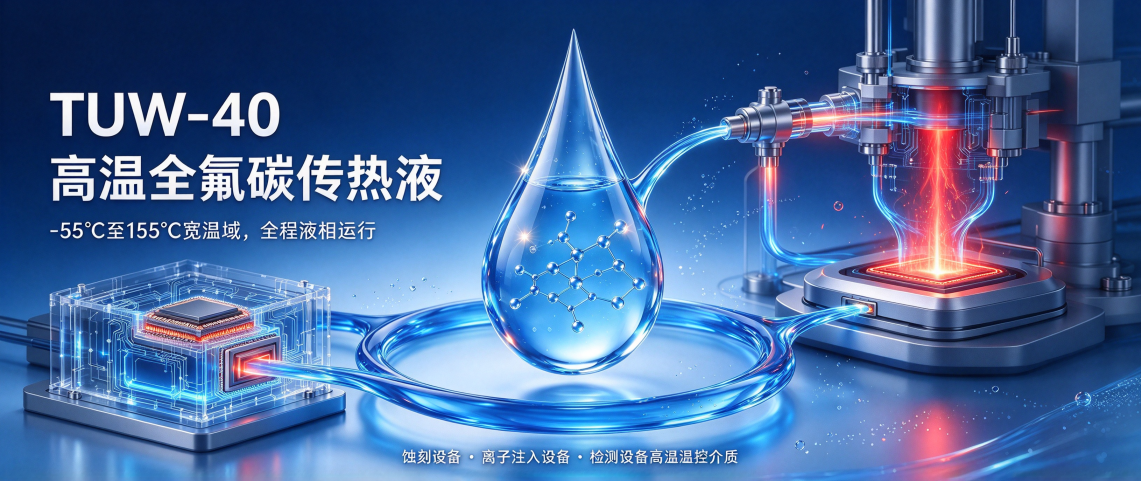
TUW-40 is a single-component perfluorinated heat-transfer fluid covering a liquid range of -55°C to 155°C. With a high boiling point and extremely low evaporation, it is designed for temperature control in etching equipment, ion implantation equipment, and inspection tools. This article details its physical properties, application scenarios, and positioning within the TUW series.
TUW-40 High-Temperature Perfluorocarbon Fluid: -55°C to 155°C Wide Temperature Range — Temperature Control for Etching and Ion Implantation High-Temperature Operations
TUW-7200 is a thermally stable perfluorinated liquid that can be used as an electronic cleaning agent, precision cleaner, grease cleaner, cooling medium, hermeticity test fluid, thermostatic fluid, and extraction solvent. This article details its six uses and NO PFAS environmental attributes, and provides guidance on selecting a domestic alternative.
TUW-7200 Electronic Fluorinated Fluid: Precision Cleaning, Hermeticity Leak Testing, Thermostatic Bath — One Fluid for Three Uses, NO PFAS Domestic Alternative
TUW-347 and TUW-458 are two hydrofluoroether (HFE) eco-friendly solvents commonly used for cleaning, drying, dust removal, and non-condensable gas elimination. TUW-458 can also serve as a synthesis feedstock and electrolyte additive. This article details the chemical identities, technical parameters, application scenarios, and selection differences between the two products.
HFE Eco-Friendly Solvents TUW-347 & TUW-458: The "Invisible Assistants" for Drying, Dust Removal, and Non-Condensable Gas Elimination