
2025 Forward: A New Blueprint for Growth in the Global Liquid Cooling Market
2025-01-23

1, the global liquid cooling market size is growing rapidly
With the global power consumption climbing sharply, data center energy consumption is a concern. The International Energy Agency (IEA) expects that global data center power consumption will reach 650 - 1050TWh by 2026, and the growth in 2022 - 2026 is equivalent to the total power consumption of Sweden (low) or Germany (high). In response, countries have introduced policies, such as Singapore's release of its “Green Data Center Roadmap” in 2024, and Europe's introduction of directives and bills that strictly define PUE metrics for data centers.
Driven by these factors, liquid cooling has moved from a relative niche to the mainstream by virtue of its high energy-efficiency, strong cooling, green environment, etc. Between 2024 and 2025, the adoption rate of liquid cooling in data centers is expected to increase from 14% to 26% globally. In the future, liquid cooling R & D will focus on high-power power modules, environmentally friendly coolant, system architecture optimization and compatibility enhancement.
2, mixed cooling mode for a long time
Mixed cooling is mainly reflected in two aspects: first, liquid cooling and air-cooled coexistence. Many data centers and rack systems will be based on the application type, heat scale, cost and facility conditions, etc., to determine the proportion of air-cooled and liquid-cooled use. For example, in AWS data centers, air cooling is used for regular compute servers, while liquid cooling is considered for GPU-related applications. Second, a variety of liquid cooling methods coexist, such as direct chip cooling (cold plate liquid cooling) and immersion liquid cooling. As various cooling technologies have their own advantages and disadvantages, data center operators may use a mixture of, for example, Microsoft uses direct chip cooling and “Sidekick” zero-water evaporation technology combination.
3., Direct Chip Cooling Dominates the Short to Medium Term Market
Although the immersion cooling ecology is developing, it is still in the early days, and direct chip cooling is still the mainstream in the short and medium term. 2025, the technology will be upgraded in many ways: hardware, to improve the uniformity of the coolant flow, cold plate thermal conductivity, and to optimize the chip micro-channel structure, in order to improve the heat dissipation efficiency and uniformity, and to expand the scope of the applicable chips; in terms of system integration, to strengthen the convergence with servers and storage devices, and improve the In terms of system integration, the integration with servers and storage devices is strengthened to enhance the synergistic heat dissipation capability; and in terms of cost control, the cost of equipment and operation and maintenance is reduced by technological innovation and scale effect. In addition, two-phase direct chip liquid cooling is beginning to enter the market, which utilizes phase change latent heat dissipation, high heat transfer efficiency and constant temperature.
4、Full stack liquid cooling to build system ecology
In 2024, full-stack liquid cooling covers single nodes, cabinets to data centers at all levels, integrating multi-disciplinary technologies. On civil construction, AWS uses low-carbon materials to reduce carbon; in the field of electricity, hyperscale service providers are exploring better power architectures and sustainable power supply solutions, such as small modular reactors, etc., and are also researching renewable energy applications and power distribution system innovations; at the software level, some companies are integrating IoT functions, using dynamic power management and AI intelligent monitoring to improve energy efficiency and intelligence.
There is also progress in coolant R&D. The OCP submerged fluid community is developing well, with many companies launching new products covering a wide range of categories to meet different application needs. The industry also attaches great importance to the compatibility and reliability of coolant and components, and relevant enterprises have conducted tests to ensure technological breakthroughs.
With the global power consumption climbing sharply, data center energy consumption is a concern. The International Energy Agency (IEA) expects that global data center power consumption will reach 650 - 1050TWh by 2026, and the growth in 2022 - 2026 is equivalent to the total power consumption of Sweden (low) or Germany (high). In response, countries have introduced policies, such as Singapore's release of its “Green Data Center Roadmap” in 2024, and Europe's introduction of directives and bills that strictly define PUE metrics for data centers.
Driven by these factors, liquid cooling has moved from a relative niche to the mainstream by virtue of its high energy-efficiency, strong cooling, green environment, etc. Between 2024 and 2025, the adoption rate of liquid cooling in data centers is expected to increase from 14% to 26% globally. In the future, liquid cooling R & D will focus on high-power power modules, environmentally friendly coolant, system architecture optimization and compatibility enhancement.
2, mixed cooling mode for a long time
Mixed cooling is mainly reflected in two aspects: first, liquid cooling and air-cooled coexistence. Many data centers and rack systems will be based on the application type, heat scale, cost and facility conditions, etc., to determine the proportion of air-cooled and liquid-cooled use. For example, in AWS data centers, air cooling is used for regular compute servers, while liquid cooling is considered for GPU-related applications. Second, a variety of liquid cooling methods coexist, such as direct chip cooling (cold plate liquid cooling) and immersion liquid cooling. As various cooling technologies have their own advantages and disadvantages, data center operators may use a mixture of, for example, Microsoft uses direct chip cooling and “Sidekick” zero-water evaporation technology combination.
3., Direct Chip Cooling Dominates the Short to Medium Term Market
Although the immersion cooling ecology is developing, it is still in the early days, and direct chip cooling is still the mainstream in the short and medium term. 2025, the technology will be upgraded in many ways: hardware, to improve the uniformity of the coolant flow, cold plate thermal conductivity, and to optimize the chip micro-channel structure, in order to improve the heat dissipation efficiency and uniformity, and to expand the scope of the applicable chips; in terms of system integration, to strengthen the convergence with servers and storage devices, and improve the In terms of system integration, the integration with servers and storage devices is strengthened to enhance the synergistic heat dissipation capability; and in terms of cost control, the cost of equipment and operation and maintenance is reduced by technological innovation and scale effect. In addition, two-phase direct chip liquid cooling is beginning to enter the market, which utilizes phase change latent heat dissipation, high heat transfer efficiency and constant temperature.
4、Full stack liquid cooling to build system ecology
In 2024, full-stack liquid cooling covers single nodes, cabinets to data centers at all levels, integrating multi-disciplinary technologies. On civil construction, AWS uses low-carbon materials to reduce carbon; in the field of electricity, hyperscale service providers are exploring better power architectures and sustainable power supply solutions, such as small modular reactors, etc., and are also researching renewable energy applications and power distribution system innovations; at the software level, some companies are integrating IoT functions, using dynamic power management and AI intelligent monitoring to improve energy efficiency and intelligence.
There is also progress in coolant R&D. The OCP submerged fluid community is developing well, with many companies launching new products covering a wide range of categories to meet different application needs. The industry also attaches great importance to the compatibility and reliability of coolant and components, and relevant enterprises have conducted tests to ensure technological breakthroughs.
Translated with DeepL.com (free version)
5. Waste Heat Recovery Drives Sustainability
By 2024, waste heat recovery in data centers will have emerged in Europe and spread globally. HPE and Danfoss are working together to develop heat reuse kits to convert waste heat into electricity or heating resources, reduce costs and environmental impact, realize energy recycling, and promote the transformation of data centers into comprehensive energy utilization centers, which will give rise to new opportunities in the market of waste heat recovery technologies and equipments.
6、Native liquid cooling design leads innovation
Native liquid cooling integrates liquid cooling technology from the source of the system to optimize the layout of the data center, cabinet architecture and memory module form, etc., to improve space utilization and heat dissipation, computing performance synergy. However, the technology is still in its early stages and deserves continued attention.
7, open source and open become an important development path
Data center scale and complexity increase, the liquid cooling requirements are higher, a single enterprise is difficult to promote the development of liquid cooling industry alone, and liquid cooling technology involves multiple fields of knowledge, so open source has become inevitable. Many enterprises actively participate in, such as OVH Cloud to OCP donation of liquid cooling technology design, NVIDIA contribution rack and computing, switch tray liquid cooling design, Stellium Datacenters and other parties to develop optimized hardware solutions based on OCP principles.
8、Industry cooperation accelerates technology integration and innovation
2024, data center liquid cooling field cross-border cooperation is frequent, including the form of acquisition and merger and strategic cooperation. Such as Modine, Vertiv acquisition of related enterprises to enhance the strength of liquid cooling, a number of companies to develop new products, overcome technical problems. 2025, industrial cooperation will be more in-depth and extensive, cross-industry giants to create an innovation platform, focusing on cutting-edge technological breakthroughs, and the mode of cooperation will be expanded from technology research and development to marketing, service sharing, and the construction of a full-life-cycle cooperation system.
By 2024, waste heat recovery in data centers will have emerged in Europe and spread globally. HPE and Danfoss are working together to develop heat reuse kits to convert waste heat into electricity or heating resources, reduce costs and environmental impact, realize energy recycling, and promote the transformation of data centers into comprehensive energy utilization centers, which will give rise to new opportunities in the market of waste heat recovery technologies and equipments.
6、Native liquid cooling design leads innovation
Native liquid cooling integrates liquid cooling technology from the source of the system to optimize the layout of the data center, cabinet architecture and memory module form, etc., to improve space utilization and heat dissipation, computing performance synergy. However, the technology is still in its early stages and deserves continued attention.
7, open source and open become an important development path
Data center scale and complexity increase, the liquid cooling requirements are higher, a single enterprise is difficult to promote the development of liquid cooling industry alone, and liquid cooling technology involves multiple fields of knowledge, so open source has become inevitable. Many enterprises actively participate in, such as OVH Cloud to OCP donation of liquid cooling technology design, NVIDIA contribution rack and computing, switch tray liquid cooling design, Stellium Datacenters and other parties to develop optimized hardware solutions based on OCP principles.
8、Industry cooperation accelerates technology integration and innovation
2024, data center liquid cooling field cross-border cooperation is frequent, including the form of acquisition and merger and strategic cooperation. Such as Modine, Vertiv acquisition of related enterprises to enhance the strength of liquid cooling, a number of companies to develop new products, overcome technical problems. 2025, industrial cooperation will be more in-depth and extensive, cross-industry giants to create an innovation platform, focusing on cutting-edge technological breakthroughs, and the mode of cooperation will be expanded from technology research and development to marketing, service sharing, and the construction of a full-life-cycle cooperation system.
Liquid Cooling Industry Sees Explosive Growth, Submerged Liquid Cooling Technology Becomes New Favourite
Two Years of CHIPS Act Implementation Yields Both Results and Concerns
Related Article
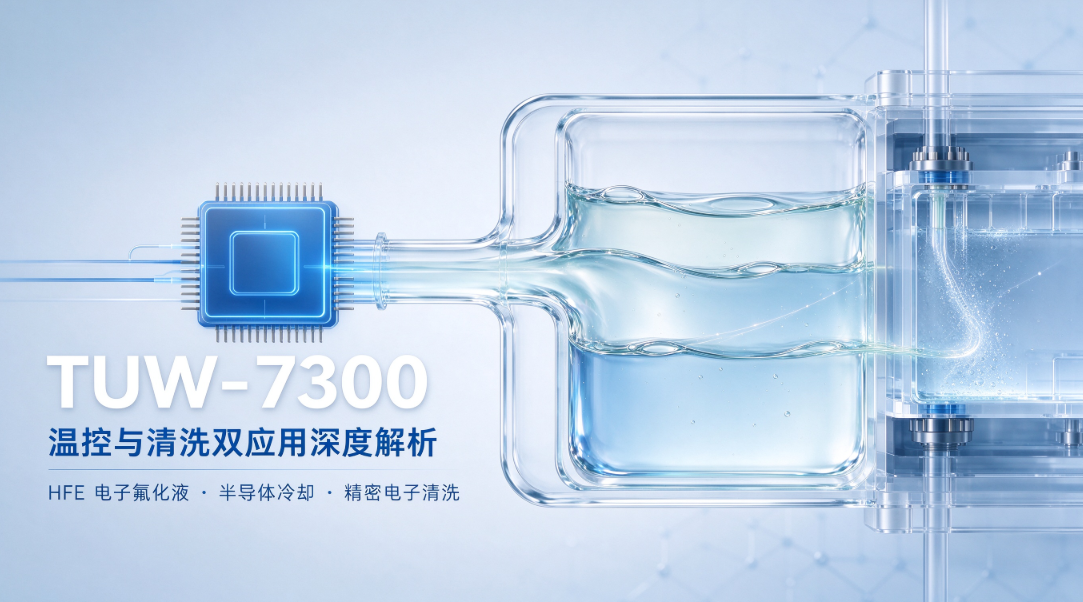
TUW-7300 is a thermally stable hydrofluoroether (HFE) electronic fluorinated fluid, benchmarked against 3M Novec 7300. It combines dual capabilities in semiconductor equipment temperature control and precision electronic cleaning. This article systematically analyzes the dual-scenario application value of TUW-7300, covering product positioning, temperature control applications, cleaning processes, performance parameters, and family product selection.
TUW-7300 HFE Electronic Fluorinated Fluid: In-Depth Analysis of Dual Applications in Semiconductor Equipment Temperature Control and Precision Cleaning

Traditional PCB conformal coating is thick, leaves BGA areas uncovered, and damages pads during rework. This article compares TUW-2704 and TUW-1700 fluoropolymer ultra-thin coatings on film thickness, rework, and protection, and provides selection guidance for NEV electronic control and consumer PCBs.
PCB Nano Conformal Coating Selection: TUW-2704 & TUW-1700 vs. Traditional Conformal Coating
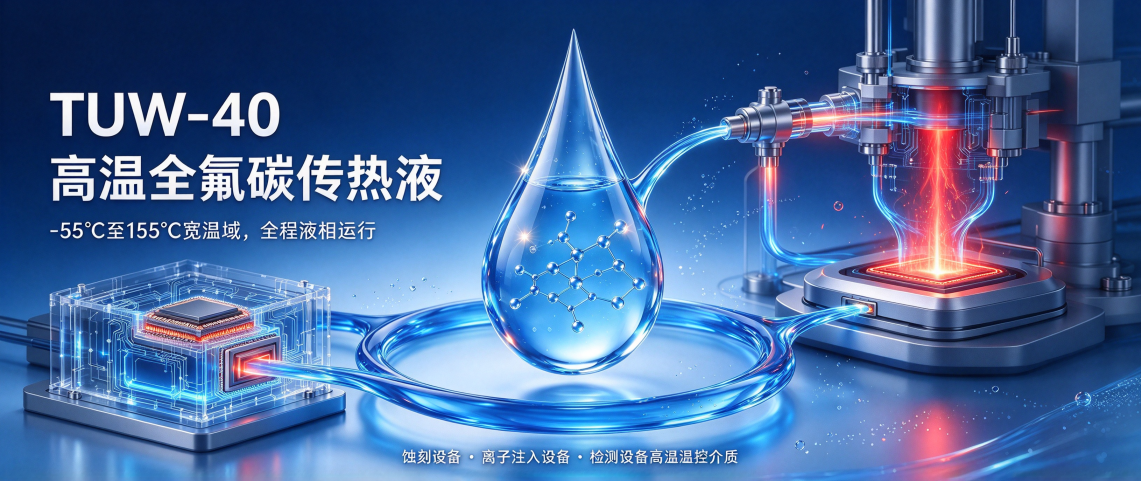
TUW-40 is a single-component perfluorinated heat-transfer fluid covering a liquid range of -55°C to 155°C. With a high boiling point and extremely low evaporation, it is designed for temperature control in etching equipment, ion implantation equipment, and inspection tools. This article details its physical properties, application scenarios, and positioning within the TUW series.
TUW-40 High-Temperature Perfluorocarbon Fluid: -55°C to 155°C Wide Temperature Range — Temperature Control for Etching and Ion Implantation High-Temperature Operations
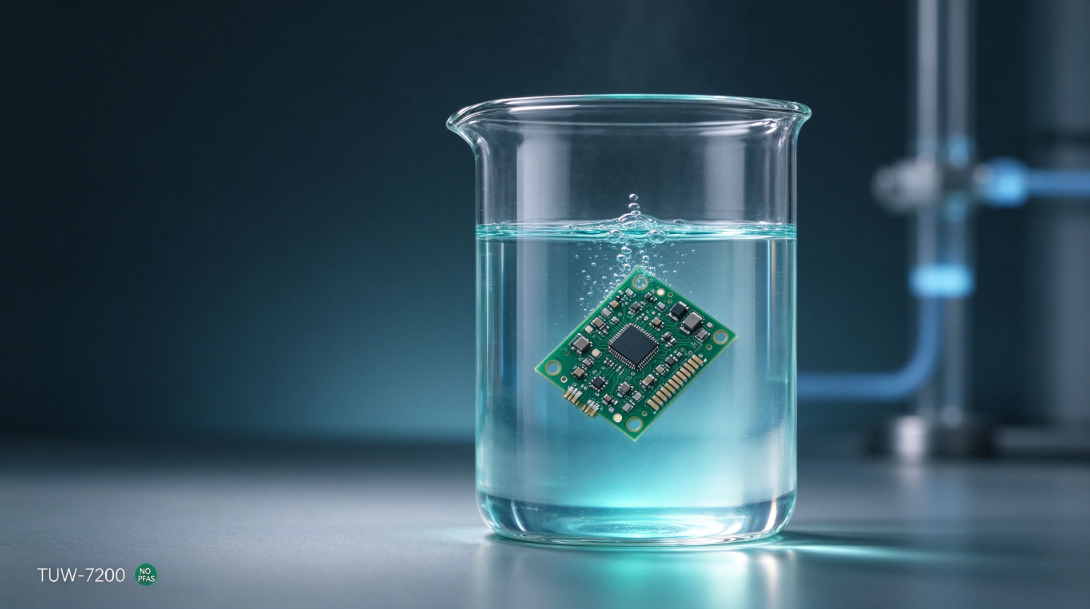
TUW-7200 is a thermally stable perfluorinated liquid that can be used as an electronic cleaning agent, precision cleaner, grease cleaner, cooling medium, hermeticity test fluid, thermostatic fluid, and extraction solvent. This article details its six uses and NO PFAS environmental attributes, and provides guidance on selecting a domestic alternative.
TUW-7200 Electronic Fluorinated Fluid: Precision Cleaning, Hermeticity Leak Testing, Thermostatic Bath — One Fluid for Three Uses, NO PFAS Domestic Alternative