
TUW-7100 Replaces 3M™ Novec™ 7100 for Efficient Degreasing of Precision Electronics
2025-03-12

Approaching the first quarter of 3M's withdrawal from the manufacture of fluorinated materials. Our product TUW-7100, with its ultra-low boiling point of 61°C and excellent dissolution performance, has officially become an ideal replacement for 3M™ Novec™ 7100.
As an “all-rounder” in both vapor phase decontamination and wet cleaning, TUW-7100 not only efficiently removes stubborn residues on precision electronic components, but also penetrates into micron-sized crevices with its extremely low surface tension, realizing “no-dead-angle” in-depth cleaning, and significantly enhancing the efficiency of the cleaning process. It can greatly improve the cleaning yield of semiconductor, optical instruments and other high-end manufacturing industries.
Core advantages at a glance:
✅ Low surface tension and boiling point of 61℃: Reduced loss and excellent performance.
✅ Strong dissolution compatibility: suitable for a variety of pollutants and materials.
✅ Environmentally safe: meets the stringent standards of industrial cleaning.
✅ Low surface tension and boiling point of 61℃: Reduced loss and excellent performance.
✅ Strong dissolution compatibility: suitable for a variety of pollutants and materials.
✅ Environmentally safe: meets the stringent standards of industrial cleaning.
Upgrade your cleaning program today and experience the revolutionary performance of TUW-7100!
The cooling demand for AI servers is soaring.
3M Novec Supplies Ring Alarm Bells at End of Quarter as Production Risks Surge, Tuwchem a Reliable Alternative
Related Article
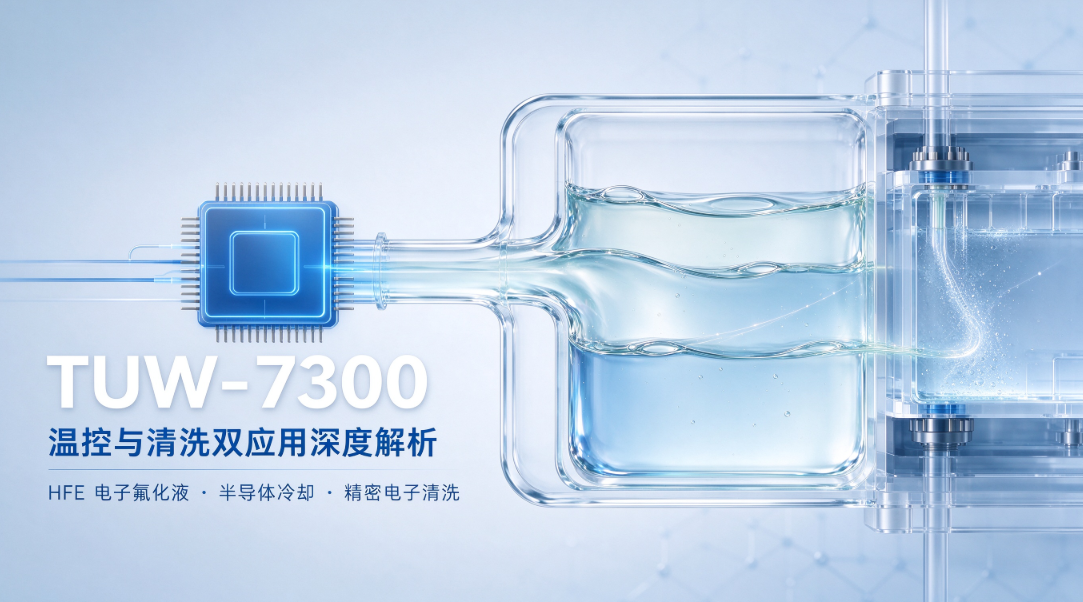
TUW-7300 is a thermally stable hydrofluoroether (HFE) electronic fluorinated fluid, benchmarked against 3M Novec 7300. It combines dual capabilities in semiconductor equipment temperature control and precision electronic cleaning. This article systematically analyzes the dual-scenario application value of TUW-7300, covering product positioning, temperature control applications, cleaning processes, performance parameters, and family product selection.
TUW-7300 HFE Electronic Fluorinated Fluid: In-Depth Analysis of Dual Applications in Semiconductor Equipment Temperature Control and Precision Cleaning

Traditional PCB conformal coating is thick, leaves BGA areas uncovered, and damages pads during rework. This article compares TUW-2704 and TUW-1700 fluoropolymer ultra-thin coatings on film thickness, rework, and protection, and provides selection guidance for NEV electronic control and consumer PCBs.
PCB Nano Conformal Coating Selection: TUW-2704 & TUW-1700 vs. Traditional Conformal Coating
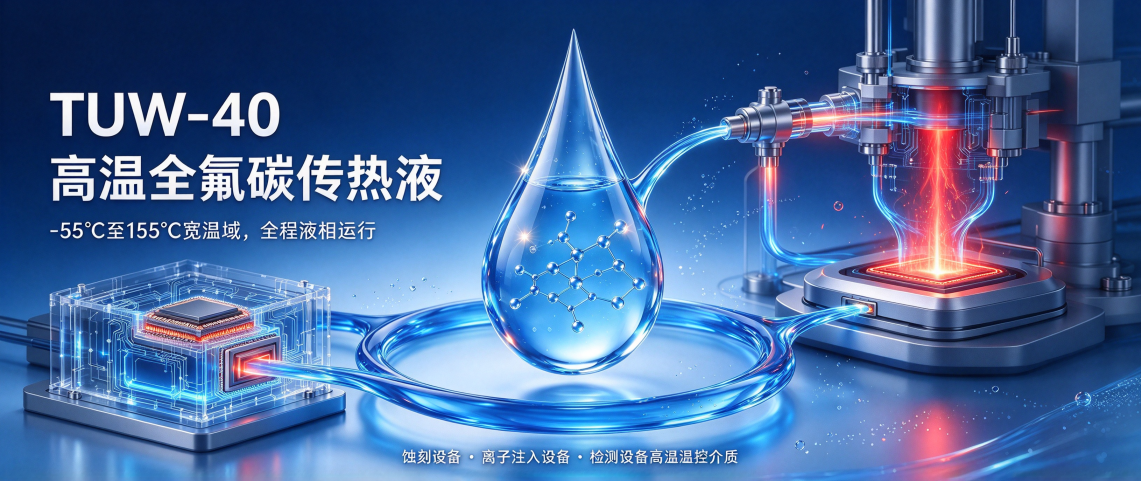
TUW-40 is a single-component perfluorinated heat-transfer fluid covering a liquid range of -55°C to 155°C. With a high boiling point and extremely low evaporation, it is designed for temperature control in etching equipment, ion implantation equipment, and inspection tools. This article details its physical properties, application scenarios, and positioning within the TUW series.
TUW-40 High-Temperature Perfluorocarbon Fluid: -55°C to 155°C Wide Temperature Range — Temperature Control for Etching and Ion Implantation High-Temperature Operations
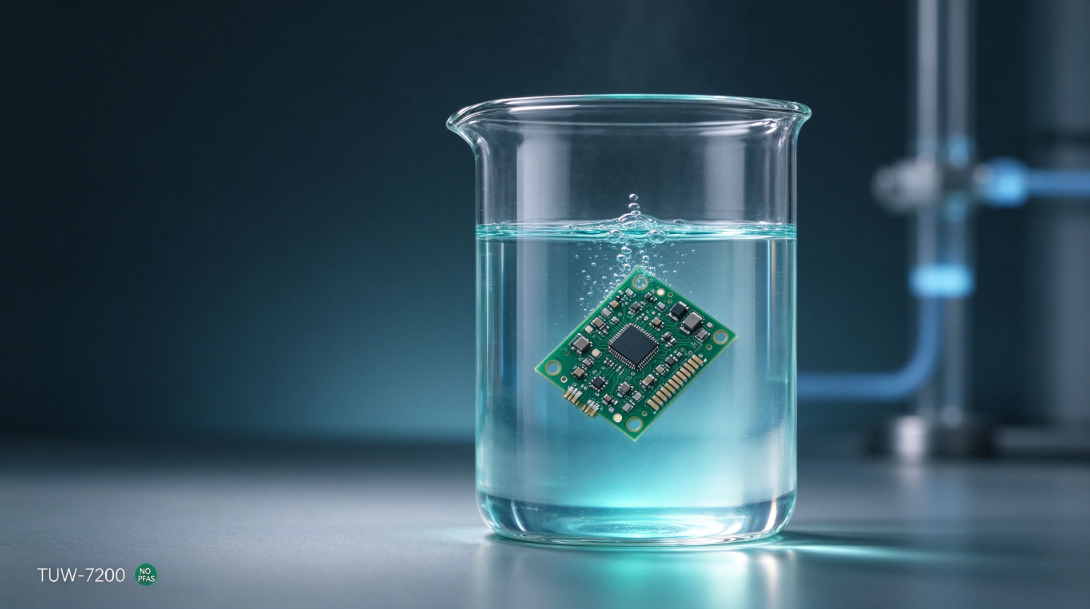
TUW-7200 is a thermally stable perfluorinated liquid that can be used as an electronic cleaning agent, precision cleaner, grease cleaner, cooling medium, hermeticity test fluid, thermostatic fluid, and extraction solvent. This article details its six uses and NO PFAS environmental attributes, and provides guidance on selecting a domestic alternative.
TUW-7200 Electronic Fluorinated Fluid: Precision Cleaning, Hermeticity Leak Testing, Thermostatic Bath — One Fluid for Three Uses, NO PFAS Domestic Alternative