
High-Prosperity Track Emerges! TUW-7500S Electronic Fluorinated Fluid Empowers the High-End Electronics Industry
2026-03-09

Against the backdrop of rapid iteration in high-end electronic industries such as semiconductors, AI computing power, and new energy vehicles, electronic fluorinated fluid, as a key functional material, has become the "process blood" supporting industrial upgrading with its unique product properties. The industry is embracing a golden period of rapid development. Among them, TUW-7500S, a high-purity electronic fluorinated fluid produced by electrolytic process, has become a core representative product in the process of domestic substitution thanks to its excellent comprehensive performance. From product characteristics to application scenarios, from market scale to industrial trends, the strategic value of TUW-7500S continues to stand out, helping the domestic electronic fluorinated fluid track achieve breakthroughs and promoting high-quality development of the industry.
Product Characteristics: TUW-7500S – The Benchmark of "All-Round Precision Fluid" in the High-End Electronics Field
Produced via advanced electrolytic technology, TUW-7500S electronic fluorinated fluid is a high-purity hydrofluoroether (HFE) product that can directly replace 3M Novec 7500. Its core advantages focus on six dimensions: high insulation, chemical inertness, low surface tension, high thermal stability, non-flammability, and low toxicity & environmental friendliness. It perfectly meets the stringent requirements of high-end electronic manufacturing and fills the market gap for domestic high-end fluorinated fluids. With CAS No. 16627-71-7, the product has a stable pH value of 6–7, is odorless and non-hazardous, and boasts a 5-year shelf life for long-term stable storage and use.
In terms of core performance, TUW-7500S features low viscosity (1–5 mPa·s) and high fluidity, suitable for microchannels and immersion circulation with lower pumping energy consumption. Its low surface tension (6–10 mN/m) enables penetration into micro/nano gaps, ensuring sufficient contact for cleaning and heat dissipation, with no residue after cleaning, fast drying and no extra drying steps. Its high insulation is particularly prominent: volume resistivity >10¹² Ω·cm, dielectric constant 2–3, allowing direct contact with live components and immersion cooling without power outage, fundamentally avoiding short circuits and circuit contamination.
In terms of purity and stability, the electrolytic process precisely controls impurities in TUW-7500S: metal ions ≤0.1 ppb, moisture <10 ppm, meeting the 5N high-purity standard for semiconductors. It is highly compatible with metals, plastics, rubbers and other materials, non-corrosive and non-coking. Meanwhile, its decomposition temperature exceeds 250℃, with no decomposition during long-term use. It has zero ozone depletion potential (ODP), complies with RoHS environmental standards, and can be recycled via distillation, balancing environmental protection and cost control, making it an indispensable core material for high-end electronics.
Application Scenarios: TUW-7500S Penetrates the Whole Industrial Chain, Supporting High-Quality Development in Multiple Fields
Relying on its excellent comprehensive properties, TUW-7500S fully covers the entire industrial chain of high-end electronic manufacturing and precision cooling. It is widely used in medical treatment, electronics, metals, precision instruments, optical lenses, communications, aerospace and many other fields, becoming a core supporting material for semiconductors, data centers, new energy vehicles and other sectors.
In semiconductor and integrated circuit manufacturing, TUW-7500S is widely used in key processes such as wafer cleaning, drying, etching and photoresist removal due to its ultra-high purity. As a temperature control coolant for semiconductor equipment, it adapts to etchers, ion implanters, lithography machines and other core devices, effectively ensuring chip yield and performance limits, making it an indispensable material for advanced processes. At present, domestic memory chip manufacturers such as Yangtze Memory Technologies and ChangXin Memory Technologies have introduced domestic high-purity fluorinated fluids including TUW-7500S into high-end production lines, gradually replacing imported products and promoting the self-reliance of the semiconductor industry.
With the explosion of AI computing power and the upgrading of energy-saving demand in data centers, the demand for TUW-7500S in immersion cooling is growing rapidly. It enables direct immersion cooling of servers, GPUs and other equipment, greatly improving heat dissipation efficiency and reducing data center energy consumption with its advantages of high insulation, non-flammability and high thermal stability, adapting to the industry trend of popularizing liquid cooling technology. According to industry data, China's annual demand for electronic fluorinated fluids in data centers exceeded 8,000 tons in 2025, among which TUW-7500S holds an important market share with its cost performance and stable performance. Its demand is expected to double in 2026 as liquid cooling penetration rises.
In addition, in the field of new energy vehicle electronics, TUW-7500S is used for cooling and cleaning core components such as vehicle controllers, motor controllers and BMS, ensuring the stable operation of automotive-grade electronic components. In electronic leak detection, precision instrument testing, aerospace and military electronics, its precise adaptability plays an irreplaceable role, with application scenarios continuously expanding.
Market Scale: 10-Billion-Yuan High-Growth Track, TUW-7500S Speeds Up Domestic Substitution
Benefiting from the continuous outbreak of downstream industries, the electronic fluorinated fluid market is growing rapidly and has become one of the most certain high-prosperity tracks in the electronic materials sector. According to industry estimates, the global electronic fluorinated fluid market reached approximately 1.65–1.86 billion USD (11.5–13 billion RMB) in 2025, with an annual growth rate of 8–10%. China's market scale reached 4.5 billion RMB, with an annual growth rate as high as 18–21% (more than twice the global growth rate) and a demand volume of about 33,500 tons.
By segment, in 2025 China's semiconductor manufacturing accounted for over 40% (1.8–2.0 billion RMB); data center/AI liquid cooling grew the fastest (1.2–1.5 billion RMB); new energy vehicle electronics reached 800 million–1 billion RMB, becoming a major growth engine. In the next three years, the global market is expected to exceed 3 billion USD by 2028, while China's market will surpass 10 billion RMB with a CAGR of over 25%.
Notably, the domestic electronic fluorinated fluid market was long monopolized by international giants such as 3M and Daikin, whose products including Novec 7500 once held over 60% of the global market share, and more than 60% of high-end semiconductor-grade products relied on imports. In recent years, however, domestic enterprises have achieved technological breakthroughs. Domestic products represented by TUW-7500S have gradually broken technological barriers and can directly replace 3M Novec 7500, with the domestic self-sufficiency rate reaching 45%. Recognized by many downstream enterprises for its stable performance, high cost-performance ratio and free sample service, TUW-7500S has been certified by leading wafer fabs, narrowing the gap with international products and accelerating domestic substitution. Meanwhile, improving industrial standards provide strong support for the standardized development of domestic products such as TUW-7500S.
Industry Trends: Policy Support + Technological Iteration Launch a New Journey for TUW-7500S
Currently, the electronic fluorinated fluid industry is in a triple-positive cycle of policy support, technological iteration and demand explosion. The national 14th Five-Year Plan clearly lists electronic chemicals as a strategic emerging industry, and the Ministry of Industry and Information Technology has included high-performance fluorinated fluids in the Catalogue of Demonstration Guidance for the First Batch of Key New Materials for many times. Policies in finance, taxation, scientific research and other aspects encourage enterprises to increase R&D investment and accelerate technological breakthroughs. At the same time, the "dual carbon" goal and stricter environmental regulations drive the industry to transform into eco-friendly products with low GWP, biodegradability and high thermal stability. TUW-7500S, with its low GWP and zero ODP, perfectly aligns with industrial trends and continues to expand its market share.
Technologically, the industry is accelerating toward high purity and refinement. Processes such as electrochemical fluorination are continuously optimized, and key indicators including metal ion residue control and thermal stability are steadily improved. As a typical product of electrolytic technology, TUW-7500S is undergoing continuous process upgrading and performance optimization, gradually breaking international technological barriers. With the advancement of 2nm and GAA transistor nodes, the molecular design of TUW-7500S will become more refined, balancing environmental friendliness and process compatibility to better meet advanced manufacturing requirements.
In the future, driven by accelerated semiconductor domestic substitution, higher liquid cooling data center penetration and upgraded new energy vehicle industry, the market demand for electronic fluorinated fluids will keep surging. Domestic products represented by TUW-7500S are expected to further increase market share with technological breakthroughs and cost advantages, promoting the industry to shift from "following" to "leading", and providing core material support for the self-reliance of China's high-end electronic industry.
3M Fluorinert™ Electronic Fluids and Novec™ Electronic Engineering Fluids: Redefining Standards for Thermal Management and Precision Manufacturing in the Electronics Industry
Promotion Essay for TUW-5060: The Ultimate Replacement for 3M™ PF-5060 Performance Fluid
Related Article

Traditional PCB conformal coating is thick, leaves BGA areas uncovered, and damages pads during rework. This article compares TUW-2704 and TUW-1700 fluoropolymer ultra-thin coatings on film thickness, rework, and protection, and provides selection guidance for NEV electronic control and consumer PCBs.
PCB Nano Conformal Coating Selection: TUW-2704 & TUW-1700 vs. Traditional Conformal Coating
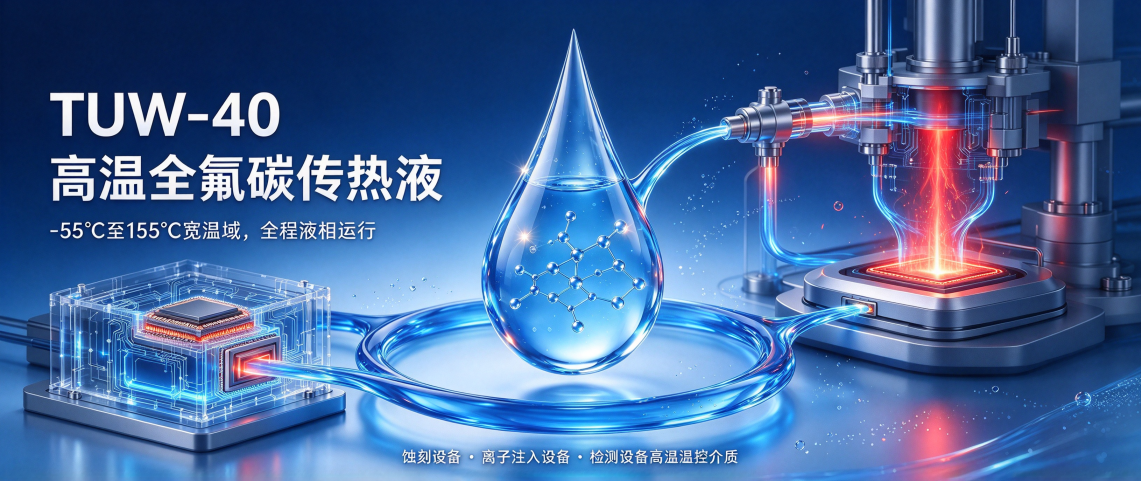
TUW-40 is a single-component perfluorinated heat-transfer fluid covering a liquid range of -55°C to 155°C. With a high boiling point and extremely low evaporation, it is designed for temperature control in etching equipment, ion implantation equipment, and inspection tools. This article details its physical properties, application scenarios, and positioning within the TUW series.
TUW-40 High-Temperature Perfluorocarbon Fluid: -55°C to 155°C Wide Temperature Range — Temperature Control for Etching and Ion Implantation High-Temperature Operations
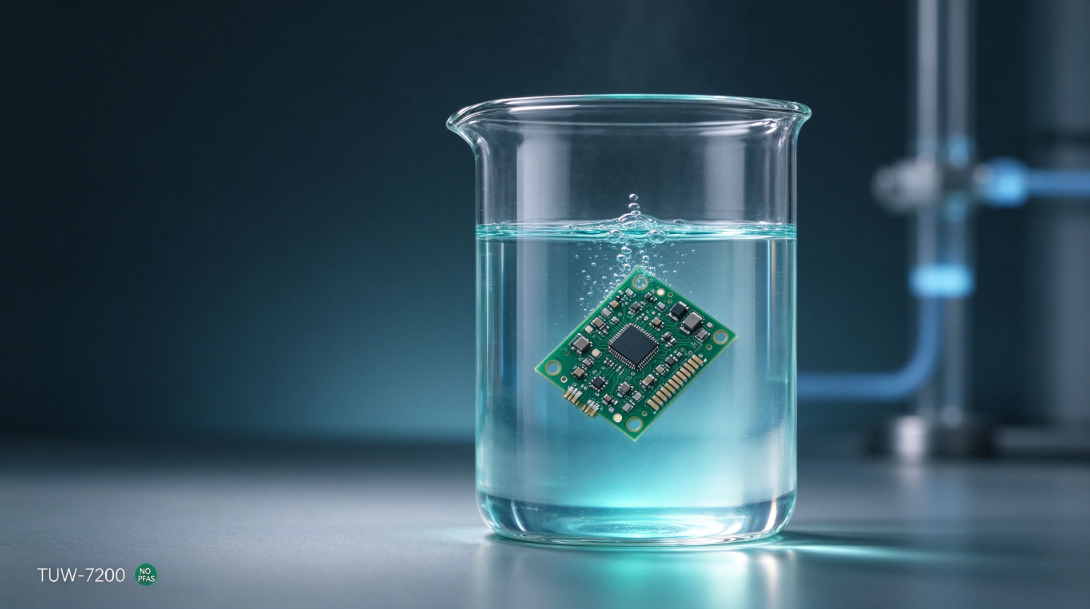
TUW-7200 is a thermally stable perfluorinated liquid that can be used as an electronic cleaning agent, precision cleaner, grease cleaner, cooling medium, hermeticity test fluid, thermostatic fluid, and extraction solvent. This article details its six uses and NO PFAS environmental attributes, and provides guidance on selecting a domestic alternative.
TUW-7200 Electronic Fluorinated Fluid: Precision Cleaning, Hermeticity Leak Testing, Thermostatic Bath — One Fluid for Three Uses, NO PFAS Domestic Alternative

TUW-347 and TUW-458 are two hydrofluoroether (HFE) eco-friendly solvents commonly used for cleaning, drying, dust removal, and non-condensable gas elimination. TUW-458 can also serve as a synthesis feedstock and electrolyte additive. This article details the chemical identities, technical parameters, application scenarios, and selection differences between the two products.
HFE Eco-Friendly Solvents TUW-347 & TUW-458: The "Invisible Assistants" for Drying, Dust Removal, and Non-Condensable Gas Elimination