
TUW Series Nano Waterproof Coating: The "Invisible Armor" for the LED Industry
2026-04-27
Introduction
The LED lighting industry has long been troubled by a chronic problem — premature equipment aging.
Outdoor LED display screens suffer from scattered dead lamp failure after one year of service in coastal cities; LED street lights malfunction frequently during plum rain seasons; landscape lighting equipment experiences accelerated light decay in high-temperature and high-humidity environments. While these issues appear to stem from product quality, the real culprit lies in the erosion of circuit boards caused by environmental factors including dampness, salt spray and condensation.
Conventional protection solutions such as three-proof paints and potting adhesives either feature thick coatings that hinder heat dissipation or fail to effectively block water vapor penetration, making it impossible to fundamentally resolve relevant defects. Today, an innovative protection technology is reshaping the industry landscape. The TUW Series Nano Waterproof Coating equips LED devices with a layer of "invisible armor" via a unique molecular-level protection mechanism.
I. Environmental Challenges Facing the LED Industry
1.1 Condensation: The Invisible Killer of LED Devices
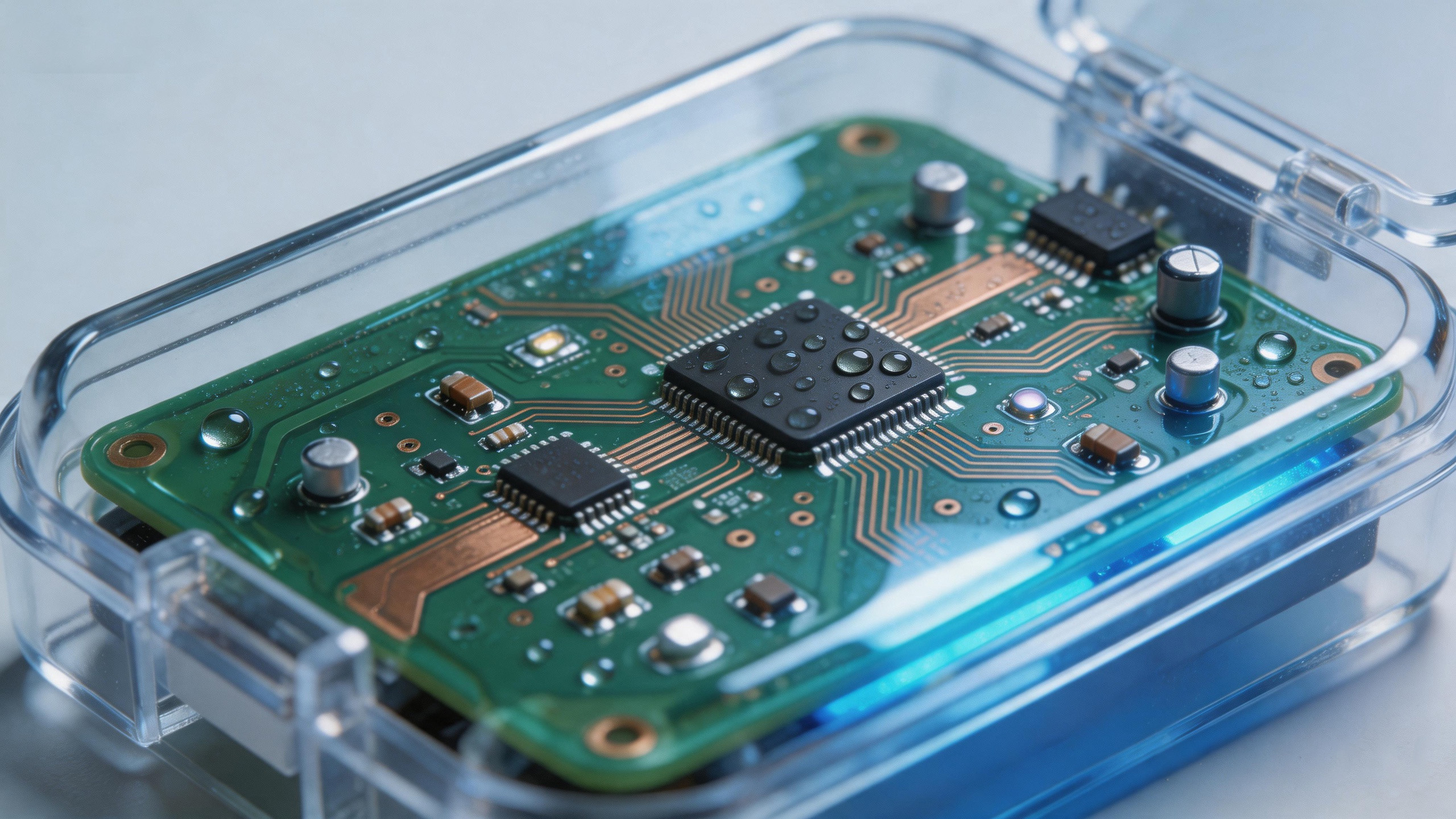
Condensation commonly occurs on LED equipment under drastic temperature differences and high humidity conditions. When the ambient temperature drops sharply, tiny water droplets form on key components of LED devices, including internal circuit boards, lamp bead pins and drive power supplies. Though barely visible to the naked eye, these droplets gradually trigger a series of failures:
- Electrical short circuits and current leakage caused by water droplets adhering to circuit lines
- Corroded metal pins, oxidized and green soldering joints, and increased contact resistance
- Electrochemical migration that leads to circuit short circuits under electric fields
- Aggravated light decay resulting from poor heat dissipation due to corroded lamp bead pins
- Greatly shortened service life of equipment
Data shows that the average service life of LED devices without effective protection is merely 30%-50% of the designed lifespan in high-humidity environments.
1.2 Limitations of Traditional Protection Solutions
Three mainstream protection solutions are widely adopted in the LED industry, with obvious drawbacks respectively:
| Protection Solution | Major Defects |
|---|---|
| Traditional Three-proof Paint | Low contact angle (<120°) prone to water film formation; thick coating (30-50μm) impairing heat dissipation; porous structure allowing water vapor penetration |
| Potting Adhesive | Excessively thick layer severely blocking heat dissipation; increased equipment weight; difficult and costly maintenance |
| Parylene | Requires vacuum equipment with high costs; slow deposition speed incompatible with large-scale mass production |
The core defect of traditional three-proof paints is surface attachment rather than surface integration. Interfaces exist between coatings and base materials, enabling water vapor to penetrate through coating pores and condense at interfaces to form an "invisible condensation layer". This explains why many devices suffer internal corrosion even with intact surface coatings.
II. Four Core Applications of TUW Nano Coating
2.1 Application 1: Fundamental Condensation Prevention
Adopting an exclusive micro-nano composite structure, the TUW Series Nano Waterproof Coating forms a superhydrophobic barrier on PCB surfaces.
Core Technical Parameters:
- Contact angle ≥ 160°: Water droplets roll off rapidly without forming continuous water films
- Coating thickness: only 1-3μm, 1/10 to 1/30 of traditional three-proof paints, causing no obstruction to heat dissipation
- Full barrier protection: Molecular penetration isolates water vapor from reaching substrate interfaces
Application Scenarios:Outdoor LED display screens, LED street lights and tunnel lights, landscape lighting control systems, traffic signal lights
2.2 Application 2: Efficient Waterproofing & Moisture Resistance
The TUW nano coating has passed the IPX7 waterproof rating test, ensuring normal circuit functions after 30 minutes of immersion in 1-meter-deep water.
| Protection Grade | Traditional Three-proof Paint | TUW Nano Coating |
|---|---|---|
| Waterproof Rating | IPX4-IPX5 | IPX7 |
| Immersion Test | Failure within 30 minutes | No damage after 30 minutes |
| High Humidity Test | 200-300 hours of durability | Over 1,000 hours of durability |
It is highly suitable for LED lamps in plum rain-prone southern regions, underground parking lot lighting, swimming pools, bathrooms and other high-humidity environments.
2.3 Application 3: Salt Spray Corrosion Resistance
LED equipment in coastal areas faces severe salt spray erosion. The TUW nano coating remains corrosion-free after 96 hours of neutral salt spray testing, with certain models reaching up to 500 hours.
| Test Item | Traditional Three-proof Paint | TUW Nano Coating |
|---|---|---|
| Neutral Salt Spray Test | Corrosion within 48 hours | No corrosion for over 96 hours |
| Seawater Immersion | Corrosion within 24 hours | No corrosion for 168 hours |
| Coastal Field Test | Failure within 6 months | Durability for over 18 months |
Typical Applications:Coastal urban LED street lights, offshore platform lighting equipment, port and dock LED indicator lights, marine LED lighting systems
2.4 Application 4: Heat Dissipation Protection & Light Efficiency Maintenance
Different from the bulky layer of traditional three-proof paints, the ultra-thin 1-3μm TUW nano coating barely affects the heat dissipation performance of LED products.
| Parameter | Traditional Three-proof Paint | TUW Nano Coating |
|---|---|---|
| Coating Thickness | 30-50μm | 1-3μm |
| Increased Thermal Resistance | Significant | Negligible |
| LED Light Decay | Accelerated | Normal |
| Light Transmittance Impact | Obvious | Fully transparent with zero impact |
This feature is particularly critical for high-power LEDs. The coating never hinders heat emission and avoids aggravated condensation caused by heat insulation.
III. Comprehensive Performance Comparison: TUW Nano Coating vs Traditional Three-proof Paint
表格
| Performance Indicator | Traditional Three-proof Paint | TUW Nano Coating | Advantage Description |
|---|---|---|---|
| Condensation Resistance | Weak, only delayed effect | Strong, fundamental inhibition | Contact angle increased by over 40° |
| Contact Angle | <120° | ≥160° | Prevent water droplet adhesion |
| Coating Thickness | 30-50μm | 1-3μm | Unobstructed heat dissipation |
| Waterproof Grade | IPX4-IPX5 | IPX7 | Supports immersion protection |
| Salt Spray Resistance | Corrosion within 48 hours | No corrosion for over 96 hours | More than doubled durability |
| Water Vapor Barrier | Poor | Excellent | Zero penetration |
| Construction Method | Spraying/Brushing with shielding required | Direct dipping without shielding | Production efficiency increased by over 5 times |
| Curing Time | 24-hour air drying or baking | 3-minute room-temperature curing | Greatly shortened production cycle |
| Maintenance Convenience | Requires peeling with substrate damage | Removable via alcohol wiping | Lower maintenance costs |
| Environmental Performance | Partial VOC content | Zero VOC | Eco-friendly production |
IV. Construction Technology & Production Efficiency
The TUW nano coating supports diverse construction methods to adapt to diversified production scenarios.
4.1 Dipping Process (Recommended)
- No shielding required: Direct protection for connectors, switches, sensors and other components
- 3-second dipping: Complete coating for circuit boards in seconds
- 3-minute room-temperature curing: No baking required
- Recyclable chemicals with low material loss
4.2 Spraying Process
Suitable for large-area PCB boards, supports selective coating, and seamlessly compatible with existing production lines.
Production Efficiency Upgrade:
- Traditional three-proof paint: Shielding, coating and baking, 4-8 hours per cycle
- TUW nano coating: Dipping plus room-temperature curing, completed within 10 minutes
V. Conclusion
With intensifying competition in the LED industry, product reliability has become a core competitive advantage for manufacturers. Boasting outstanding performance in condensation prevention, waterproofing, moisture resistance and salt spray resistance, alongside ultra-thin design and convenient construction, the TUW Series Nano Waterproof Coating is establishing a new standard for LED equipment protection.
From outdoor display screens and street lighting to coastal and high-humidity environment equipment, TUW nano coating delivers reliable protection solutions for a growing number of LED enterprises. Adopting TUW nano coating means not only upgrading protection technology, but also achieving lower overall costs, higher product quality and stronger market competitiveness.
From mountaineering apparel to battery breathable membranes — Huayi Brothers’ eco-friendly water and oil repellent safeguards compliance for protective, electronics and industrial sectors.
TUW-71DA/72DA Precision Cleaning Series Electronic Fluorinated Liquids, Empowering Domestic Substitution
Related Article

Traditional PCB conformal coating is thick, leaves BGA areas uncovered, and damages pads during rework. This article compares TUW-2704 and TUW-1700 fluoropolymer ultra-thin coatings on film thickness, rework, and protection, and provides selection guidance for NEV electronic control and consumer PCBs.
PCB Nano Conformal Coating Selection: TUW-2704 & TUW-1700 vs. Traditional Conformal Coating
TUW-40 is a single-component perfluorinated heat-transfer fluid covering a liquid range of -55°C to 155°C. With a high boiling point and extremely low evaporation, it is designed for temperature control in etching equipment, ion implantation equipment, and inspection tools. This article details its physical properties, application scenarios, and positioning within the TUW series.
TUW-40 High-Temperature Perfluorocarbon Fluid: -55°C to 155°C Wide Temperature Range — Temperature Control for Etching and Ion Implantation High-Temperature Operations
TUW-7200 is a thermally stable perfluorinated liquid that can be used as an electronic cleaning agent, precision cleaner, grease cleaner, cooling medium, hermeticity test fluid, thermostatic fluid, and extraction solvent. This article details its six uses and NO PFAS environmental attributes, and provides guidance on selecting a domestic alternative.
TUW-7200 Electronic Fluorinated Fluid: Precision Cleaning, Hermeticity Leak Testing, Thermostatic Bath — One Fluid for Three Uses, NO PFAS Domestic Alternative

TUW-347 and TUW-458 are two hydrofluoroether (HFE) eco-friendly solvents commonly used for cleaning, drying, dust removal, and non-condensable gas elimination. TUW-458 can also serve as a synthesis feedstock and electrolyte additive. This article details the chemical identities, technical parameters, application scenarios, and selection differences between the two products.
HFE Eco-Friendly Solvents TUW-347 & TUW-458: The "Invisible Assistants" for Drying, Dust Removal, and Non-Condensable Gas Elimination