
Electronic Coating Agents: Why They Become the Preferred Protection Solution in the Electronics Industry
2026-05-15
Introduction
In electronic manufacturing, protection is not merely a technical issue, but also concerns cost control, production efficiency and even sustainable development.
Outdoor communication equipment, BMS systems of new energy vehicles, mainboards of smart home appliances are all constantly exposed to moisture, salt spray, dust and corrosion. Traditional protection methods were once sufficient, yet as electronic devices grow more compact, operating environments become harsher and customers set higher standards for product reliability, mere adequacy has turned into a major hidden risk.
This is a common dilemma across the whole electronic manufacturing industry: what is the most suitable electronic protection solution for current demands?
The answer is undergoing a fundamental shift.
I. Limitations of Traditional Solutions: Outdated Methods Fail to Meet New Demands
Traditional Conformal Coatings: Functional yet Costly
Long widely applied in the industry, traditional conformal coatings have obvious drawbacks.
| Comparison Item | Traditional Conformal Coating | Nano Electronic Coating Agent |
|---|---|---|
| Coating Thickness | 30-100 microns | 5-10 microns |
| Heat Dissipation Impact | Greatly increases thermal resistance | Negligible impact |
| Construction Efficiency | Complicated spraying and brushing processes | Dip coating in 3 seconds, room temperature curing |
| Flexibility | Brittle, prone to cracking and peeling | Excellent, no cracking after bending |
| Repairability | Difficult to remove, needs heating | Supports selective partial treatment |
The thickness gap directly restricts core performance. Thick coatings hinder heat dissipation of high-power chips and occupy precious internal space, conflicting with the miniaturization trend of electronic products.
Potting Compounds: Full Protection with Irreversible Drawbacks
Potting compounds deliver superior protection, yet their fully sealed structure brings many disadvantages. Once components need maintenance or replacement, the whole potting layer has to be removed. They add excessive weight, fail to adapt to lightweight design, require hours or even over 24 hours for curing to slow down production, and show poor flexibility for bending and vibration scenarios.
In short, full protection by potting compounds comes at the cost of maintainability and production efficiency.
Heat Shrinkable Tubes & Physical Protection: Temporary Isolation with Poor Durability
Heat shrinkable tubes only provide simple physical isolation with poor thermal conductivity and difficult fitting for complex structures. They age easily after long-term use and cannot ensure stable insulation performance, making them incompetent for high-reliability application scenarios.
II. Breakthrough of Electronic Coating Agents: Redefine Protection in Four Core Aspects
Nano electronic coating agents perfectly resolve the conflict between performance and practicality of traditional solutions.
1. Process Advantage: Dramatically Boost Production Efficiency
Dip-type nano coatings achieve revolutionary construction efficiency. Workpieces can be fully coated without dead corners within 3 seconds, get surface dry in 3-5 minutes at room temperature with no oven required. No masking work is needed for connectors and precision parts, and partial rework is available conveniently.
表格
| Construction Method | Single-piece Processing Time | Curing Condition | Equipment Investment |
|---|---|---|---|
| Traditional Conformal Coating | 5-15 minutes | Heat curing | High investment in spraying equipment and fixtures |
| Potting Compound | 30 mins - 2 hours | Room temperature / heat curing | High cost for mixing equipment and molds |
| Heat Shrinkable Tube | 3-8 minutes | Heat shrinking | Special heating equipment required |
| Nano Coating Agent | Within 30 seconds | Natural room temperature curing | Minimal equipment investment |
It greatly raises daily output and cuts unit production costs for mass electronic production lines.
2. Performance Advantage: Ultra-thin Film with Superior Protection
表格
| Performance Index | Traditional Conformal Coating | Potting Compound | Typical Nano Electronic Coating Agent |
|---|---|---|---|
| Coating Thickness | 30-100μm | Full encapsulation | 5-10μm |
| Water Contact Angle | 90°-110° | N/A | ≥160° |
| Salt Spray Resistance | 200-500 hours | Over 1000 hours | Over 1000 hours |
| Insulation Resistance | 10⁹-10¹⁰Ω | 10¹²Ω | 10¹²Ω |
| Flexibility | Poor | Poor | Excellent, supports 180° bending |
With super-hydrophobic lotus leaf effect, water droplets slide off easily without infiltration, effectively protecting devices in coastal, humid and extreme outdoor environments and extending service life greatly.
3. Cost Advantage: Optimize Total Comprehensive Cost
Though the raw material price is not the lowest, it owns outstanding advantages in Total Cost of Ownership. Traditional coatings involve high equipment depreciation, labor cost and high rework rate; potting compounds have high material and maintenance costs. Nano coating agents simplify working procedures, lower defect rate and after-sales cost, achieving better comprehensive economic benefits.
4. Environmental Protection Advantage: Comply with Global Regulatory Standards
With increasingly strict global regulations including EU RoHS and REACH, as well as stricter control over PFAS substances, low-VOC and eco-friendly coating materials have become essential. Electronic coating agents adopt optimized fluorinated solvent systems to meet stringent environmental protection requirements and facilitate global market access.
III. Industry Trends: Prime Time for Popularization
-
Restructured Supply ChainSince 2023, mainstream international enterprises have gradually withdrawn from PFAS-related businesses, leaving a huge market gap which is rapidly filled by domestic alternative electronic coating solutions.
-
Miniaturization Trend of Electronic DevicesConsumer electronics, automotive electronics and IoT devices are developing towards miniaturization and lightweight design. Ultra-thin nano coatings are perfectly compatible with such trends while traditional thick coatings are eliminated gradually.
-
Diversified Extreme Application ScenariosNew energy vehicles, outdoor base stations, marine electronic equipment and intelligent hardware used in extreme climates raise higher protection standards, accelerating the phase-out of backward traditional protection technologies.
Solvay Galden® HT: PFPE Heat Transfer Fluid Solution with Wide Temperature Range from -70°C to 290°C
New Solvent-Based Fluorinated Silicone Release Agent – Empowering High-Performance PSA Release Treatment for Uniform and Stable Release Force
Related Article

Traditional PCB conformal coating is thick, leaves BGA areas uncovered, and damages pads during rework. This article compares TUW-2704 and TUW-1700 fluoropolymer ultra-thin coatings on film thickness, rework, and protection, and provides selection guidance for NEV electronic control and consumer PCBs.
PCB Nano Conformal Coating Selection: TUW-2704 & TUW-1700 vs. Traditional Conformal Coating
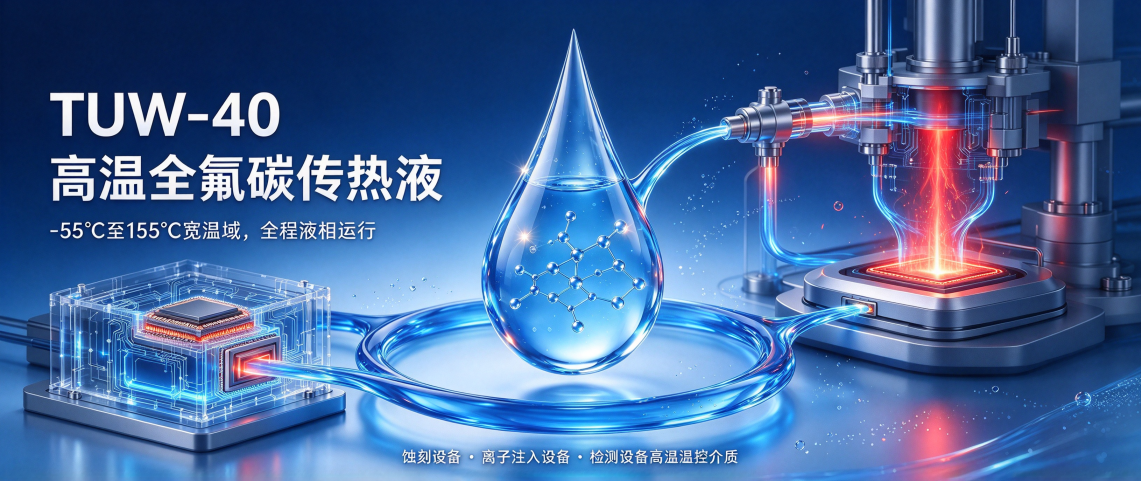
TUW-40 is a single-component perfluorinated heat-transfer fluid covering a liquid range of -55°C to 155°C. With a high boiling point and extremely low evaporation, it is designed for temperature control in etching equipment, ion implantation equipment, and inspection tools. This article details its physical properties, application scenarios, and positioning within the TUW series.
TUW-40 High-Temperature Perfluorocarbon Fluid: -55°C to 155°C Wide Temperature Range — Temperature Control for Etching and Ion Implantation High-Temperature Operations
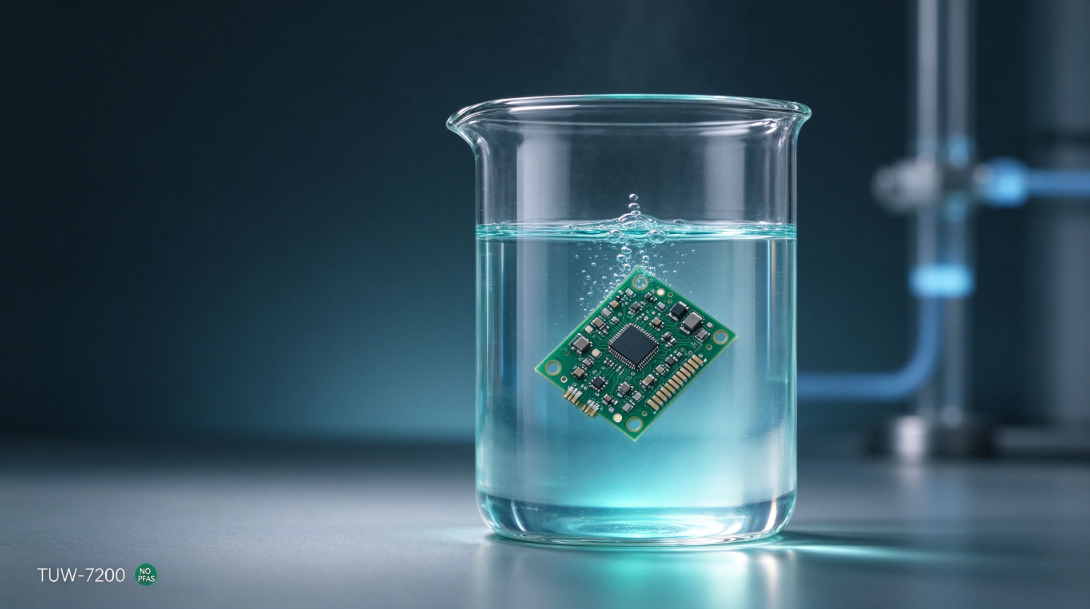
TUW-7200 is a thermally stable perfluorinated liquid that can be used as an electronic cleaning agent, precision cleaner, grease cleaner, cooling medium, hermeticity test fluid, thermostatic fluid, and extraction solvent. This article details its six uses and NO PFAS environmental attributes, and provides guidance on selecting a domestic alternative.
TUW-7200 Electronic Fluorinated Fluid: Precision Cleaning, Hermeticity Leak Testing, Thermostatic Bath — One Fluid for Three Uses, NO PFAS Domestic Alternative
TUW-347 and TUW-458 are two hydrofluoroether (HFE) eco-friendly solvents commonly used for cleaning, drying, dust removal, and non-condensable gas elimination. TUW-458 can also serve as a synthesis feedstock and electrolyte additive. This article details the chemical identities, technical parameters, application scenarios, and selection differences between the two products.
HFE Eco-Friendly Solvents TUW-347 & TUW-458: The "Invisible Assistants" for Drying, Dust Removal, and Non-Condensable Gas Elimination