
Solvay Galden® HT: PFPE Heat Transfer Fluid Solution with Wide Temperature Range from -70°C to 290°C
2026-05-19

As a leading enterprise in the field of high-performance specialty polymers, Solvay continuously delivers innovative thermal management solutions for key industries including semiconductors, chemical processing, pharmaceuticals, power generation and nuclear energy. Recently, Solvay officially launched its Galden® HT series perfluoropolyether (PFPE) heat transfer fluids. Featuring an ultra-wide operating temperature range from -70°C to 290°C, along with outstanding chemical inertness and dielectric properties, this product line serves as an ideal solution for high-standard thermal management applications.
Wider Boiling Point Range to Meet Diverse Process Requirements
The Galden® HT series covers multiple grades ranging from HT55 to HT270, with boiling points spanning 55°C to 270°C and pour points below -125°C. Its practical operating temperature extends as low as -100°C and as high as 290°C. This exceptional wide temperature range sets it apart from conventional fluorinated heat transfer fluids, enabling it to handle both low-temperature refrigeration and high-temperature heat dissipation efficiently.
Core Characteristics & Safety Advantages
- Superior Thermal Stability & Chemical Inertness: Fully fluorinated non-polar structure ensures barely any reaction with metals, plastics and elastomers, delivering excellent material compatibility.
- Outstanding Dielectric Performance: Dielectric strength reaches 40 kV (at 2.54 mm gap), and volume resistivity stands at 10¹⁴~10¹⁶ Ω·cm, making it suitable for immersion cooling of electrical equipment such as transformers and supercomputers.
- Inherent Safety: Non-flash point, non-autoignition and explosion-proof, certified with FM Approvals 6930.
- Low Evaporation Loss: High-boiling grades including HT230 and HT270 feature extremely low evaporation rate at high temperatures, supporting long-term stable operation at 260°C without pressurized systems.
Precise Selection by Three Temperature Zones
| Temperature Zone | Recommended Grades | Typical Application Scenarios |
|---|---|---|
| Low Temperature | HT55, HT70, HT80 | Sub -100°C cryogenic processes, freeze drying, cooling of pharmaceutical reaction kettles |
| Medium Temperature | HT110, HT135, HT170 | Low volatility and leakage prevention below 0°C, replacement of high-evaporation fluids |
| High Temperature | HT200, HT230, HT270 | 260°C high-temperature aging tests, semiconductor etching, nuclear power thermal management |
Eco-friendliness & Low-maintenance Design
Galden® HT series has zero ozone depletion potential (ODP). It is recommended for use in closed-loop systems to minimize environmental emissions. Its non-corrosive nature and inherent stability greatly reduce fluid replacement frequency and maintenance costs, helping clients improve overall equipment effectiveness (OEE).
Broad Material Compatibility
These fluids are fully compatible with metals such as AISI 316 steel, copper, aluminum and stainless steel; plastics including PE, PP, PTFE, PVC and polycarbonate; as well as elastomers like butyl rubber, NBR, EPDM and silicone rubber. Over 99% of industrial polymer plasticizers are hydrocarbon-based, which show no affinity with Galden® fluids, thus eliminating the risk of plasticizer precipitation.
Application Fields
- Semiconductor manufacturing (temperature control for etching and deposition chambers)
- Chemical and pharmaceutical industry (jacket heating and cooling for reaction kettles)
- Vapor phase heating processes
- Immersion cooling for transformers and supercomputers
- Thermal management for nuclear facilities
Application of Hydrofluoroether Solvent 7200 in Precision Cleaning
Electronic Coating Agents: Why They Become the Preferred Protection Solution in the Electronics Industry
Related Article

Traditional PCB conformal coating is thick, leaves BGA areas uncovered, and damages pads during rework. This article compares TUW-2704 and TUW-1700 fluoropolymer ultra-thin coatings on film thickness, rework, and protection, and provides selection guidance for NEV electronic control and consumer PCBs.
PCB Nano Conformal Coating Selection: TUW-2704 & TUW-1700 vs. Traditional Conformal Coating
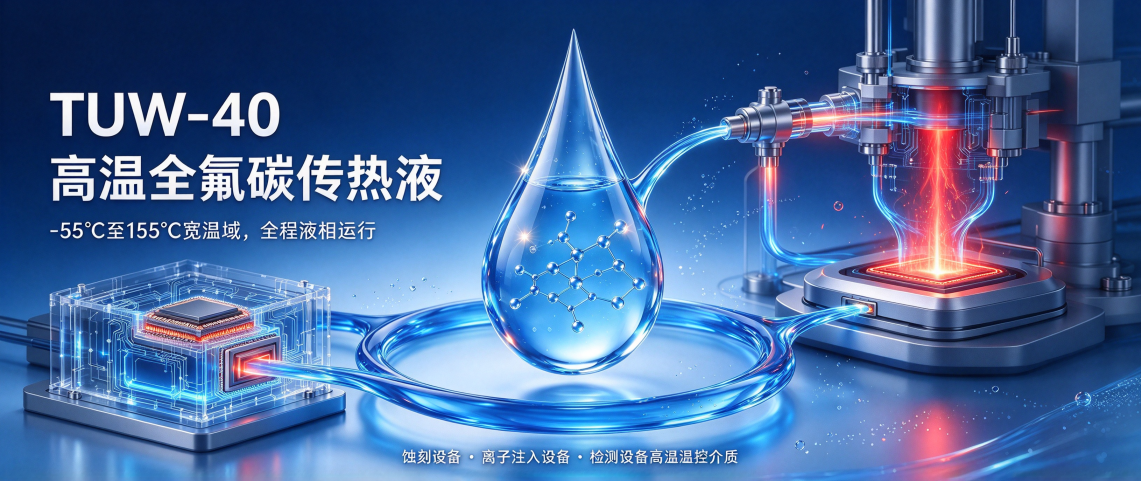
TUW-40 is a single-component perfluorinated heat-transfer fluid covering a liquid range of -55°C to 155°C. With a high boiling point and extremely low evaporation, it is designed for temperature control in etching equipment, ion implantation equipment, and inspection tools. This article details its physical properties, application scenarios, and positioning within the TUW series.
TUW-40 High-Temperature Perfluorocarbon Fluid: -55°C to 155°C Wide Temperature Range — Temperature Control for Etching and Ion Implantation High-Temperature Operations
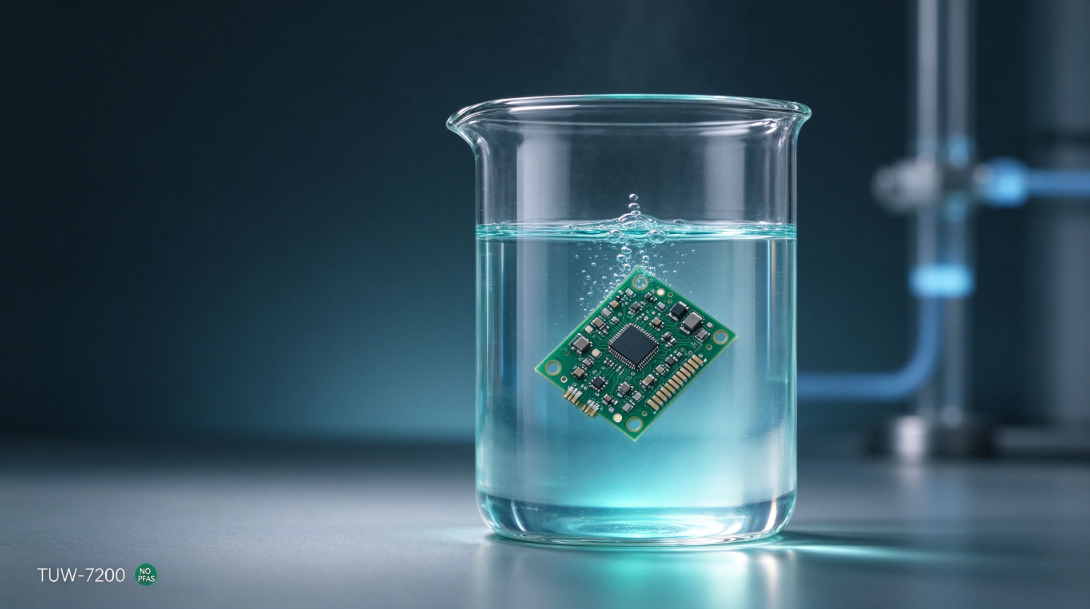
TUW-7200 is a thermally stable perfluorinated liquid that can be used as an electronic cleaning agent, precision cleaner, grease cleaner, cooling medium, hermeticity test fluid, thermostatic fluid, and extraction solvent. This article details its six uses and NO PFAS environmental attributes, and provides guidance on selecting a domestic alternative.
TUW-7200 Electronic Fluorinated Fluid: Precision Cleaning, Hermeticity Leak Testing, Thermostatic Bath — One Fluid for Three Uses, NO PFAS Domestic Alternative

TUW-347 and TUW-458 are two hydrofluoroether (HFE) eco-friendly solvents commonly used for cleaning, drying, dust removal, and non-condensable gas elimination. TUW-458 can also serve as a synthesis feedstock and electrolyte additive. This article details the chemical identities, technical parameters, application scenarios, and selection differences between the two products.
HFE Eco-Friendly Solvents TUW-347 & TUW-458: The "Invisible Assistants" for Drying, Dust Removal, and Non-Condensable Gas Elimination