
Potassium Perfluorobutanesulfonate: The "Invisible Guardian" for Flame Retardancy and Antistatic Properties of Engineering Plastics
2026-06-18

Background Introduction
With the rapid development of electrical and electronic equipment, automotive lightweighting and semiconductor packaging, the flame retardant and antistatic properties of engineering plastics have become critical thresholds for product safety. Polycarbonate (PC) is widely used in electronic housings, optical devices and automotive interiors due to its excellent transparency and mechanical strength. However, it has limited inherent flame retardancy. Traditional halogen-based flame retardants can improve flame resistance but usually compromise the transparency of materials and may release toxic hydrogen halide gases during combustion. Achieving efficient flame retardancy while maintaining the original transparency of materials has long been an unsolved technical contradiction in the engineering plastics industry. The emergence of perfluoroanionic surfactants provides a brand-new solution to this challenge, delivering dual functions of flame retardancy and antistatic performance at an extremely low dosage without impairing the optical properties of the substrate.
Product Introduction
Potassium perfluorobutanesulfonate is a perfluoroanionic surfactant that features the general properties of fluorosurfactants, including low surface tension and high thermal stability. As a special additive for flame retardant and antistatic modification of engineering plastics, it exhibits outstanding performance in polycarbonate systems and is regarded as one of the best available flame retardants for PC materials. In addition, it is compatible with various transparent resins such as polystyrene, polyimide, polyester and polyamide. It can improve the flame retardant rating and transparency of materials simultaneously, realizing a win-win effect of "flame retardancy and high transparency".
Technical & Performance Characteristics
|
Test Item
|
Quality Standard
|
|
Purity
|
≥ 99%
|
|
Appearance
|
Crystalline white powder
|
|
pH Value
|
5 ~ 7
|
|
Water Content
|
≤ 500 ppm
|
|
Sulfate Content
|
≤ 10 ppm
|
|
Free Fluorine
|
≤ 20 ppm
|
|
Calcium Content
|
≤ 30 ppm
|
|
Iron Content
|
≤ 5 ppm
|
|
Sodium Content
|
≤ 35 ppm
|
|
Particle Size (HS Grade)
|
75 ~ 180 μm
|
|
Particle Size (HSM Grade)
|
37 ~ 75 μm
|
The product is available in two particle size grades to adapt to different processing technologies. The HS grade is suitable for conventional compounding and extrusion processes, while the finer particle size distribution of the HSM grade facilitates uniform dispersion, making it ideal for precision injection molding scenarios with high dispersion requirements. The high purity of ≥99% and strictly controlled metal ion content (Ca ≤ 30 ppm, Fe ≤ 5 ppm, Na ≤ 35 ppm) ensure the reliability of materials in impurity-sensitive applications such as semiconductors and precision electronics.
Application Value
Electrical and Electronic Industry: PC housings and connectors can achieve a V-0 flame retardant rating while maintaining high transparency, meeting the dual requirements of safety and aesthetics for consumer electronics and industrial equipment.
Automotive Industry: Against the backdrop of automotive lightweighting, PC/ABS alloys are widely used in automotive interiors and lighting systems. The low dosage requirement of potassium perfluorobutanesulfonate avoids degradation of material mechanical properties and endows products with long-term antistatic performance to reduce dust adsorption.
Semiconductors and Precision Electronics: The ultra-fine particle size of the HSM grade ensures uniform dispersion in high-performance resins such as polyimide, and the low metal ion content meets the cleanliness requirements of chip packaging environments.
Optical Materials: When compounded with transparent resins including PET and PS, the product causes no increase in haze after flame retardant treatment, applicable to high-transmittance-sensitive components such as optical lenses and display panels.
Safety & Compliance Guidelines
Containing a perfluoroalkyl sulfonate (PFAS) structure, this product is categorized as a persistent organic pollutant. Its production, application and waste disposal must strictly comply with local PFAS regulatory standards, including EU REACH, US TSCA and relevant Chinese industry specifications. Operators shall wear protective gloves and goggles to avoid inhalation of dust, and the product shall be hermetically sealed after opening to prevent moisture absorption. It may decompose to produce toxic gases such as hydrogen fluoride at high temperatures (>200°C), so sufficient ventilation must be ensured during processing.
Perfluoropolyether (PFPE) Oil as Cosmetic Additive: Core Edge – Silky Slip Without Greasiness
Perfluoropolyether Special Additives for Cosmetics: A New Solution for Long-Lasting Skin Care "Liquid Glove"
Related Article

Traditional PCB conformal coating is thick, leaves BGA areas uncovered, and damages pads during rework. This article compares TUW-2704 and TUW-1700 fluoropolymer ultra-thin coatings on film thickness, rework, and protection, and provides selection guidance for NEV electronic control and consumer PCBs.
PCB Nano Conformal Coating Selection: TUW-2704 & TUW-1700 vs. Traditional Conformal Coating
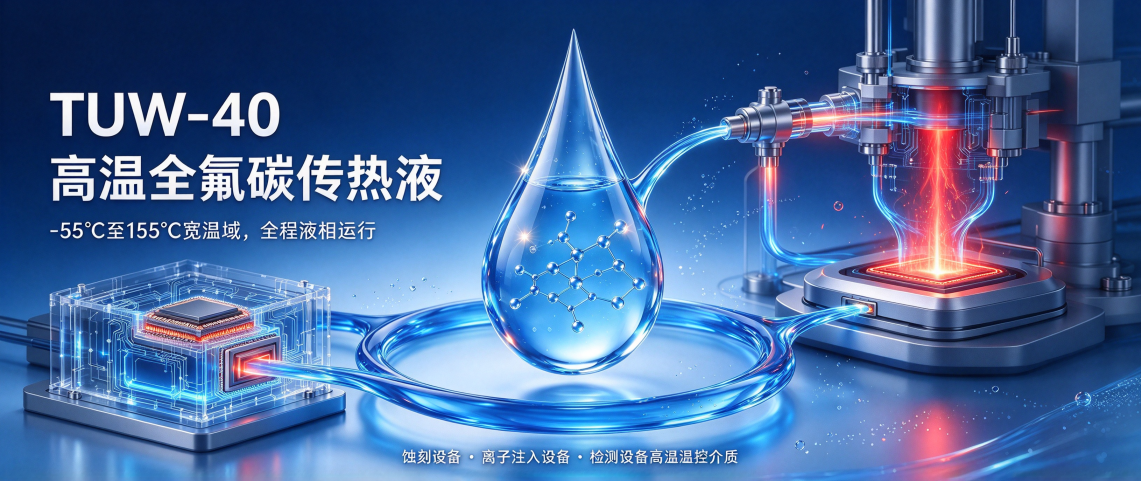
TUW-40 is a single-component perfluorinated heat-transfer fluid covering a liquid range of -55°C to 155°C. With a high boiling point and extremely low evaporation, it is designed for temperature control in etching equipment, ion implantation equipment, and inspection tools. This article details its physical properties, application scenarios, and positioning within the TUW series.
TUW-40 High-Temperature Perfluorocarbon Fluid: -55°C to 155°C Wide Temperature Range — Temperature Control for Etching and Ion Implantation High-Temperature Operations
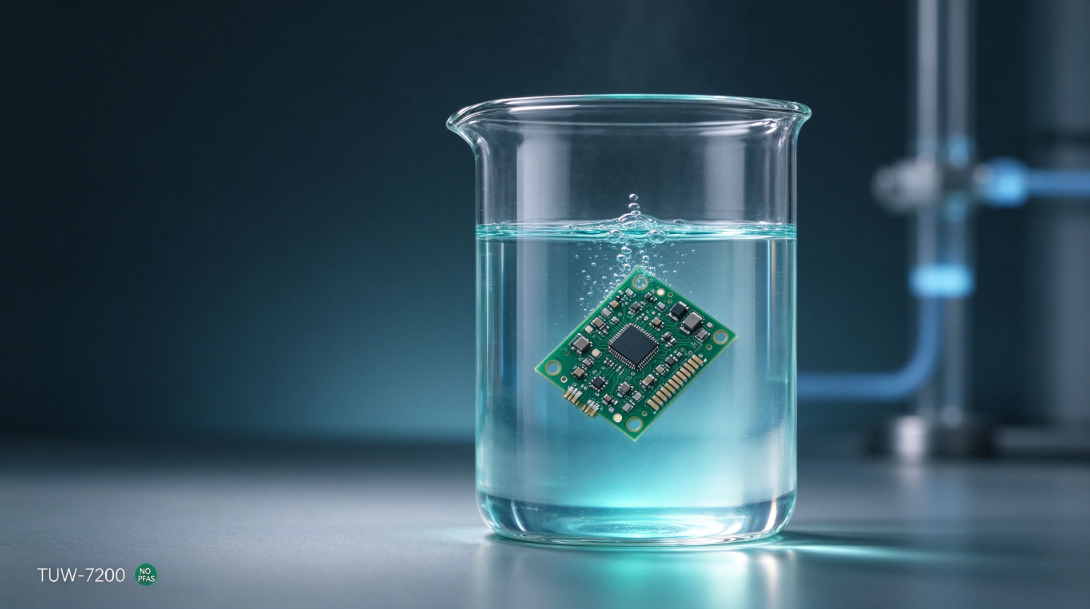
TUW-7200 is a thermally stable perfluorinated liquid that can be used as an electronic cleaning agent, precision cleaner, grease cleaner, cooling medium, hermeticity test fluid, thermostatic fluid, and extraction solvent. This article details its six uses and NO PFAS environmental attributes, and provides guidance on selecting a domestic alternative.
TUW-7200 Electronic Fluorinated Fluid: Precision Cleaning, Hermeticity Leak Testing, Thermostatic Bath — One Fluid for Three Uses, NO PFAS Domestic Alternative

TUW-347 and TUW-458 are two hydrofluoroether (HFE) eco-friendly solvents commonly used for cleaning, drying, dust removal, and non-condensable gas elimination. TUW-458 can also serve as a synthesis feedstock and electrolyte additive. This article details the chemical identities, technical parameters, application scenarios, and selection differences between the two products.
HFE Eco-Friendly Solvents TUW-347 & TUW-458: The "Invisible Assistants" for Drying, Dust Removal, and Non-Condensable Gas Elimination