1-Micron “Invisible Armor”: How Nano Conformal Coatings Deliver Waterproof, Moisture-Proof and Anti-Corrosion Protection
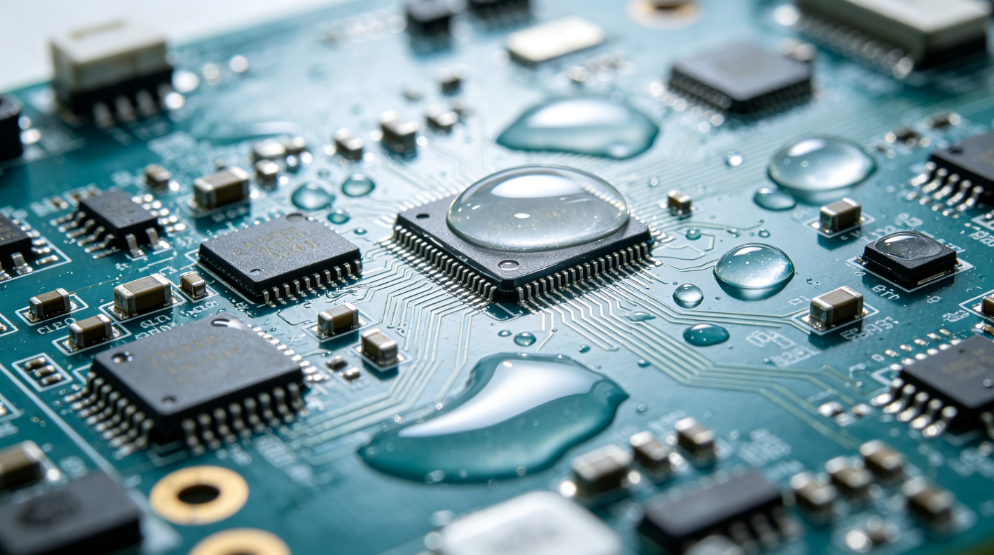
When your phone falls into water and still works after being wiped dry, it is often not just “luck.” An invisible nano coating may be doing the real work. As PCBs become smaller and components denser, the tens-of-microns thickness of traditional conformal coatings has become a design bottleneck. Nano conformal coatings, at only about 1 micron thick, are redefining electronic protection at the molecular level.
1. What Does “Three-Proof” Mean? Why Traditional Conformal Coatings Hit Limits
In the electronics industry, “three-proof” usually refers to moisture-proof, salt-spray-proof and mold-proof protection. In a broader sense, it also covers waterproof, anti-corrosion and anti-oil protection. In humid, salty or condensing environments, water vapor and corrosive ions can penetrate PCB gaps, causing short circuits, leakage, metal corrosion and final product failure.
Traditional conformal coatings work by forming a tens-of-microns thick protective layer around the PCB. But in TWS earbuds, smartwatches, phone motherboards, sensors and automotive electronics, this thick coating creates clear limitations:
-
It may cover precision components, connectors and test points.
-
It can affect heat dissipation and signal transmission.
-
It adds weight and changes appearance.
-
It is difficult to remove during rework.
-
It struggles to uniformly cover BGA bottoms, 0201 pin gaps and other blind areas.
The value of nano conformal coatings is that they form an ultra-thin, around 1-micron film that provides waterproof, moisture-proof, anti-corrosion and anti-oil protection while minimizing changes to appearance, weight and thermal design.
2. Molecular-Level Principle: How Does 1 Micron Become Invisible Armor?
The biggest difference between nano conformal coatings and traditional conformal coatings is the film-forming mechanism.
The coating material exists as a very low-surface-tension liquid. Through capillary action, it can penetrate areas that traditional coatings cannot easily reach—such as under BGA chips, between 0201 component pins, and even micro-gaps down to 0.1 micron. It then self-assembles on the component surface to form a dense, uniform nano-scale protective film around 1 micron thick.
Its core functions include:
-
Superhydrophobic water repellency: Water droplets struggle to spread and remain in a superhydrophobic state, reducing liquid water ingress.
-
Barrier against moisture and ions: It reduces the chance of water vapor, salt spray, sweat and corrosive ions reaching metal surfaces.
-
Corrosion inhibition: It helps reduce electrochemical corrosion caused by water, oxygen and ions.
-
Anti-oil and anti-smudge: Low surface energy makes oil, sweat and contaminants less likely to adhere.
-
Anti-mold and moisture resistance: It suppresses the moisture environment needed for mold growth.
Ultra-thin film formation means almost no added weight, minimal impact on heat dissipation and signal transmission, and excellent transparency and reworkability. That is why it is called “invisible armor.”
3. Core Selling Points: Why Choose Nano Conformal Coatings?
3.1 Ultra-Thin: About 1 Micron, 1/10 to 1/100 the Thickness of Traditional Coatings
Traditional conformal coatings are often tens of microns thick. Nano coatings are only about 1 micron, creating less design interference for thin-and-light products such as TWS earbuds, smartwatches and phone motherboards.
3.2 Strong Penetration: Covers BGA Bottoms and Micro-Gaps
Low-surface-tension liquids can penetrate BGA bottoms, 0201 pin gaps and 0.1-micron micro-gaps through capillary action, reducing protection blind spots. This is difficult for traditional thick spray coatings to achieve consistently.
3.3 Minimal Impact on Appearance, Weight and Heat Dissipation
The nano coating is transparent and ultra-thin. It barely changes component appearance or weight and avoids the obvious thermal and signal impact of thick coatings.
3.4 Better Reworkability
For PCBs that require repair, testing and rework, nano coatings are easier to handle than traditional thick conformal coatings, reducing production maintenance difficulty.
3.5 Flexible Application: Suitable for Dipping and Spraying
For example, 5018 supports colorless, transparent dipping/spraying. 5058 has 15%–25% solid content and a surface dry time of about 30 minutes, suitable for moisture and corrosion protection of PCB boards and components. Refer to the TDS for exact application and curing conditions.
3.6 Broad Protection: Water, Moisture, Salt Spray, Corrosion, Oil and Mold
It is suitable not only for consumer electronics but also for sensors, capacitors, PCB substrates and phone components sensitive to moisture and corrosion.
4. Main Products and Selling Points
| Model | Source | Key Selling Points | Applications | Selection Value |
|---|---|---|---|---|
| 1700 (EGC-1700) | 3M Electronic Coating | Dry film about 1μm, anti-oil, moisture-proof | PCB substrates, capacitors, sensors, phone components | Ideal for precision parts requiring ultra-thin, transparent, oil/moisture protection |
| 2704 (Novec 2704) | 3M Electronic Coating | Fluoropolymer, ultra-thin film | Electronic coatings, PCB moisture and corrosion protection | Suitable for PCB-level moisture and corrosion protection with low surface energy |
| 5058 | Domestic nano conformal coating | 15%–25% solid content, surface dry about 30 min | PCB boards, components, moisture and corrosion protection | Suitable for batch production, supply stability and application efficiency |
| 5018 | Domestic nano conformal coating | Colorless and transparent, dipping/spraying | PCB moisture and corrosion protection | Suitable for complex PCBs, transparent appearance and flexible application |
5. Advantages Over Traditional Conformal Coatings
| Item | Traditional Conformal Coating | Nano Conformal Coating |
|---|---|---|
| Thickness | Tens of microns | About 1 micron |
| Penetration | Limited coverage under BGA and micro-gaps | Capillary penetration into tiny gaps |
| Appearance & weight | May change appearance and add weight | Transparent, ultra-thin, almost no added weight |
| Heat & signal | Thick coating may interfere | Ultra-thin, minimal impact |
| Rework | Difficult to clean | Relatively easier to rework |
| Trend fit | Traditional industrial electronics | Consumer electronics, micro PCBs, automotive electronics |
Traditional conformal coatings are usually tens of microns thick, easily covering precision components and affecting heat dissipation and signals, while being difficult to clean during rework. Nano coatings are only 1/10 to 1/100 of that thickness, yet can provide equal or even better protection. They barely change component appearance and weight, allowing waterproof performance, thin design and high performance to coexist. This is why they are becoming a mainstream choice for TWS earbuds, smartwatches, phone motherboards and automotive electronics.
6. Typical Applications
-
Phone motherboards, TWS earbuds, smartwatches
-
PCB boards, capacitors, sensors
-
BGA, 0201 and other micro-component areas
-
Automotive electronics, outdoor electronics, humid and salt-spray environments
-
Precision electronics requiring transparent, ultra-thin and reworkable protection
7. How to Select the Right Coating
Key selection questions:
-
Protection target: waterproof, moisture-proof, salt-spray-proof, anti-corrosion or anti-oil?
-
Substrates and components: Are there BGA, 0201, connectors or sensors?
-
Application method: dipping, spraying or selective coating?
-
Appearance requirements: Does it need to be colorless, transparent and non-intrusive?
-
Rework requirements: Does it need to be reworkable and easy to clean?
-
Compliance and cost: Is domestic supply or a specific regulatory statement required?
Want to know which coating is better for your product? Contact us for samples, application recommendations and protection performance testing support.
To Clean or Not to Clean PCBA? Hidden Risks of Flux Residue and HFE Azeotropic Cleaning Solvent Solutions
Related Article