From Thermal Shock to Package Leak Testing: A Detailed Look at TUW-3283 in Electronic Reliability Verification
From design to mass production, a single chip must pass dozens of reliability tests. Among them, thermal shock and package hermeticity (leak) testing are two almost mandatory standard validations. Although these two tests do not directly participate in production, they directly determine whether a product can pass automotive and military grade certification.
The key consumable supporting these two tests is perfluorinated carbon fluid. If the medium in the test bath lacks purity or has an insufficient temperature range, the test data becomes unreliable — and the device under test may even be contaminated. Taking TUW-3283 as an example, this article details the application of perfluorinated carbon fluid in reliability verification.
I. Why Perfluorinated Carbon Fluid Is Used for Thermal Shock Testing
The purpose of thermal shock testing is to verify the structural reliability of a device under extreme, rapid temperature changes. The test equipment has two baths — a high-temperature bath and a low-temperature bath — and the device under test is rapidly switched between the two, typically from -55°C to +125°C, with a transition time of no more than 10 seconds.
This test places four hard requirements on the bath fluid:
- Wide temperature range: Must not freeze below -55°C in the low-temperature bath, and must not boil above 125°C in the high-temperature bath
- Low viscosity: The fluid must respond quickly during temperature switching; viscosity changes must not cause uneven temperature fields
- Chemical inertness: Must not react with device surfaces, solder, or packaging materials
- Non-flammability: The high-temperature bath may exceed 100°C, so the medium must not become a fire hazard
Traditional media such as glycerin, ethylene glycol, and silicone oil either lack a wide enough temperature range, become too viscous at low temperatures, or are incompatible with certain plastic packages. Perfluorinated carbon fluid is nearly the optimal solution across all four dimensions.
II. Parameter Matching of TUW-3283 in Thermal Shock Testing
| Test Requirement | TUW-3283 Parameter | Matching Status |
|---|---|---|
| Low bath temperature | Pour point -65°C | Covers -55°C and even lower |
| High bath temperature | Boiling point 128°C | Covers +125°C upper test limit |
| Temperature response speed | Kinematic viscosity 1.32 cSt | Low viscosity ensures fast heat exchange |
| Temperature field uniformity | Specific heat capacity 1.431 J/g·°C | High specific heat reduces temperature fluctuation |
| Device compatibility | Extremely strong chemical inertness | Does not corrode solder or packages |
| Safety | No flash point | Non-flammable in high-temperature environment |
The liquid range formed by a 128°C boiling point and a -65°C pour point exactly covers most consumer electronics (-40°C~+85°C) and automotive electronics (-55°C~+125°C) thermal shock test standards.
III. Application in Package Hermeticity Leak Detection
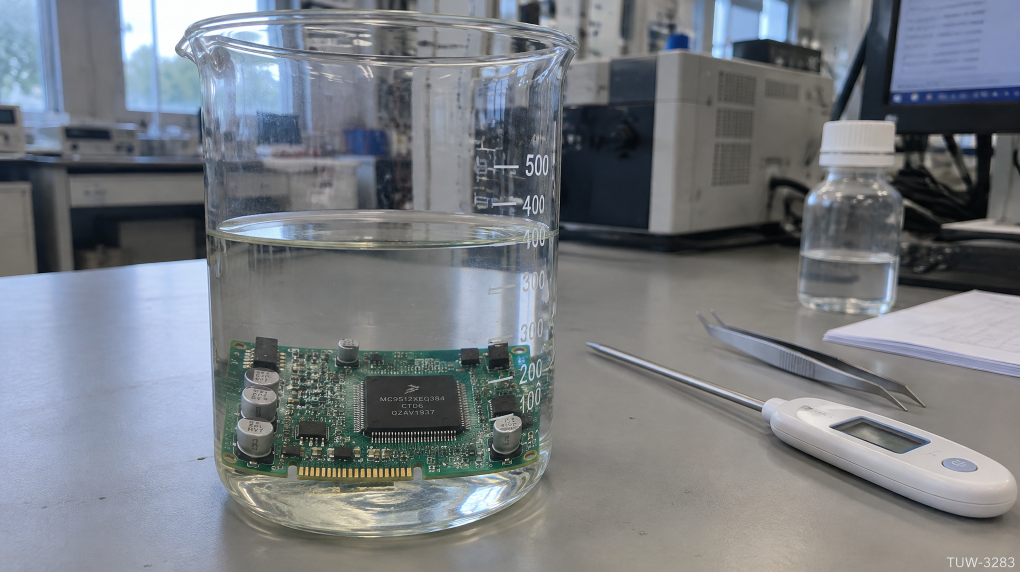
MEMS microphones, accelerometers, RF modules, optoelectronic devices, and more operate within sealed cavities. If a package has a micro-leak, moisture and oxygen slowly enter the cavity, causing electrode corrosion and performance drift. Therefore, 100% hermeticity testing must be performed after packaging.
The most common leak detection method is the bubble method: a heated device is immersed in leak detection fluid. If the package has a leak, the internal air expands from the heat and escapes through the leak hole, forming a continuous stream of bubbles at the liquid surface.
This method places special requirements on the leak detection fluid:
- Extremely low surface tension: Otherwise the fluid cannot penetrate micron-level leak holes, and the miss rate is high
- Chemical inertness: Must not corrode devices and leads
- Fast evaporation, no residue: The device must not be contaminated after testing
- High transparency: For easy observation of bubbles
TUW-3283 has a surface tension of only 12.7 dyn/cm — among the lowest of common liquids — enabling it to penetrate extremely fine gaps. The high purity achieved through electrolytic production ensures no residue after evaporation, so tested devices can move directly to the next process step without cleaning.
IV. Why Purity Requirements for Test Media Are Stricter Than for Production
Some may ask: since both are perfluorinated carbon fluids, why is the purity requirement for testing even higher than for production?
The reason is: fluid on a production line, though it circulates in equipment, does not come into direct contact with the final product. Test fluid, however, directly immerses the devices under test — and these devices are delivered to customers after testing.
If the test fluid contains volatile impurities or high-boiling-point residues:
- Water spots or oil films may form on device surfaces, being misjudged as package defects
- Particles may precipitate during high-low temperature cycling, adhering to leads or contacts
- Once the medium itself is contaminated, the repeatability of subsequent test results deteriorates
Therefore, perfluorinated carbon fluid for reliability testing should satisfy at least: purity ≥99%, water content ≤50ppm, acid value ≤10ppm, evaporation residue ≤100ppm. TUW-3283's quality indicators are controlled precisely to this standard.
V. Extended Applications in Other Reliability Tests
Beyond thermal shock and package leak detection, TUW-3283 is also used in the following reliability tests:
- Temperature Cycling: Similar to thermal shock but with a slower transition rate, typically cycling hundreds of times between -40°C and +125°C. TUW-3283 serves as a constant-temperature bath medium providing a stable temperature field.
- High-Temperature Reverse Bias (HTRB): Power devices are subjected to reverse bias voltage at high temperatures to verify long-term reliability. TUW-3283 serves as the heating bath medium, while its high insulation supports live testing.
- Insulation Withstand Voltage Testing: Samples are immersed in TUW-3283 and subjected to high voltage to verify insulation performance. A 44kV dielectric strength and 10¹⁴Ω·cm resistivity ensure the test environment itself does not leak current.
VI. The Economic Value of Multi-Purpose Single Fluid
For third-party testing laboratories or IDM factories, maintaining multiple types of fluorinated fluid is costly to manage. TUW-3283, as a single medium, can cover thermal shock, temperature cycling, package leak detection, and insulation testing across multiple stages — reducing fluid variety, inventory management, and waste fluid disposal costs.
In semiconductor factories, TUW-3283 can also be used simultaneously as the temperature control medium for etchers. Using the same fluid in both the test center and the production workshop further reduces material management complexity.
VII. Usage and Maintenance Recommendations
- Periodically inspect the appearance and odor of the medium; if discoloration or unusual odor is found, take a sample for analysis
- Medium in thermal shock baths operating at high temperatures for long periods: recommend testing acid value and water content every six months
- Medium in leak detection baths is easily contaminated by oil carried in by devices; recommend regular filtration or replacement
- Store sealed to reduce moisture absorption and evaporation loss
Shenzhen Huayi Brothers focuses on supplying electronic fluorinated fluids and fluorinated functional fluids, providing customers with product literature, sample testing, and application solution consultation. For sample testing, please contact: 15014124590 / 18870870567
Related Article