
TUW Industrial Synthetic Heat Transfer Fluid Optimal Solution for High-Temperature Thermal Management
2026-05-07

Product Overview
TUW heat transfer oil series is a high-performance synthetic heat transfer fluid specially designed for industrial heating and cooling applications. Adopting advanced synthetic aromatic hydrocarbon formula technology, it delivers stable and reliable heat conduction performance over a wide temperature range of -30°C to 310°C, suitable for both open and closed circulation systems.
As an upgraded alternative to traditional mineral-oil-based heat transfer fluids, TUW thermal oil features outstanding thermal stability, low viscosity and excellent safety performance. It is widely used in chemical, pharmaceutical, new energy material processing and other industries.
Technical Specifications
| Item | Index | Test Standard |
|---|---|---|
| Operating Temperature Range | -30°C ~ 310°C | — |
| Maximum Bulk Temperature | 310°C | — |
| Maximum Film Temperature | 330°C | — |
| Density (20°C) | 0.85 g/cm³ | — |
| Kinematic Viscosity (40°C) | 1 mm²/s | DIN 51561 |
| Flash Point | >172°C | EN 22719 |
| Fire Point | 330°C | — |
| Autoignition Point | >360°C | DIN 51794 |
| Volume Expansion Coefficient | 1.20×10⁻³ K⁻¹ | — |
| Acid Value | <100 mg/kg | — |
Performance Advantages
Wide Temperature Adaptability
It maintains stable physical and chemical properties from low temperature of -30°C up to high working temperature of 310°C. Moderate viscosity at low temperature ensures smooth system startup; excellent thermal stability at high temperature resists thermal decomposition.
Excellent Heat Transfer Efficiency
Extremely low kinematic viscosity of 1 mm²/s @ 40°C brings low flow resistance and high heat exchange efficiency. Combined with low density of 0.85 g/cm³, it provides superior volumetric heat capacity and reduces system energy consumption.
High Safety Performance
Flash point over 172°C, fire point up to 330°C, autoignition point above 360°C. Compared with flammable solvents, it greatly reduces fire risks and improves industrial production safety.
Long Service Life
With excellent thermal decomposition resistance under normal working conditions, its service life reaches 2–3 times that of traditional mineral thermal oil, lowering maintenance frequency and fluid replacement cost.
Good Material Compatibility
Non-corrosive to ferrous metals, non-ferrous metals and most sealing materials, compatible with most industrial heat exchange systems.
Application Fields
Typical Application Scenarios
-
Chemical Process Temperature ControlUsed as heating and cooling medium for jacketed reactors to realize precise temperature control. The wide temperature range meets temperature regulation requirements of different reaction stages.
-
Pharmaceutical IndustryIdeal for temperature control in API synthesis, extraction and refining processes. Low acid value (<100 mg/kg) makes it suitable for high-purity production scenarios.
-
New Energy Material ProcessingApplied in thermal treatment processes of lithium battery materials, solar cell pastes and other new energy materials, supporting stable temperature control for automated production lines.
-
Industrial Drying SystemServed as heat transfer medium in closed-loop thermal oil circulation systems for drying processes in food, building materials, textile and other industries.
-
Laboratory & Pilot PlatformsProvides reliable heat and cold source solutions for laboratory reaction equipment and semi-industrial pilot test systems.
Selection Guidelines
Key factors to consider when selecting heat transfer fluid:
| Consideration | Description |
|---|---|
| Maximum System Temperature | Shall not exceed the maximum operating temperature of 310°C |
| System Type | Suitable for both open and closed circulation systems |
| Cold Start Requirement | Low-temperature viscosity shall be considered for pumping performance |
| Service Life Expectation | Long-term high-temperature operation accelerates fluid aging |
| Material Compatibility | Verify compatibility with heat exchanger and sealing materials |
New Solvent-Based Fluorinated Silicone Release Agent – Empowering High-Performance PSA Release Treatment for Uniform and Stable Release Force
From mountaineering apparel to battery breathable membranes — Huayi Brothers’ eco-friendly water and oil repellent safeguards compliance for protective, electronics and industrial sectors.
Related Article

Traditional PCB conformal coating is thick, leaves BGA areas uncovered, and damages pads during rework. This article compares TUW-2704 and TUW-1700 fluoropolymer ultra-thin coatings on film thickness, rework, and protection, and provides selection guidance for NEV electronic control and consumer PCBs.
PCB Nano Conformal Coating Selection: TUW-2704 & TUW-1700 vs. Traditional Conformal Coating
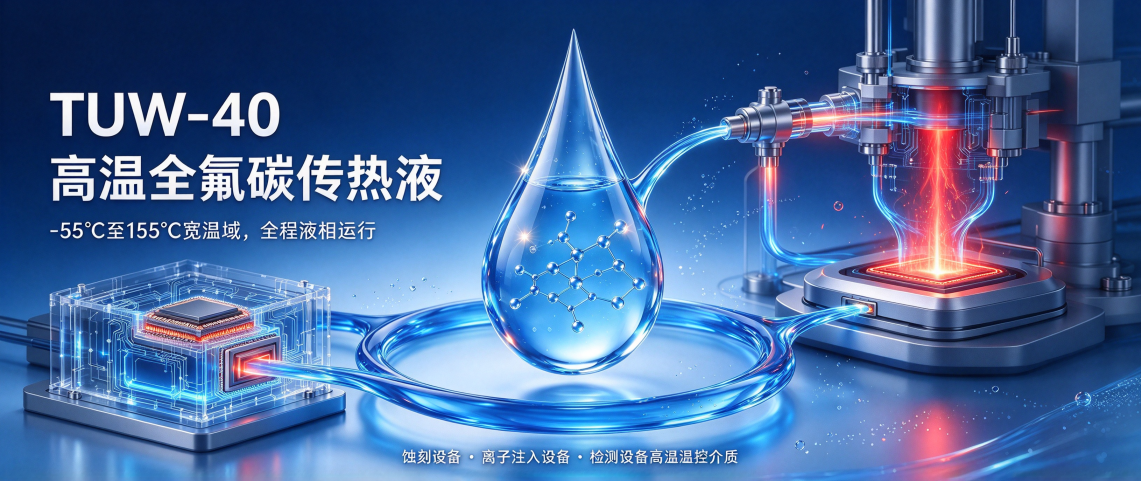
TUW-40 is a single-component perfluorinated heat-transfer fluid covering a liquid range of -55°C to 155°C. With a high boiling point and extremely low evaporation, it is designed for temperature control in etching equipment, ion implantation equipment, and inspection tools. This article details its physical properties, application scenarios, and positioning within the TUW series.
TUW-40 High-Temperature Perfluorocarbon Fluid: -55°C to 155°C Wide Temperature Range — Temperature Control for Etching and Ion Implantation High-Temperature Operations
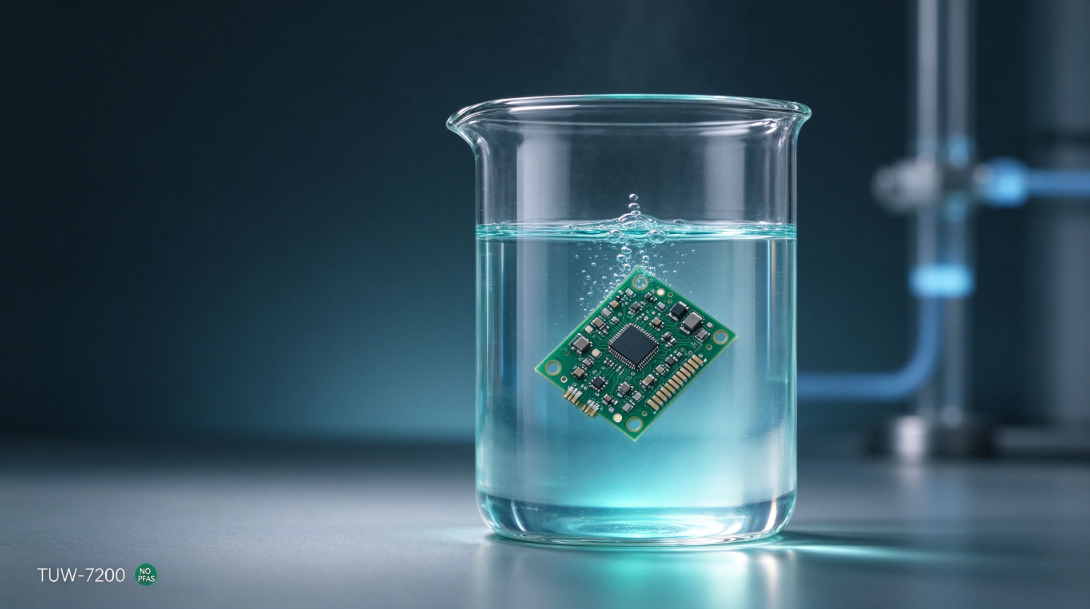
TUW-7200 is a thermally stable perfluorinated liquid that can be used as an electronic cleaning agent, precision cleaner, grease cleaner, cooling medium, hermeticity test fluid, thermostatic fluid, and extraction solvent. This article details its six uses and NO PFAS environmental attributes, and provides guidance on selecting a domestic alternative.
TUW-7200 Electronic Fluorinated Fluid: Precision Cleaning, Hermeticity Leak Testing, Thermostatic Bath — One Fluid for Three Uses, NO PFAS Domestic Alternative

TUW-347 and TUW-458 are two hydrofluoroether (HFE) eco-friendly solvents commonly used for cleaning, drying, dust removal, and non-condensable gas elimination. TUW-458 can also serve as a synthesis feedstock and electrolyte additive. This article details the chemical identities, technical parameters, application scenarios, and selection differences between the two products.
HFE Eco-Friendly Solvents TUW-347 & TUW-458: The "Invisible Assistants" for Drying, Dust Removal, and Non-Condensable Gas Elimination