
Two Years of CHIPS Act Implementation Yields Both Results and Concerns
2025-01-13

Recently, the U.S. CHIPS programme office released a document summarising the two-year implementation of the Chip and Science Act.
The Act invested $38 billion to revitalise the local semiconductor industry and strengthen the economy and national security. More than 96 per cent of the funds have been allocated and more than 86 per cent have been disbursed. The results have been remarkable, with a surge in manufacturing investment, a commitment to build 17 new fabs, eight new supply chain and advanced packaging facilities, and five of the world's largest chipmakers investing in the United States. This has boosted U.S. chip production capacity, helped build the semiconductor supply chain, and promoted innovation. The bill also focuses on protecting taxpayer funds.
However, the characteristics of the semiconductor industry pose challenges, and Trump's attitude towards the bill is negative, and if he returns to the White House, the policy uncertainty may affect the relevant enterprises. How to balance the interests of all parties and the rational use of public funds is the key issue facing the bill's follow-up.
The Act invested $38 billion to revitalise the local semiconductor industry and strengthen the economy and national security. More than 96 per cent of the funds have been allocated and more than 86 per cent have been disbursed. The results have been remarkable, with a surge in manufacturing investment, a commitment to build 17 new fabs, eight new supply chain and advanced packaging facilities, and five of the world's largest chipmakers investing in the United States. This has boosted U.S. chip production capacity, helped build the semiconductor supply chain, and promoted innovation. The bill also focuses on protecting taxpayer funds.
However, the characteristics of the semiconductor industry pose challenges, and Trump's attitude towards the bill is negative, and if he returns to the White House, the policy uncertainty may affect the relevant enterprises. How to balance the interests of all parties and the rational use of public funds is the key issue facing the bill's follow-up.
2025 Forward: A New Blueprint for Growth in the Global Liquid Cooling Market
New developments in the US semiconductor industry under Trump's policy guidance
Related Article
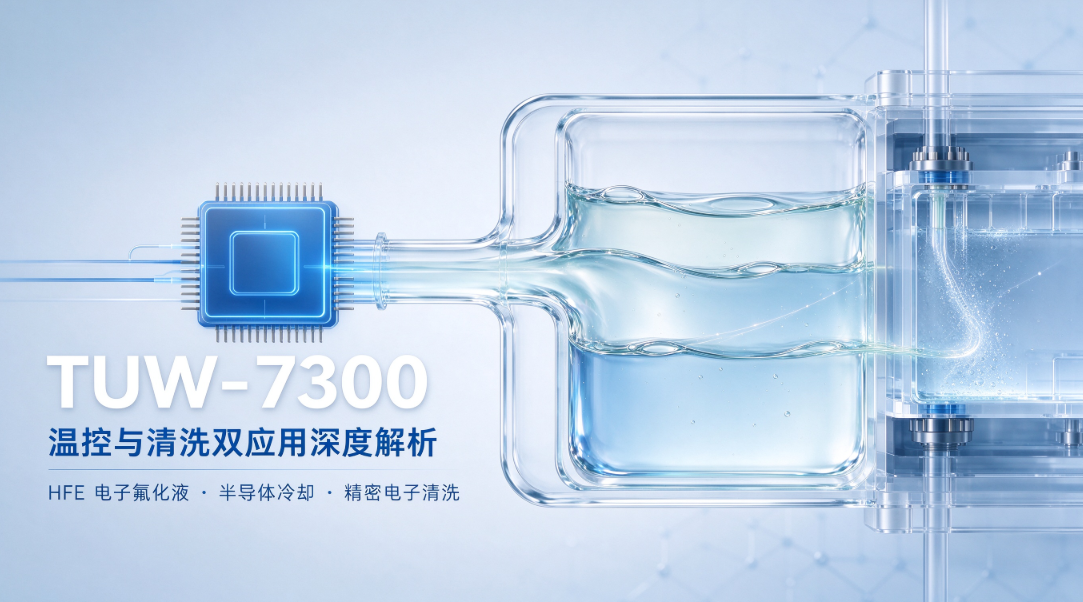
TUW-7300 is a thermally stable hydrofluoroether (HFE) electronic fluorinated fluid, benchmarked against 3M Novec 7300. It combines dual capabilities in semiconductor equipment temperature control and precision electronic cleaning. This article systematically analyzes the dual-scenario application value of TUW-7300, covering product positioning, temperature control applications, cleaning processes, performance parameters, and family product selection.
TUW-7300 HFE Electronic Fluorinated Fluid: In-Depth Analysis of Dual Applications in Semiconductor Equipment Temperature Control and Precision Cleaning

Traditional PCB conformal coating is thick, leaves BGA areas uncovered, and damages pads during rework. This article compares TUW-2704 and TUW-1700 fluoropolymer ultra-thin coatings on film thickness, rework, and protection, and provides selection guidance for NEV electronic control and consumer PCBs.
PCB Nano Conformal Coating Selection: TUW-2704 & TUW-1700 vs. Traditional Conformal Coating
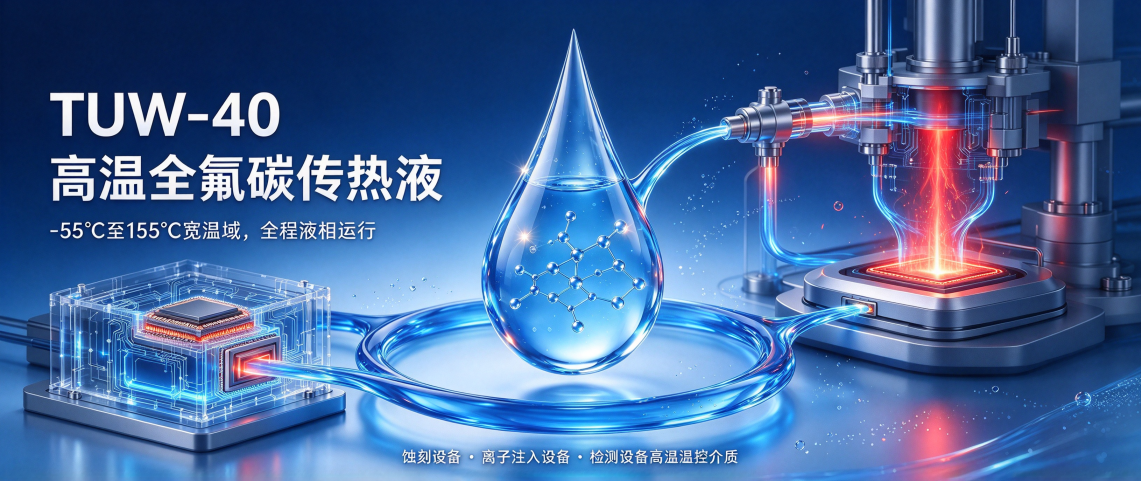
TUW-40 is a single-component perfluorinated heat-transfer fluid covering a liquid range of -55°C to 155°C. With a high boiling point and extremely low evaporation, it is designed for temperature control in etching equipment, ion implantation equipment, and inspection tools. This article details its physical properties, application scenarios, and positioning within the TUW series.
TUW-40 High-Temperature Perfluorocarbon Fluid: -55°C to 155°C Wide Temperature Range — Temperature Control for Etching and Ion Implantation High-Temperature Operations
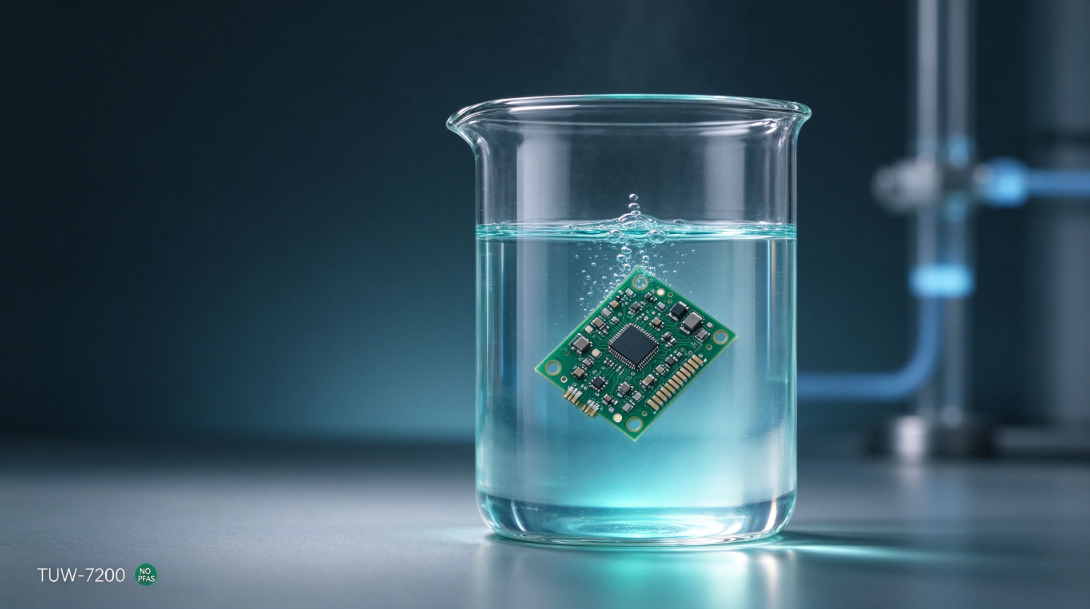
TUW-7200 is a thermally stable perfluorinated liquid that can be used as an electronic cleaning agent, precision cleaner, grease cleaner, cooling medium, hermeticity test fluid, thermostatic fluid, and extraction solvent. This article details its six uses and NO PFAS environmental attributes, and provides guidance on selecting a domestic alternative.
TUW-7200 Electronic Fluorinated Fluid: Precision Cleaning, Hermeticity Leak Testing, Thermostatic Bath — One Fluid for Three Uses, NO PFAS Domestic Alternative