
Selection of High-Temperature Synthetic Heat Transfer Fluids
2026-06-05

In the processing of chemical fibers and polymer materials, heat transfer fluid systems supply full-process heating ranging from melt transportation to spinning forming. Operating temperatures vary from 180℃ to 400℃, covering two heat transfer modes: liquid-phase and vapor-phase heat exchange. Improper selection will, in mild cases, accelerate fluid degradation and frequent oil replacement; in severe cases, lead to coking and pipeline blockage, spinning breakage and full-line shutdown. Selecting high-temperature synthetic heat transfer fluids is far more than a simple temperature matching task; it requires systematic evaluation combining process characteristics, heat transfer modes, equipment precision and maintenance cycles.
Core Selection Principle: Process Temperature Determines Upper Limit of Fluid Grade
The maximum allowable working temperature of selected heat transfer fluid must be at least 10–20℃ higher than actual process temperature, serving as the bottom-line selection criterion. Operation beyond rated temperature speeds up thermal cracking of fluids, producing low-boiling substances that cause vapor lock inside systems, while high-boiling condensed residues deposit as coke on tube walls and trigger a vicious cycle of local overheating.
For chemical fiber and polymer industries, fluid selection is divided into three temperature brackets:
- Medium-temperature range below 280℃: Applications including acrylic spinning rollers (≤180℃), DTY texturing spindle discs (≤220℃), BOPP/BOPET film production (≤280℃) adopt medium & low-temperature synthetic heat transfer fluids such as TUW-170, TUW-181, TUW-210 and TUW-240.
- High-temperature range of 280–330℃: Core processes including direct polyester melt spinning transportation (320–340℃), PBT/PTT/PC processing (320–330℃), PBS/PBAT synthesis (≤330℃) require high-temperature liquid-phase fluids including TUW-320, TUW-330, TUW-350D or TUW-1000.
- Ultra-high-temperature range of 330–400℃: Polyimide film manufacturing (300–400℃) demands biphenyl-biphenyl ether blended fluid TUW-400 applicable for both liquid and vapor phase service.
Heat Transfer Mode: Matching Rules for Liquid vs Vapor Phase
The adoption of liquid or vapor heat transfer in fiber manufacturing depends on temperature control accuracy and system design. Featuring low operating pressure and easy operation, liquid-phase heat transfer is the preferred solution for most spinning processes. For typical liquid-phase working conditions including direct-spinning polyester melt pipelines, polyamide spinning packs and polyester chip heating, hydrogenated terphenyl-based fluids represented by TUW-350D are prioritized. At 350℃ liquid-phase condition, its saturated vapor pressure is merely around one-fifth of biphenyl-biphenyl ether blend at identical temperature, delivering lower system pressure and wider safety margin.
Vapor-phase heat transfer fits processes requiring precise temperature control, such as VK tube for staple polyester filament and high-speed FDY spinning packs. TUW-400 biphenyl-biphenyl ether mixture realizes ±1℃ precise temperature regulation via cyclic vaporization-condensation under vapor status. Note that vapor-phase systems impose stricter sealing requirements with drastically rising working pressure along with temperature growth, hence system design must fully accommodate pressure bearing capacity.
Segmented Process: Grade Differentiation by Raw Material Types
Polyester fiber ranks as the highest-consumption product in chemical fiber industry, with its full production chain from PTA & MEG polycondensation to direct melt spinning covering 280–340℃. TUW-350D liquid-phase fluid is recommended for melt transfer pipelines of direct-spinning polyester with an up-to-10-year service life; TUW-400 is preferable for melt pumps and spinneret heating featuring concentrated high heat load, with around 6-year replacement cycle.
Biodegradable polymer stands as the fastest-growing subdivision in recent years. PBS/PBAT synthesis and spinning run under maximum 330℃, which can be satisfied by TUW-350D and TUW-350, yet operating temperature shall never exceed fluid’s rated limit to prevent accelerated thermal aging.
Industrial yarn and film production cover wide temperature variation: TUW-350D and TUW-1000 are suitable for polyester industrial yarn drawing ovens (≤300℃); polyimide film production at up to 400℃ exclusively adopts TUW-400 dual-purpose liquid/vapor ultrahigh-temperature fluid. For PPS processing at 320–330℃, besides conventional high-temperature liquid fluids, special wide-range grades TUW-HVT/MVT/LVT are available to satisfy differentiated requirements across different process sections.
Maintenance Cycle & Economic Analysis for Fluid Selection
Selection evaluation covers not only upfront procurement cost but full-lifecycle economy. Taking direct polyester melt transportation as an example: TUW-350D supports 10-year service with minimal annual top-up; unspecified inferior fluids degrade within 3–5 years, with extra expenditure on pipeline cleaning and production downtime leading to far higher comprehensive cost than initial price gap. Regular fluid replacement schedule is compulsory for high-precision spinning equipment (FDY/POY spinning packs) to avoid filament breakage and product quality fluctuation induced by deteriorated heat transfer fluid.
Essentially, high-temperature synthetic heat transfer fluid selection balances process temperature, heat transfer pattern, raw material property and full-cycle operation cost. Process temperature defines maximum grade limit, heat transfer mode determines fluid type, detailed craft finalizes specific model and economic calculation guides final decision. Properly selected heat transfer fluid serves as a reliable thermal power core for full chemical fiber and polymer production lines.
Perfluoropolyether Special Additives for Cosmetics: A New Solution for Long-Lasting Skin Care "Liquid Glove"
Selection of High-temperature Synthetic Heat Transfer Fluids
Related Article
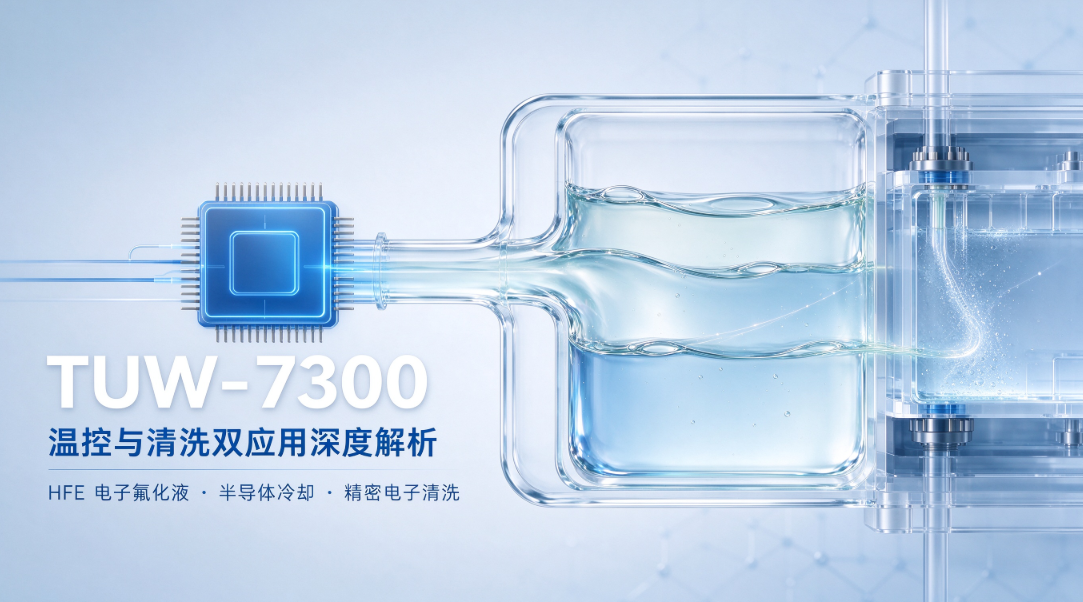
TUW-7300 is a thermally stable hydrofluoroether (HFE) electronic fluorinated fluid, benchmarked against 3M Novec 7300. It combines dual capabilities in semiconductor equipment temperature control and precision electronic cleaning. This article systematically analyzes the dual-scenario application value of TUW-7300, covering product positioning, temperature control applications, cleaning processes, performance parameters, and family product selection.
TUW-7300 HFE Electronic Fluorinated Fluid: In-Depth Analysis of Dual Applications in Semiconductor Equipment Temperature Control and Precision Cleaning

Traditional PCB conformal coating is thick, leaves BGA areas uncovered, and damages pads during rework. This article compares TUW-2704 and TUW-1700 fluoropolymer ultra-thin coatings on film thickness, rework, and protection, and provides selection guidance for NEV electronic control and consumer PCBs.
PCB Nano Conformal Coating Selection: TUW-2704 & TUW-1700 vs. Traditional Conformal Coating
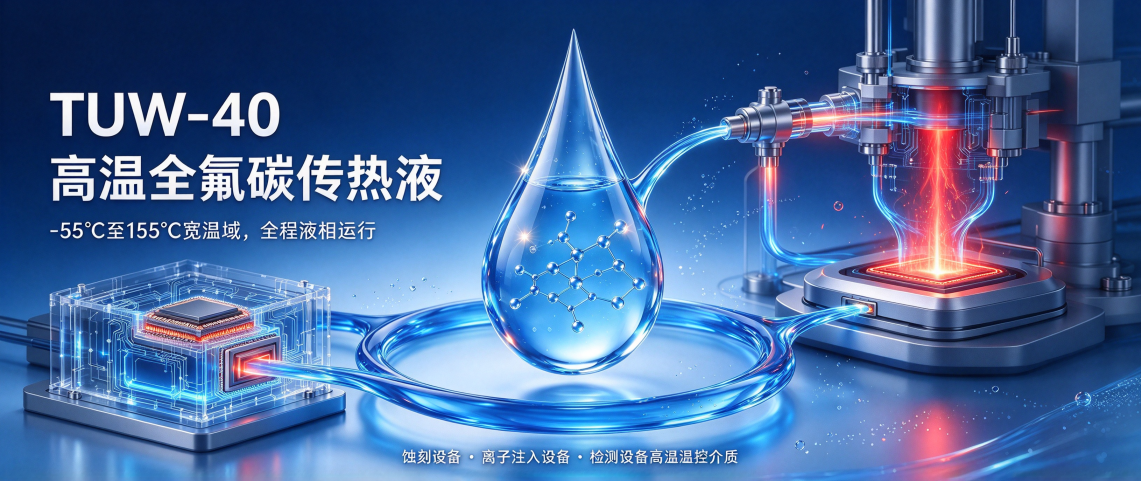
TUW-40 is a single-component perfluorinated heat-transfer fluid covering a liquid range of -55°C to 155°C. With a high boiling point and extremely low evaporation, it is designed for temperature control in etching equipment, ion implantation equipment, and inspection tools. This article details its physical properties, application scenarios, and positioning within the TUW series.
TUW-40 High-Temperature Perfluorocarbon Fluid: -55°C to 155°C Wide Temperature Range — Temperature Control for Etching and Ion Implantation High-Temperature Operations
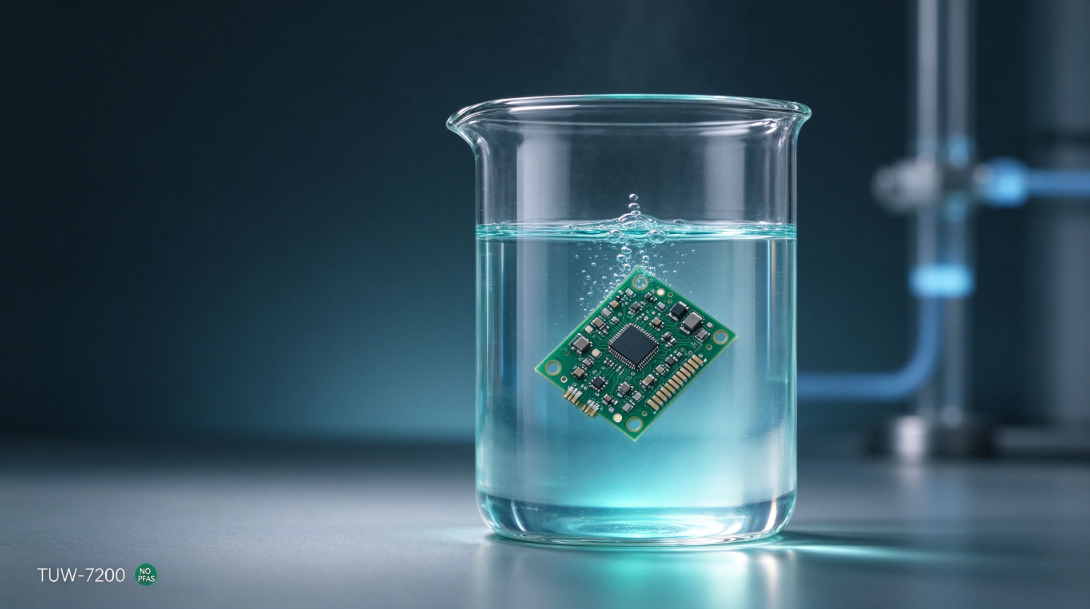
TUW-7200 is a thermally stable perfluorinated liquid that can be used as an electronic cleaning agent, precision cleaner, grease cleaner, cooling medium, hermeticity test fluid, thermostatic fluid, and extraction solvent. This article details its six uses and NO PFAS environmental attributes, and provides guidance on selecting a domestic alternative.
TUW-7200 Electronic Fluorinated Fluid: Precision Cleaning, Hermeticity Leak Testing, Thermostatic Bath — One Fluid for Three Uses, NO PFAS Domestic Alternative