From IPX4 to IPX8: How Nano Coating Thickness, Material Systems, and Structural Waterproofing Work Together
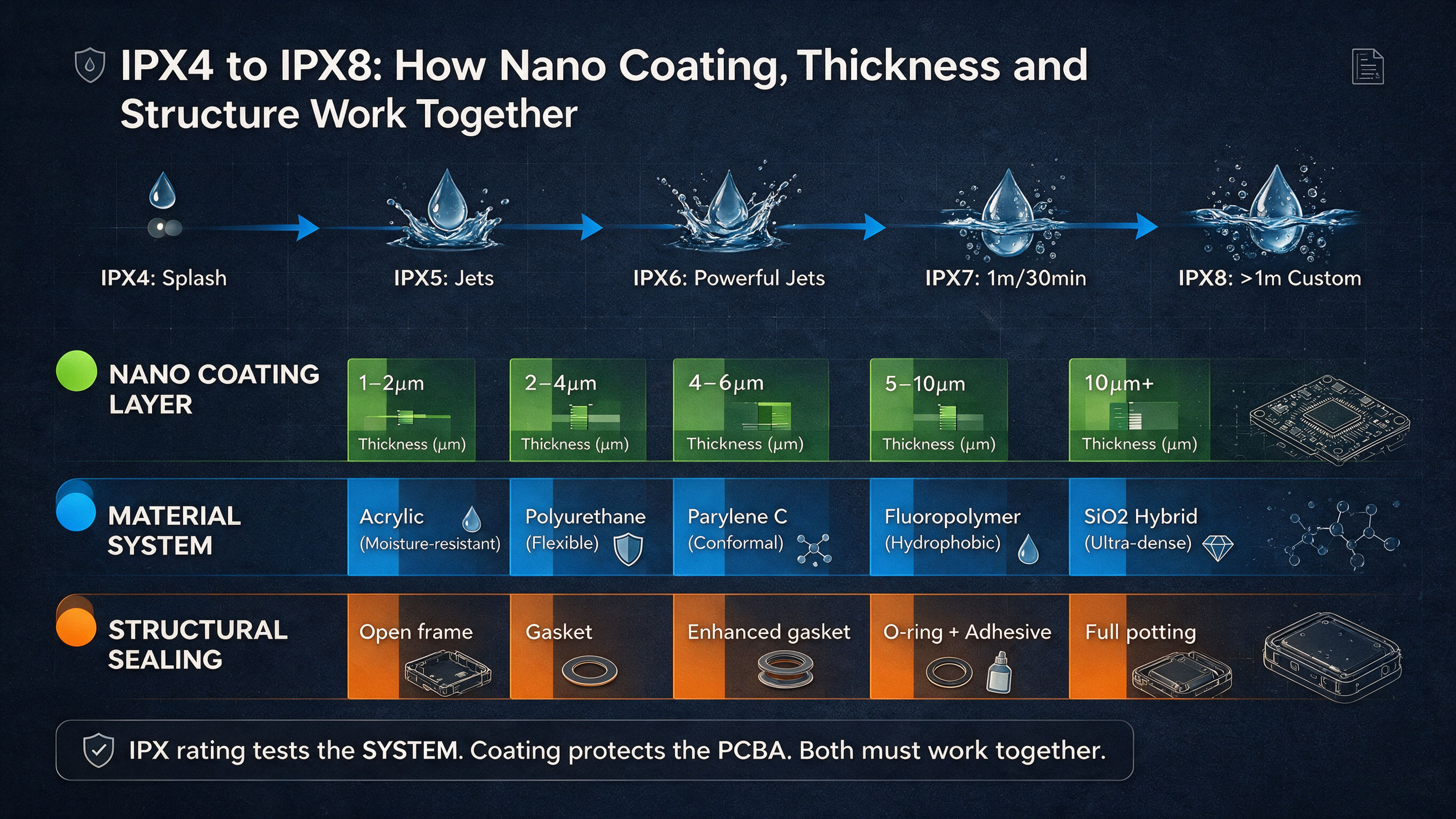
I. What Exactly Does IPX Rating Test?
IP (Ingress Protection) ratings are defined by the IEC 60529 standard, where the second digit indicates the waterproof rating, from IPX0 (no protection) to IPX9K (high-temperature high-pressure water jet). Each rating corresponds to specific test conditions that simulate water intrusion into the device from the outside.
| Rating | Test Condition | Protection Meaning | Role of Coating |
|---|---|---|---|
| IPX1 | Vertical dripping water, 10 min | Protection against vertical dripping | Moisture-grade (50–300 nm) sufficient |
| IPX2 | 15° tilted dripping, 10 min | Protection against tilted dripping | Moisture-grade |
| IPX3 | 60° range spraying, 5 min | Protection against rain | Standard-grade (300–800 nm) |
| IPX4 | Splashing from any direction | Protection against splashing | Standard-grade (500–800 nm) |
| IPX5 | 6.3 mm nozzle, 12.5 L/min, 3 min | Protection against water jets | Enhanced-grade (800–3000 nm) |
| IPX6 | 12.5 mm nozzle, 100 L/min, 3 min | Protection against powerful water jets | Enhanced / high-waterproof grade |
| IPX7 | 1 m depth immersion, 30 min | Protection against short-term immersion | High-waterproof grade (2–5 μm) + structural sealing |
| IPX8 | Manufacturer-specified depth, continuous immersion | Protection against continuous immersion | PECVD / Parylene + structural waterproofing + localized potting |
There are three key points to understanding this table:
First, water pressure is the core variable. The water pressure of IPX4 splashing is far lower than the hydrostatic pressure at 1 meter depth in IPX7 (approximately 10 kPa), and IPX8 involves even greater water pressure at deeper levels. From IPX4 to IPX7, the water pressure difference can reach tens of times. The hydrophobic properties of coating can resist wetting by condensation and splashing, but against water penetration driven by sustained pressure, structural sealing must serve as the first line of defense.
Second, IPX testing is a pass/fail whole-device test. During testing, the product must not allow water ingress into hazardous live parts, must not accumulate water that affects safety, and must not exhibit functional abnormalities. This means that even if the PCBA is coated, if water entering the housing forms a conductive path between connector pins or accumulates beneath the display causing functional abnormalities, the product is still judged as failing.
Third, "coating achieves IPX8" is an incorrect statement. IPX rating is a system-level test result for the whole device — the coating itself has no IP rating; it is one component of the device's protection scheme. The correct understanding is: coating can serve as a board-level protection solution in a device's IPX7/IPX8 design, and the actual rating is subject to whole-device test results. Any claim that "the coating itself achieves IPX8" should be treated with caution.
II. The Correspondence Between Film Thickness and Protection Capability
Although coating alone cannot determine IP rating, film thickness is indeed a key parameter affecting board-level protection capability. Different film thickness ranges correspond to different protection scenarios; the following correspondence can serve as a selection reference (note: reference ranges only, not guaranteed values — actual protection effectiveness must be verified through whole-device design and testing):
50–300 nm: Moisture and condensation protection grade. This thickness range primarily addresses moisture vapor penetration and temperature-difference condensation, suitable for indoor products operating in relatively mild environments, such as smart speakers, indoor small appliances, and ordinary IoT sensors. The coating forms an ultra-thin hydrophobic barrier on the PCB surface, with water contact angles reaching >120° (according to some manufacturers' public TDS, high-end products approximately 123°), effectively reducing moisture adhesion on the board surface and the formation of condensation water films. Volume resistivity ≥ 1×10¹⁵ Ω·cm prevents leakage and electrochemical migration caused by condensation.
300–800 nm: IPX4/IPX5 splash protection grade. With increased film thickness, the coating's tolerance to splashing and short-duration water jets improves, suitable for products that may come into daily contact with water, such as TWS earbuds, smart door locks, and kitchen/bathroom appliances. According to public P2i product data, its Splash-proof series with 15–40 nm film thickness can handle IPX1–2 scenarios, while its Barrier series with 300–2500 nm film thickness can cover system-level solutions from IPX3 to IPX8+ — but it must be emphasized that the IPX ratings here are the result of coordination between coating and whole-device structure, not achieved by coating alone.
800–3000 nm: IPX5–IPX7 water jet and short-immersion grade. This film thickness range is suitable for wearables, outdoor IoT, and handheld terminals that need to withstand water jets and short-term immersion. The coating forms a denser barrier on the PCB and component surfaces, delaying water penetration driven by voltage. However, in IPX7 scenarios, the coating must work in conjunction with structural sealing methods such as sealing rings and waterproof adhesives — coating alone cannot guarantee no water ingress at 1 meter depth for 30 minutes.
2000–5000 nm or composite schemes: IPX7/IPX8 and insulation enhancement grade. High-reliability products such as smartphone sub-boards, drone flight controllers, and industrial modules typically use this range or composite coating schemes. A thicker film provides stronger insulation and barrier capability, but film thickness is not the higher the better — excessively thick coating may affect connector contact reliability, increase thermal resistance, generate stress between fine-pitch components, and even develop microcracks during temperature cycling.
Automotive-grade / outdoor extreme environments: Fluorinated or PECVD/Parylene composite. In scenarios such as ECUs, BMS, in-vehicle sensors, and outdoor communications equipment, the coating must simultaneously withstand multiple challenges including salt spray (5% NaCl, 48–500 h+), dual-85 testing (85°C / 85% RH, 1000 h+), and thermal shock (-40°C ↔ 85/125°C, 500–1000 cycles). Such scenarios typically select fluorinated liquid-phase coatings, PECVD, or Parylene, combined with structural waterproofing and localized potting to form a multi-layer protection system.
It is particularly important to note that the relationship between film thickness and protection capability is not linear. The protective effect of coating depends on multiple factors including film thickness, material system, coating process consistency, PCB design, and pretreatment quality. A PCB with inadequate pretreatment (ionic residue) may still experience electrochemical migration in dual-85 testing even with a 5 μm coating. Film thickness is a necessary condition, but not a sufficient one.
III. The Three-Line-of-Defense Coordination Model
The most intuitive way to understand the role of coating in IP ratings is the "three lines of defense" model:
First line of defense: Structural waterproofing (sealing rings, waterproof adhesive, enclosure design)
    ↓ Upon failure (seal aging, assembly gaps, accidental immersion)
Second line of defense: Board-level nano coating (moisture, condensation, sweat, short-circuit corrosion protection)
    ↓ Extreme conditions (prolonged immersion, high-pressure water jets)
Third line of defense: Localized potting / encapsulation (critical device areas)
These three lines of defense are not "choose one of three" — they are a system design of progressive layers with mutual redundancy.
First Line of Defense: Structural Waterproofing
Structural waterproofing is the primary barrier preventing external water from entering the product interior, including:
- Sealing rings (O-ring / Gasket): Materials typically include silicone, EPDM, or foamed silicone. Design requires controlling compression ratio (usually 20%–30%), compression set, and assembly tolerances. The lifespan of sealing rings is affected by temperature changes, UV, sweat/chemical erosion, and will age over time.
- Waterproof adhesive / dispensing: Used at enclosure seams, around connectors, and near acoustic openings; commonly UV-curing adhesive or RTV silicone. The width, height, and continuity of the dispensing path directly determine sealing effectiveness.
- Enclosure structural design: Includes seam rabbet design, drainage channels, acoustic waterproof mesh (ePTFE membrane), waterproof buttons, and waterproof SIM card trays. Excellent structural design can achieve IPX7 or even IPX8 without relying on coating.
- Waterproof connectors and contacts: Exposed interfaces such as charging ports and headphone jacks are the most common water ingress paths; using waterproof connectors or magnetic contact solutions can significantly reduce ingress risk.
With well-executed structural waterproofing, a product can pass IPX7 testing with coating playing no role at all. But structural waterproofing has an inherent weakness: it is not permanently reliable. Sealing rings age and develop compression set, assembly may have tolerance deviations, drops can cause micro-deformation of the enclosure, and sealing performance may decline after disassembly for repair. This is why the second line of defense exists.
Second Line of Defense: Board-Level Nano Coating
Nano coating plays the role of a "safety net" among the three lines of defense. When structural waterproofing fails due to aging, defects, or accidents and water enters the housing interior, the coating ensures the PCBA does not immediately short-circuit, corrode, or malfunction.
The unique value of coating in this position is reflected in several aspects:
Covering blind spots of structural waterproofing. There are always positions inside the product that structural sealing cannot fully cover: charging contacts must be exposed, microphones and speakers require acoustic openings, and micro-gaps on the PCB and beneath components are unreachable by dispensing. Nano coating, deposited via vapor or liquid phase, can penetrate beneath fine-pitch pins and under BGAs where conformal coating and potting struggle to cover, providing comprehensive board-level protection.
Addressing "gaseous intrusion." Sealing rings can block liquid water but cannot block water vapor. In high-temperature, high-humidity environments, water vapor diffuses through sealing ring materials and assembly gaps into the housing interior, forming condensation when temperature changes occur. The moisture barrier of nano coating can effectively address this dual "gaseous + liquid" intrusion, which structural waterproofing alone cannot solve.
Buying "survival time after water ingress." In IPX7/IPX8 scenarios, even if water enters the housing, the coating can delay the time it takes for water to form a conductive path on the PCB surface, allowing the product to maintain function during immersion. P2i's Dunkable solution is a system-level IPX8 case — it is not just coating, but also includes structural design recommendations and assembly process optimization, with all three working together to achieve continuous immersion protection.
Not affecting product functionality. Nano coating film thickness is typically below 1 μm, with a dielectric constant of approximately 3.0 @ 1 kHz, having minimal impact on RF signals, acoustic performance, heat dissipation, and electrical connections. This means the coating can provide full-board protection without sacrificing product functionality — something conformal coating and potting struggle to achieve.
Third Line of Defense: Localized Potting / Encapsulation
For critical devices such as power management ICs, BGA chips, and high-voltage areas, even if water enters the housing and the coating barrier is breached, these devices must not be allowed to fail. Localized potting or encapsulation provides the final physical protection.
The third line of defense typically uses epoxy resin or silicone for localized potting of critical areas, with dosage controlled to a minimum to balance weight, heat dissipation, and reworkability. In automotive ECUs, industrial controllers, and high-reliability communications equipment, "full-board nano coating protection + localized potting of critical devices" is a proven and mature solution.
IV. IP Rating Upgrade Roadmap
Upgrading from IPX4 to IPX8 cannot be achieved overnight. Each level leap requires coordinated upgrades across three dimensions: coating, structure, and testing.
IPX4 → IPX5: From Splash Protection to Water Jet Protection
- Structural changes: IPX4 splashing energy is relatively low, and simple enclosure rabbets and acoustic mesh are usually sufficient. Upgrading to IPX5 (6.3 mm nozzle water jet) requires adding sealing rings or waterproof adhesive at seams, and using waterproof connectors or plugs for exposed interfaces.
- Coating upgrade: Coating upgrades from moisture-grade (50–300 nm) to standard-grade (300–800 nm), ensuring the PCBA does not short-circuit when water jets enter the housing. Full-board dip or spray coating is sufficient, no special masking required.
- Test verification: Conduct IPX5 water jet testing per IEC 60529, checking functionality and insulation resistance after testing.
IPX5 → IPX7: From Water Jet Protection to Immersion Protection
- Structural changes: This is the largest leap in rating. IPX7 requires no water ingress at 1 meter depth for 30 minutes, and sustained water pressure demands reliable sealing at all seams and openings. Requirements include: compression sealing rings at critical seams (controlling compression ratio and tolerances), ePTFE waterproof acoustic membranes at acoustic openings, waterproof connectors or magnetic solutions for charging ports, integrated waterproof design for SIM card trays/buttons, and continuity verification of enclosure dispensing paths.
- Coating upgrade: Coating upgrades to high-waterproof grade (2–5 μm), with enhanced coating or secondary coating processes at connector and contact areas. Select fluorinated or PFAS-free high-waterproof formulations to ensure coating barrier durability under water immersion conditions.
- Test verification: Before IPX7 immersion testing, it is recommended to first perform air-tightness detection (pressure differential method or helium mass spectrometry leak detection) to identify sealing weak points. After immersion testing, perform functional testing, insulation resistance testing, and visual inspection. Some products also require re-testing after temperature cycling to verify protection performance after seal aging.
IPX7 → IPX8: From Short Immersion to Continuous Immersion
- Structural changes: IPX8 test conditions are specified by the manufacturer (typically deeper and longer than IPX7), imposing extremely high requirements on full-system waterproof design. A full-system waterproof design review is required, including: aging resistance verification of sealing ring materials, anti-corrosion design of metal enclosures, sealing solutions for all openings, assembly process SOP, and 100% air-tightness inspection in mass production. Some products adopt potting or semi-potting structures.
- Coating upgrade: Adopt high-uniformity coating technologies such as PECVD or Parylene, with further improvements in film thickness and density, combined with localized potting for triple protection of critical devices. PECVD's edge-effect-free and high-aspect-ratio coverage capabilities offer advantages on high-density PCBAs.
- Test verification: In addition to IPX8 immersion testing, the following are typically required: live functional testing after immersion, combined temperature cycling + immersion testing, salt spray testing (coastal/outdoor products), re-testing after long-term aging, and 100% air-tightness detection in mass production.
Summary of Upgrade Points by Rating
表格
| Upgrade Path | Structural Changes | Coating Scheme | Key Verification |
|---|---|---|---|
| IPX4 → IPX5 | Add sealing rings / waterproof adhesive | Standard-grade 300–800 nm | IPX5 water jet test |
| IPX5 → IPX7 | Full-seam sealing + waterproof connectors + acoustic membrane | High-waterproof grade 2–5 μm | Air-tightness detection + IPX7 immersion |
| IPX7 → IPX8 | Full-system waterproof review + possible localized potting | PECVD / Parylene + potting | IPX8 + temperature cycling + aging re-test |
V. FAQ
Q: Is thicker coating always better for waterproofing?
A: Not necessarily. Film thickness must match the protection scenario. Increasing film thickness does improve barrier capability, but excessively thick coating can bring negative effects: poor connector contact, increased thermal resistance, greater stress between fine-pitch components, and higher risk of microcracks after temperature cycling. The optimal film thickness is "the thinnest thickness that meets protection requirements," which must be determined through test verification.
Q: Can nano coating alone achieve IPX7?
A: IPX7 is a whole-device system-level test result; coating is one component of the protection scheme and cannot achieve IPX7 rating alone. When structural waterproofing has obvious defects, no matter how thick the coating is, water will enter the housing driven by pressure and may cause functional abnormalities. The value of coating lies in: when structural waterproofing has minor defects or ages, delaying water erosion of the PCBA and buying survival time for the product.
Q: Does passing the IPX7 test mean everything is fine?
A: IPX7 is a one-time test under laboratory conditions (new product state, 1 meter depth, 30 minutes, still water). In actual use, products face more complex environments: temperature cycling causes seal aging, drops cause enclosure micro-deformation, sweat and chemicals corrode sealing materials, and UV irradiation accelerates silicone aging. It is recommended to add post-temperature-cycling re-testing, post-aging re-testing, and post-chemical-exposure testing on top of IPX7 testing to verify the durability of protection performance.
Q: If structural waterproofing is well done, is coating still needed?
A: It is recommended to add it. Structural waterproofing is the first line of defense, but not a permanent one. Sealing rings have compression set, assembly has tolerances, drops are inevitable, and sealing performance may decline after disassembly for repair. As the second line of defense, nano coating typically costs only "cents to dollars" per unit (coating area 5–20 m²/kg, per typical industry data), yet provides critical protection when structural waterproofing fails — a very high return on investment. Especially in "gaseous intrusion" scenarios such as sweat and condensation, structural waterproofing alone cannot completely prevent water vapor penetration.
Q: Can PFAS-free coatings meet IPX7/IPX8 requirements?
A: PFAS-free fluorine-free nano coating is an industry development trend. According to public ViriDyn product data, its PFAS-free coating 101-XP-300 has a film thickness of 0.5–1.0 μm, breakdown strength of 3000 V/mil, fast curing in 5–30 seconds, and solder-through reworkability, with core indicators such as contact angle (>100°) and dielectric constant (3.0 @ 1 kHz) already approaching fluorinated systems. However, data on PFAS-free solutions for long-term outdoor weather resistance (>1000 h salt spray / dual-85) is still accumulating, and thorough whole-device verification is recommended in high-reliability scenarios of IPX7 and above.
Conclusion
From IPX4 to IPX8, improving waterproof rating is a systems engineering problem that cannot be solved by a single material. Structural waterproofing is the first line of defense, bearing the primary task of preventing external water intrusion; nano coating is the second line of defense, protecting the PCBA from corrosion when structural waterproofing fails or water vapor penetrates; localized potting is the third line of defense, providing final protection for critical devices. Only through the coordination of all three can reliable protection performance be maintained in both laboratory testing and long-term use.
The "Internal Rainy Season" of Robot Vacuum PCBAs: How to Protect Circuit Boards from Condensation in the Mopping Era
Potting, Conformal Coating, or Nano Coating? A Clear Comparison of Cost, Repairability, and Reliability
Related Article