The "Internal Rainy Season" of Robot Vacuum PCBAs: How to Protect Circuit Boards from Condensation in the Mopping Era
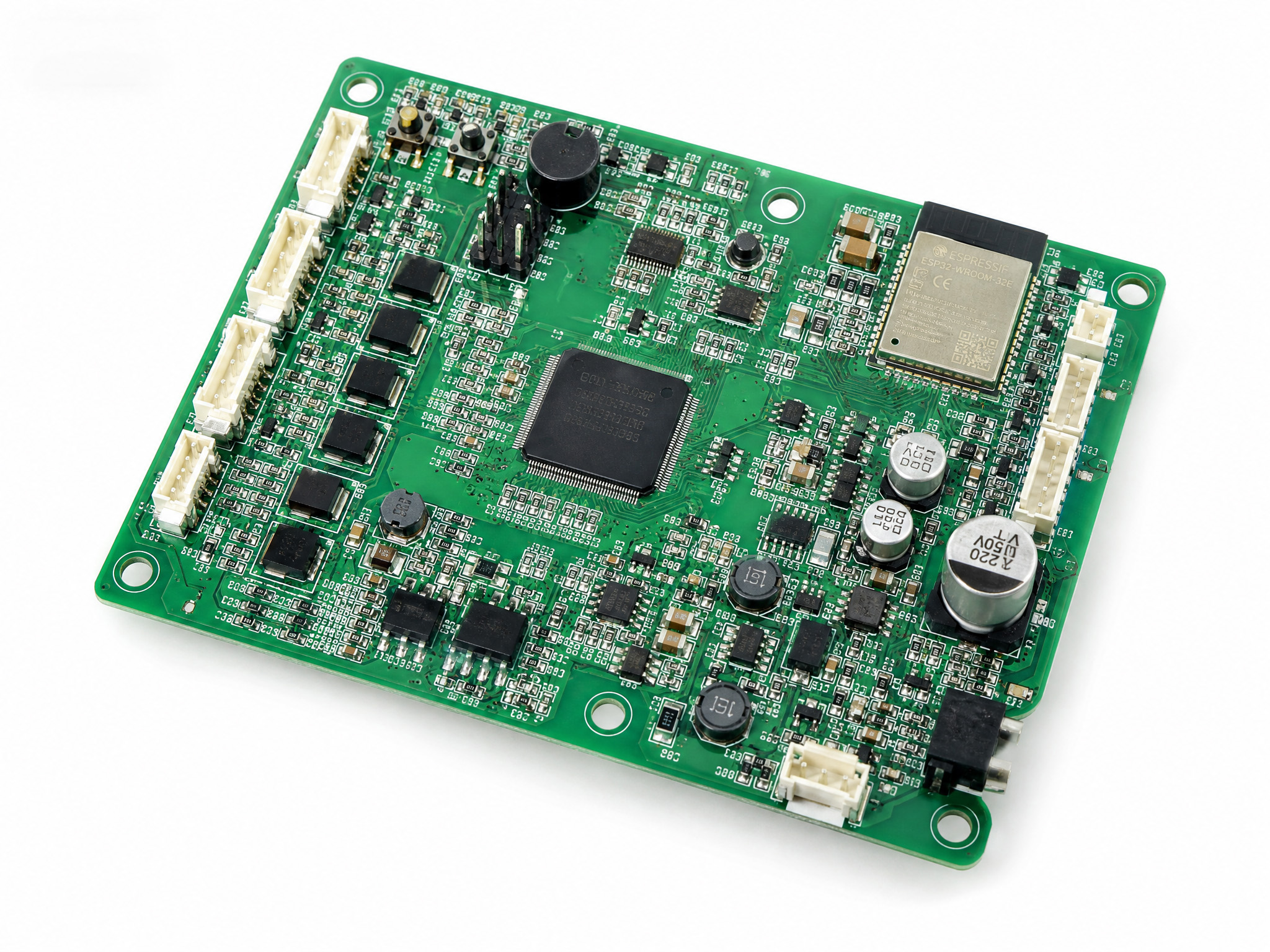
In 2025, the global smart robot vacuum market reached USD 8.74 billion, with total shipments exceeding 34.5 million units, representing a 16.2% year‑on‑year increase (per Industrial World industry analysis). China’s online omnichannel sales hit RMB 17.51 billion with 5.796 million units sold (per Luotu Technology data). Models equipped with self‑emptying base stations accounted for 54.3% of total sales, integrating five core functions: sweeping, mopping, mop washing, hot‑air drying and dust collection within one unit.
Against this functional integration lies an emerging reliability challenge: the mopping feature creates an artificial "rainy season" inside robot vacuums.
During mopping, the robot operates under persistent high‑humidity conditions. Upon returning to the base station, hot‑air drying at 60‑70 °C generates substantial water vapor. Vapor seeps into the unit through housing gaps and condenses into water droplets on cooler main‑board surfaces. This is not water ingress from splashes or rain from outside; condensation conditions are self‑generated by the robot’s own functions. Repeated condensation triggers ongoing electrochemical corrosion on solder joints, copper traces and connectors of the PCBA.
This article focuses on unique PCBA failure modes for consumer‑grade robot vacuums, breaking down the formation mechanism of this "internal rainy season" and board‑level protection engineering solutions.
I. What Threatens Robot Vacuum PCBAs? Five Key Hazards
Hazard 1: The "internal rainy season" caused by mopping
Mopping exposes the whole device to long‑term high‑humidity environments. After docking at the base station, water vapor produced by 60‑70 °C hot‑air drying penetrates through housing clearances, chassis seams and sensor windows. Condensation forms once vapor contacts the relatively cool main‑board surface.
Unlike rain or salt fog encountered by outdoor equipment, this condensation originates inside the device, driven by the robot’s mopping and drying cycles, independent of weather or seasons. Every mopping‑drying loop may trigger a full cycle of "condensation‑evaporation‑re‑condensation" on internal circuit boards.
Hazard 2: Condensation from cross‑room temperature differences
Robot vacuums frequently move between rooms with varying temperatures. Transitioning from an air‑conditioned room at 25 °C to a kitchen floor at 35 °C with RH above 90 %, both the enclosure and internal PCBA face temperature‑difference‑driven condensation. Multiple such thermal transitions per day produce repeated condensation‑evaporation cycles, inflicting cumulative fatigue on conformal coatings and solder joints.
Hazard 3: Water leakage from base‑station water systems
Auto‑fill base stations operate under constant water pressure. Aging seals, improper tank installation or loose pipe joints can allow water to seep onto internal base‑station circuit boards. Base stations house dedicated control boards, pump driver boards and communication modules; water intrusion can disable the entire robot.
Hazard 4: Oxidation of charging contacts
Bottom charging spring contacts and docking‑station metal contacts reside in persistently humid conditions. Oxidation builds up on copper substrates. Once the oxide layer exceeds 0.02 mm, charging efficiency drops by over 90 % (per IDC Smart‑Home Device Maintenance Report). User complaints of "charging failure", "hot charging dock" and "no‑charge issues" frequently trace back to contact oxidation.
Hazard 5: Corrosion from cleaning‑solution or disinfectant vapors
Many end‑users add disinfectants or floor cleaners into water tanks. Chlorinated or acid‑alkaline ingredients volatilize and deposit corrosive residues across PCBA surfaces. Compared with pure‑water condensation, vapors from cleaning agents accelerate erosion of copper traces and solder joints.
II. Protection Conflicts across Six Core PCBA / Electronic Components
Six key PCBA and electronic assemblies inside robot vacuums each present distinct protection requirements and engineering trade‑offs.
表格
| Component | Core Protection Requirement | Special Constraints | Conflict Focus |
|---|---|---|---|
| Main unit mainboard | Moisture resistance & electrical insulation | WiFi / Bluetooth signal attenuation < 0.3 dB | Coatings must not block wireless signals |
| LDS LiDAR module | Moisture protection for internal circuitry | Optical window must not block 905 nm laser | Condensation on drive circuit → LiDAR stall → navigation failure |
| Charging contacts / springs | Anti‑corrosion | Maintain conductive contact; contact resistance increment < 5 mΩ | Full insulating coating cannot be applied |
| Motor driver board | Waterproofing & vibration resistance | Mounted close to floor; prone to residual water intrusion | Combined stress from motor vibration and moisture |
| Base‑station control board | Long‑term high‑humidity tolerance | Continuous operation under 95 %RH | Cannot fully eliminate water‑leak risks from fluid systems |
| Various sensor windows | Preserve sensing performance | Cliff infrared, ultrasonic, carpet‑detection apertures | Balance protection and sensor sensitivity |
The mainboard features a large footprint (~100 mm × 80 mm) and large component height variation; height gaps between BGA chips and electrolytic capacitors can reach 15 mm, imposing strict requirements for coating uniformity. Meanwhile, main SoC and WiFi/Bluetooth modules dissipate heat continuously during operation; coatings must not obstruct thermal dissipation.
LDS LiDAR delivers core navigation functionality. Industry reports put the three‑year failure rate of LDS modules in mainstream models at approximately 0.37 %, a large share stemming from internal circuit moisture damage. LiDAR lenses carry an ~80 nm dust‑repellent nano‑coating. Yet condensation‑induced anomalies in stepper‑motor drive circuits stall the LiDAR and break navigation. Optical windows demand masking from coating, while internal circuits require full protection.
Charging contacts face a classic dilemma: corrosion protection is needed, yet full insulating coating is forbidden. Nickel‑ or gold‑plated copper‑alloy contacts oxidize in humid environments with rising contact resistance. Selective coating — coating solder roots only while keeping contact surfaces bare — serves as a common engineering compromise.
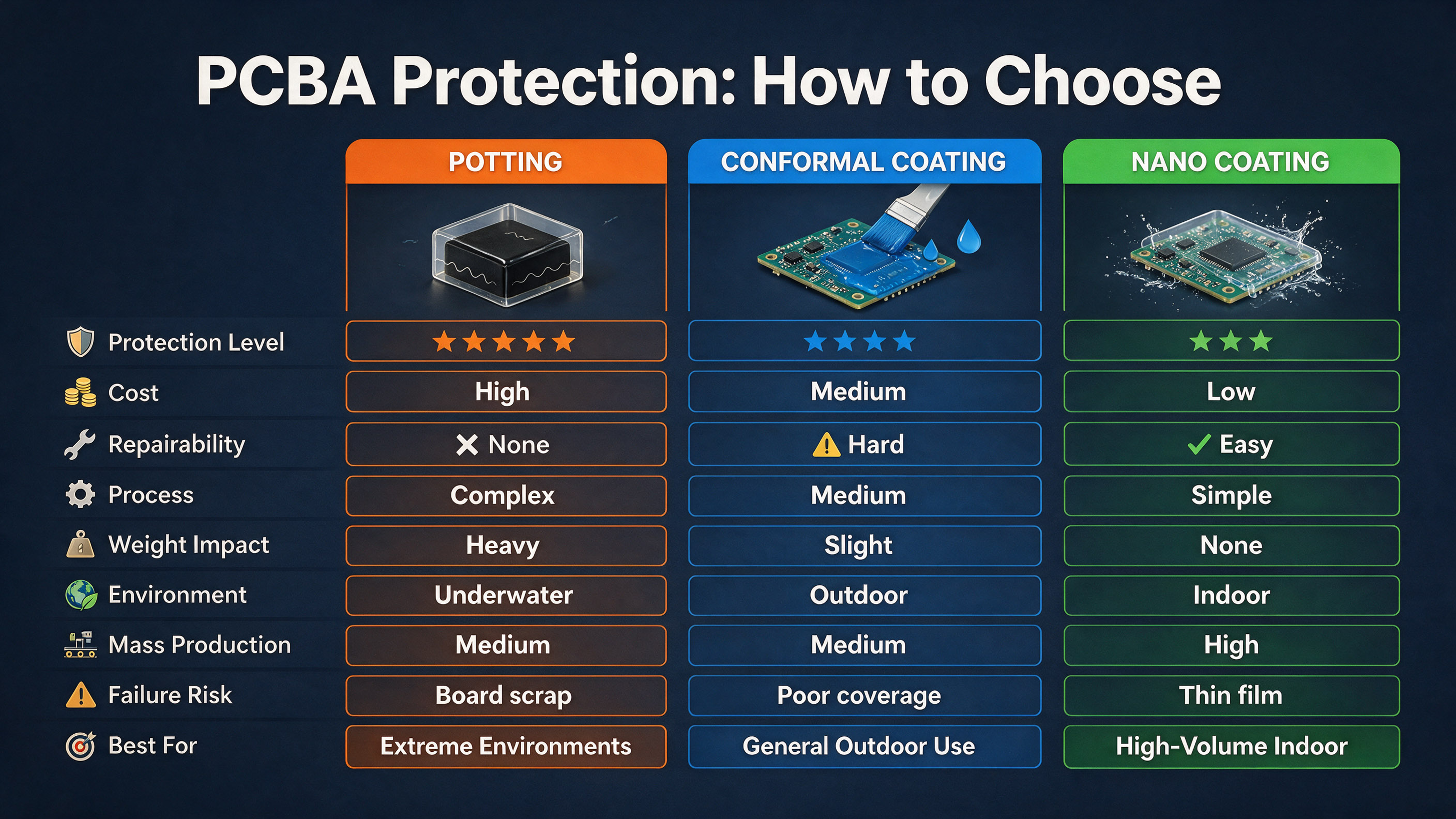
III. Conformal Coating Selection: Full‑Spectrum Comparison
Coating Solution Benchmark
表格
| Solution | Film Thickness | Contact Angle | Curing Profile | Suitability for Robot Vacuums |
|---|---|---|---|---|
| Acrylic conformal coating | 25‑75 μm | 90‑100° | UV / thermal cure, 30‑60 min | Poor: thick film impairs heat dissipation; repair requires stripping; high VOC |
| Silicone conformal coating | 25‑200 μm | 85‑95° | Room‑temp / heat cure, multi‑hour cure | Fair: only for potting local critical zones; excessive thickness hinders assembly |
| Polyurethane conformal coating | 25‑75 μm | 80‑90° | UV / moisture cure | Fair: cure performance sensitive to ambient humidity; unsuitable for precision sensor zones |
| PECVD nano‑coating | 100 nm‑1 μm | 110‑130° | Plasma‑enhanced deposition, automated | Good: ultra‑thin & uniform for high‑volume lines; relatively brittle film |
| Dip‑applied superhydrophobic nano‑coating | 1‑3 μm | > 150° | Dip coating + ambient dry ~3 min | Good: ultra‑thin superhydrophobic, repels condensed droplets; fits high‑speed production |
| Parylene vacuum deposition | 0.1‑100 μm | 100‑110° | Vacuum vapor‑phase deposition | Good: molecular‑level conformal, zero stress; for premium models; higher cost |
Recommendation Matrix
表格
| Component | Recommended Solution | Suggested Film Thickness | Key Constraints |
|---|---|---|---|
| Main unit mainboard | Superhydrophobic nano‑coating (dip) or PECVD | 1‑3 μm | WiFi/Bluetooth attenuation < 0.3 dB |
| LDS LiDAR drive board | Parylene or PECVD | 0.5‑2 μm | Mask optical windows; preserve stepper‑motor precision |
| Charging contacts | Selective nano‑coating | < 500 nm | Contact resistance increment < 5 mΩ |
| Motor driver board | Superhydrophobic nano‑coating | 2‑3 μm | Pass 1000 thermal cycles (−20 °C ~ 80 °C) without cracking under vibration |
| Base‑station control board | PECVD or superhydrophobic nano‑coating | 1‑3 μm | Long‑term resistance to 95 %RH continuous exposure |
| Sensor windows | Masked, no coating | — | Preserve infrared / ultrasonic transmittance |
Production‑Line Cycle Constraints
Consumer‑home‑appliance production lines differ significantly from industrial‑equipment manufacturing. Target UPH (units per hour) exceeds 120. Very limited time is available for PCBA coating and curing. Coatings should achieve dry‑to‑handle status within ≤ 5 minutes; room‑temperature curing is preferred to protect thermally sensitive components such as MEMS sensors and battery connectors. VOC content must be below 50 g/L to comply with mandatory standard GB 24409‑2025.
IV. Benchmark Test Data: What Condensation‑Protection Performance Targets to Meet
Hydrophobic Performance
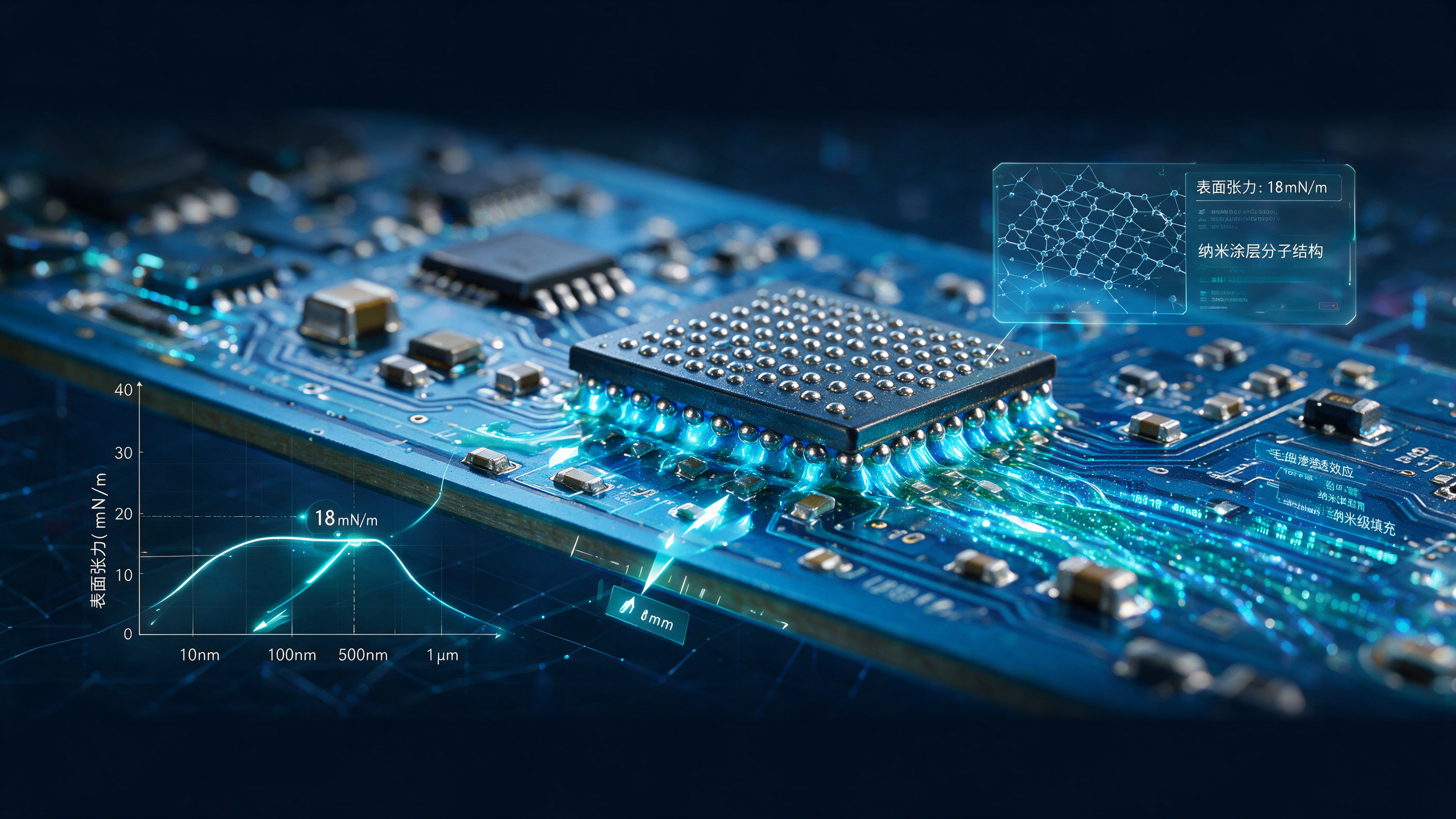
On superhydrophobic coatings with contact angle > 150°, condensed droplets cannot spread or adhere and roll off the surface. Compared with conventional conformal coatings (90‑100° contact angle), residual water volume on PCBA surfaces under identical condensation conditions decreases by more than one order of magnitude.
Salt‑Spray & Thermal Cycling
Superhydrophobic nano‑coatings withstand ≥ 96 h neutral salt‑spray testing (35 °C, 5 % NaCl, per ASTM B117 / IEC 60068‑2‑11) with no obvious corrosion. No coating cracking occurs after 1000 thermal cycles (−20 °C ↔ 80 °C, per IEC 60068‑2‑14). For indoor home appliances, this provides ample reliability margin beyond real‑world operating stress.
Signal Integrity
WiFi 2.4 GHz / 5 GHz and Bluetooth 5.0 signal attenuation stays below 0.3 dB, leaving APP‑based connectivity unaffected. This constitutes a core structural advantage over traditional conformal coatings: 25‑75 μm‑thick conformal coatings introduce measurable signal shielding, while 1‑3 μm nano‑coatings are nearly RF‑transparent.
Condensation Simulation Test
Under condensation‑simulation conditions (20 °C temperature difference + 90 %RH, reference IEC 60068‑2‑30), PCBA samples with superhydrophobic coating show no short‑circuit or leakage anomalies. Uncoated control samples exhibit multiple leakage paths across solder joints.
Resistance to Cleaning‑Agent Corrosion
After 48 h exposure to vapors from 1 % chlorine‑containing disinfectant, nano‑coated samples display no discoloration, delamination or copper‑trace corrosion.
V. Protection Value Reflected by After‑Sales Data
Industry After‑Sales Pain Points
PCBA‑related failures represent a substantial share of robot‑vacuum after‑sales issues: main‑board short‑circuits from water ingress or condensation, charging failures caused by contact oxidation, and LiDAR stalls driven by internal moisture recur widely in user feedback and product reviews.
Contact oxidation manifests visibly to end‑users. Thickening oxide layers raise contact resistance, reducing charging current or cutting power delivery entirely. Common user countermeasures — sanding contacts or repeated docking — risk further damaging plating layers.
Observed Protection Outcomes
Per public OEM disclosures after adopting superhydrophobic nano‑coatings:
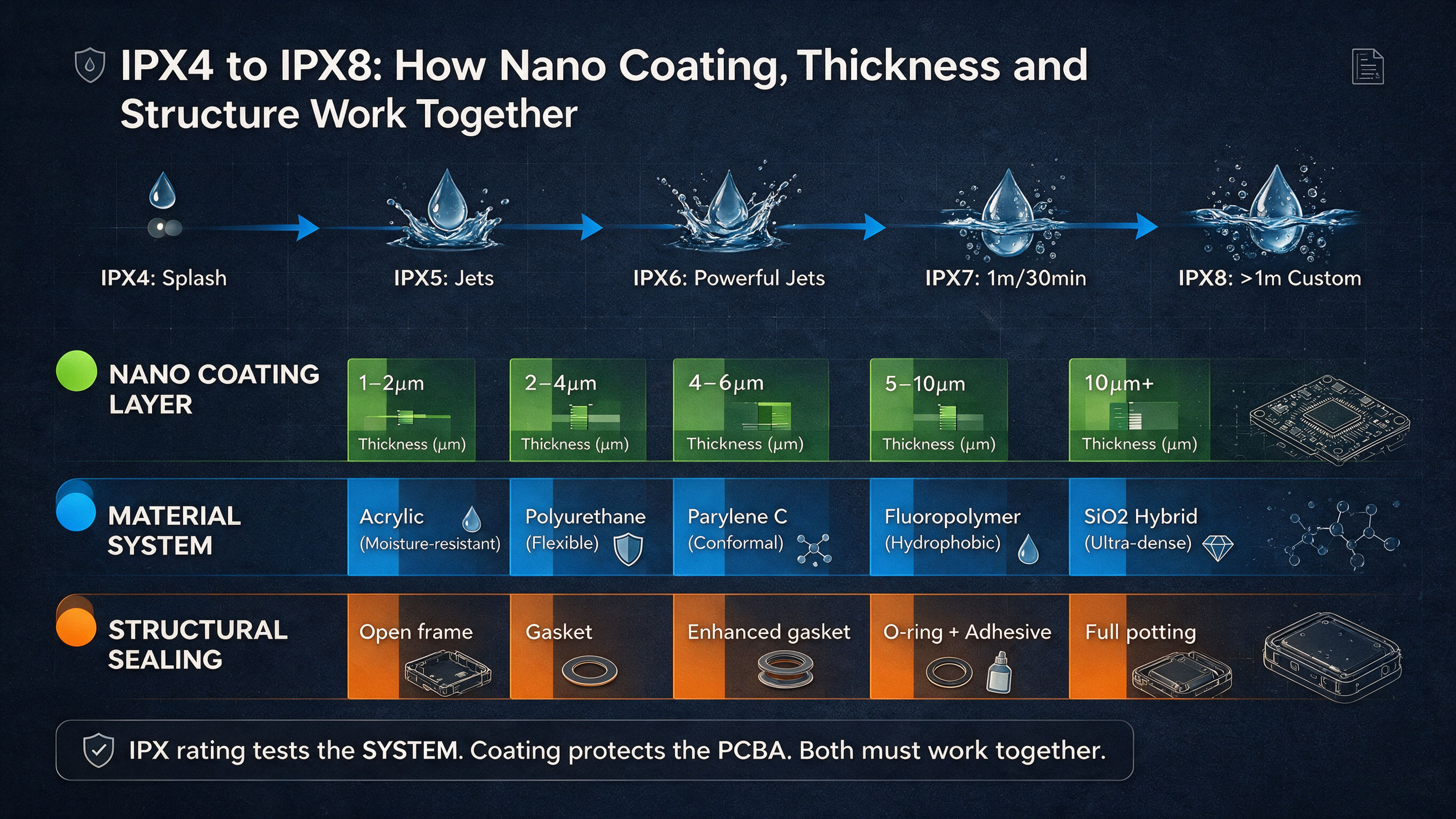
- One top‑tier brand reported roughly 90 % reduction in mainboard failure rates; 整机 IPX7 water‑resistance (30‑min immersion at 1.2 m depth, signal delay only 0.01 s). Note: this is a system‑level whole‑unit test result; coatings form only one component of the full protection strategy.
- PECVD implementations delivered ~30 % lower failure rates, ~20 % improved navigation accuracy and ~15 % higher cleaning efficiency (per solution‑provider marketing documentation; actual improvement depends on baseline test conditions and reference benchmarks).
- Parylene coatings achieve > 1000 h salt‑spray resistance (ASTM B117) and water‑vapor transmission rate < 0.1 g·mm/(m²·day), suited for long‑lifespan premium‑grade devices.
Brand and Cost Impacts
Average robot‑vacuum selling prices have climbed from thousand‑RMB levels in the early‑2020s to RMB 3024 in 2025, with premium models above RMB 3000 accounting for 46.7 % of sales (per Luotu Technology data). Premium‑segment buyers hold high reliability expectations. A single "main‑board water damage" after‑sales incident can damage brand reputation and repurchase intent.
From cost perspectives, nano‑coating for a single PCBA costs roughly RMB 10‑30 (industry reference pricing). Meanwhile, on‑site service or unit replacement may cost hundreds of RMB. With after‑sales failure rates reduced by several percentage points, coating investment delivers payback within production batches rather than multi‑year cycles.
Conclusion
Robot vacuums have evolved from dry‑sweeping tools into wet‑operation platforms. Mopping, hot‑air drying and auto‑water‑refill functions continuously introduce moisture inside the robot. When device‑native functions create an internal "rainy season", PCBA protection standards must advance beyond splash‑resistance toward sustained internal condensation mitigation.
Consumer‑appliance production‑line throughput, RF‑signal integrity, assembly precision and cost constraints limit the suitability of traditional thick conformal coatings for this application. Ultra‑thin, fast‑curing, signal‑transparent nano‑coating solutions are emerging as the preferred board‑level protection path for this product category. This is no longer a purely theoretical topic; it is already deployed across multi‑million‑unit‑per‑annum mass‑production lines.
From IPX4 to IPX8: How Nano Coating Thickness, Material Systems, and Structural Waterproofing Work Together
Related Article